

In December 2020, two vaccines changed the course of a pandemic using a piece of science that, it turns out, almost nobody in the room agreed on who owned. Five years on, that disagreement has hardened into one of the most tangled patent fights in the history of the pharmaceutical industry, seven companies, nine disputes, four continents, and at least one case where a German court and the US Patent Office reached opposite conclusions about the same patent on the same day.
This is usually told as a legal story. It’s actually a business story, and a more interesting one: it’s about what happens when a technology becomes too valuable, too fast, for its ownership to be settled before it ships.
$111 billion. That’s roughly what Comirnaty and Spikevax generated between them in 2021–22 alone, the revenue base every royalty and damages claim in this landscape is, in one way or another, still arguing over.
$740 million has already changed hands in the one dispute that’s fully resolved, before a single dollar of ongoing royalty is counted.
55%. The share of Moderna’s entire forward COVID franchise now sitting inside a lawsuit that’s barely four months old.
Six disputes are still live. Two have settled. In every single one, the underlying science isn’t contested, only who owns it.
A decade of patents, collapsed into a pandemic
Here’s the part that doesn’t make it into most coverage: the intellectual property fight over mRNA vaccines didn’t start in 2020. It started roughly a decade earlier, in labs that had nothing to do with COVID-19.
Alnylam Pharmaceuticals spent ten years perfecting the lipid nanoparticle, the fatty molecular shell that keeps fragile mRNA intact long enough to reach a human cell for an entirely different drug, a rare-disease RNAi therapy called Onpattro, approved in 2018. Arbutus Biopharma built a parallel LNP platform for similar reasons. CureVac and GSK were independently solving the mRNA-stability problem years before anyone had heard of SARS-CoV-2. None of these companies had a COVID vaccine on the market. All of them, it turned out, had a patent claim on the technology that made one possible.
When Moderna and Pfizer/BioNTech raced modified mRNA into billions of arms in under a year, they didn’t just win a public health emergency, they also, according to at least five separate plaintiffs, walked through doors other people had spent a decade unlocking. That’s the tension underneath every case that follows: a genuine, world-saving acceleration of science, built on foundations whose ownership the acceleration never gave anyone time to sort out.
Six storylines worth knowing by name
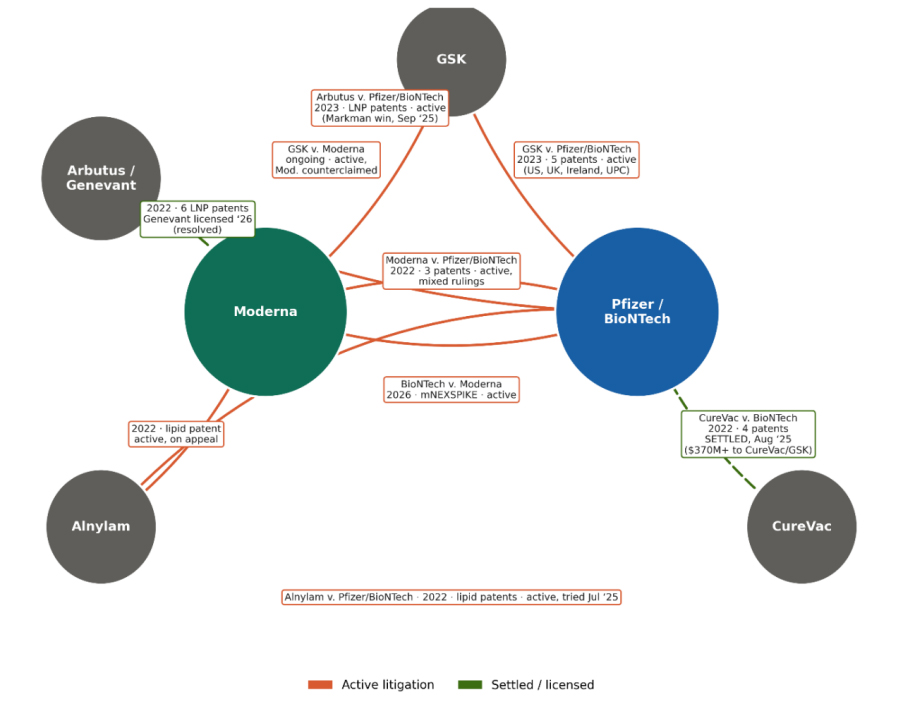
Moderna v. Pfizer/BioNTech is the case that refuses to end cleanly. Filed in August 2022 over three foundational patents, it has now produced a genuinely strange record: on the very same day in March 2025, a Düsseldorf court found Pfizer/BioNTech liable for infringement while, an ocean away, the US Patent Office’s review board ruled two of the three underlying Moderna patents invalid. The UK has sided with Moderna twice. Nobody has “won” this case, they’ve each won somewhere, which is arguably worse for predictability than losing everywhere.
BioNTech v. Moderna is the plot twist. Filed in February 2026, this one flips the usual script: it’s BioNTech, not a third-party licensor, going after Moderna directly over mNEXSPIKE, the lower-dose next-generation shot Moderna is counting on to carry its COVID business forward. The detail that makes this suit sharper than most: mNEXSPIKE is expected to generate roughly 55% of Moderna’s COVID-19 vaccine revenue this season. This isn’t a fight over the past. It’s a fight over the majority of what Moderna has left.
Arbutus and Genevant chose different paths and the divergence tells you something. Both sued Moderna and Pfizer/BioNTech together in the early wave of 2022 litigation. By 2026, Genevant had quietly licensed its patents to Moderna, ending that fight, while Arbutus kept its parallel case against Pfizer/BioNTech alive, and recently won a favorable claim-construction ruling. Why the split decision? One filing offers a clue: Comirnaty alone accounts for roughly two-thirds of all global COVID-mRNA vaccine sales to date. When the pie is that lopsided, it makes sense to settle with the smaller slice and keep fighting for the larger one.
Alnylam is the platform pioneer with the longest memory. Its lipid patents predate the pandemic by a decade, and its case against Pfizer/BioNTech finally reached trial in July 2025 after three years of litigation, while its case against Moderna is now on appeal following an adverse ruling. Of everyone in this fight, Alnylam has arguably the deepest technical claim to the delivery technology at the center of it all.
CureVac is the only company that’s actually walked away with a number. Its patent claim against BioNTech, filed in 2022, settled in August 2025 folded into BioNTech’s $1.25 billion acquisition of CureVac itself. The price of resolution: $740 million upfront, split with licensing partner GSK, plus a running 1% royalty on US sales going forward (GSK). It’s the single closest thing this landscape has to a public price tag.
GSK is fighting the broadest war of anyone in the room. Its own claim against Pfizer/BioNTech separate from the CureVac settlement, which GSK was careful to note doesn’t touch it, now spans the US, UK, Ireland, and the EU’s Unified Patent Court simultaneously, with Pfizer and BioNTech countersuing to revoke GSK’s patents outright. One patent publication now calls it likely the largest mRNA dispute in Europe (JUVE Patent). GSK is also suing Moderna, separately, at the same time.
What’s actually riding on this
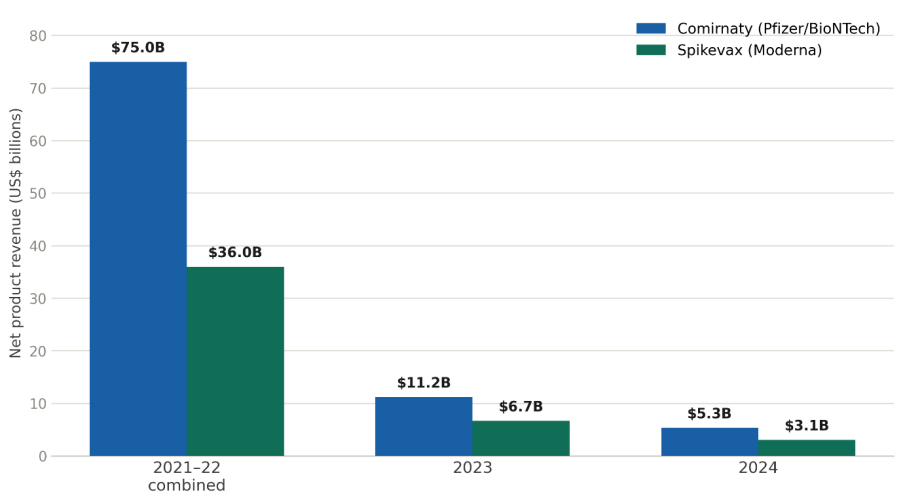
Here’s the number that should reframe how anyone reads this landscape: combined Comirnaty and Spikevax revenue has fallen roughly 93% since its 2021–22 peak from $111 billion to an estimated $8.4 billion in 2024. Every one of these lawsuits is, functionally, a fight over a pie that’s already shrunk to a tenth of its original size, argued out on timelines slow enough that most of them will be decided years after the money they’re nominally about has already been spent.
That mismatch is, if anything, the single most important thing about this entire dispute. It explains why settlements have landed in the hundreds of millions rather than the tens of billions the peak-year headlines might lead you to expect plaintiffs with genuinely strong technical claims are choosing running royalties on a smaller, steadier future market over a costly fight for damages tied to a moment that’s already passed. It also explains why BioNTech’s new suit against Moderna is the one worth watching most closely: unlike almost everything that came before it, it’s not aimed at the shrinking pandemic-era pie. It’s aimed at what’s left going forward which is exactly why it’s the freshest and, arguably, the most consequential filing in the entire landscape.
Three things this landscape teaches, that go well beyond COVID vaccines
Corporate events resolve patent disputes faster than courtrooms do. The only fully settled case in this entire landscape: CureVac v. BioNTech didn’t end because a judge ruled. It ended because BioNTech decided to buy CureVac outright, and folding the litigation into the acquisition was simply the cleanest way to close the deal. For anyone assessing exposure in a similar dispute elsewhere, the M&A calendar may be a better predictor of resolution timing than the litigation calendar.
Split verdicts aren’t a bug in this system, they’re becoming the system. Every live dispute here spans at least two jurisdictions, and the results consistently contradict each other: a loss in Germany paired with a win at the US Patent Office, on the same day, in the same case. Anyone waiting for a single “landmark ruling” to settle this landscape is waiting for something that this pattern suggests won’t happen. The more useful frame is portfolio-level: which side is accumulating favorable rulings across the most jurisdictions, not which side won the loudest headline.
The most consequential patents here were never about COVID at all. Alnylam’s and Arbutus’s core claims are lipid nanoparticle technology built for gene-silencing drugs a decade before anyone needed a pandemic vaccine — which means the eventual rulings on LNP ownership will reach well past COVID vaccines and into the delivery technology underpinning gene editing, RNAi therapeutics, and the next generation of mRNA medicine generally. This is arguably the most under-covered angle in the entire story: the fight everyone’s watching for its COVID-era headlines may turn out to matter more for what it decides about the technology platform behind it.
The bottom line
Seven companies. Nine disputes. A revenue base that’s collapsed by more than 90% since the fight began and yet the dollar figures actually settled so far are measured in the hundreds of millions, not the tens of billions the peak sales years might suggest. That gap is the story: even plaintiffs holding strong technical positions are settling for a share of a smaller, steadier future rather than holding out for damages tied to a windfall that’s already gone. Whether that pattern holds for the disputes still active, particularly the ones against Pfizer/BioNTech, which alone still represents roughly two-thirds of the global market will be the clearest signal yet of how this entire category of dispute gets priced from here.