


Artificial intelligence has rapidly evolved from an emerging technology to a core component of modern healthcare. Today, AI-enabled software helps radiologists detect cancers earlier, cardiologists identify heart abnormalities faster, neurologists triage stroke patients within minutes, and ophthalmologists screen for diabetic retinopathy with remarkable accuracy.
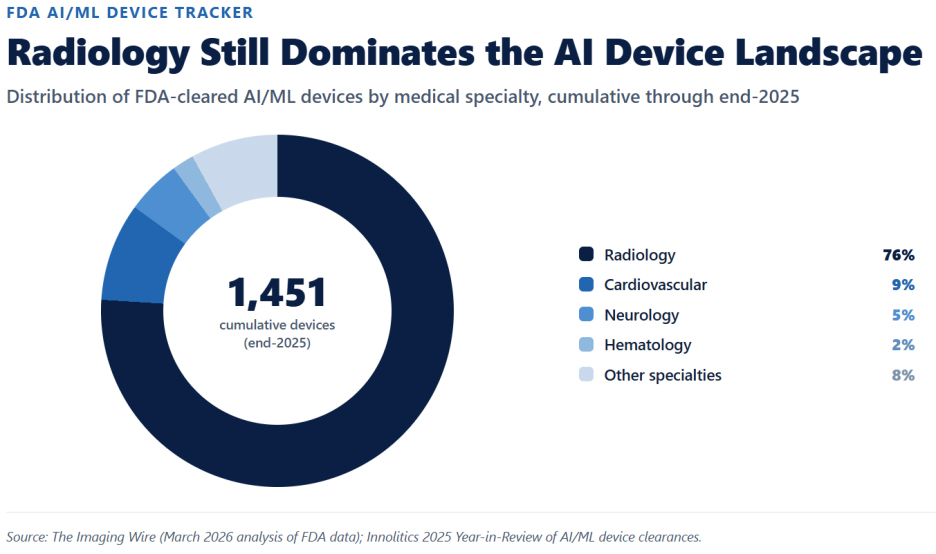
The numbers reflect this transformation. As of 2026, the U.S. Food and Drug Administration (FDA) has authorized well over 1,000 AI-enabled medical devices, with approvals accelerating significantly over the past five years. Most of these devices are concentrated in radiology, followed by cardiovascular medicine, neurology, and ophthalmology, where large imaging datasets have driven rapid advances in machine learning.
However, while AI innovation has accelerated, regulation has had to evolve alongside it. Traditional medical device regulations were designed for software that remained largely unchanged after approval. AI systems, particularly those powered by machine learning, can continuously improve and adapt using new data, creating challenges that conventional regulatory frameworks were never built to address.
To keep pace, the FDA has shifted from regulating AI as static software to adopting a Total Product Lifecycle (TPLC) approach that emphasizes continuous oversight, post-market monitoring, and responsible software updates. This marks one of the most significant changes in medical device regulation and is reshaping how MedTech companies develop, validate, and maintain AI-enabled technologies.
The Rise of AI in Medical Devices
Artificial intelligence has become an integral part of modern healthcare, helping clinicians detect cancers, identify strokes, assess cardiac function, screen retinal diseases, and improve surgical planning.
According to the FDA, radiology remains the largest area of adoption because medical imaging provides vast amounts of data for machine-learning models. Cardiovascular medicine, neurology, ophthalmology, gastroenterology, and pathology are also experiencing rapid growth.
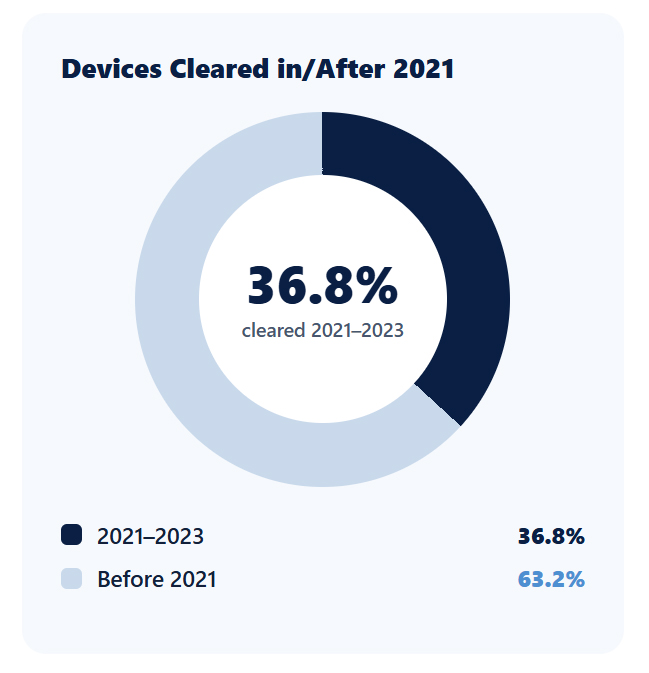
While AI-enabled medical devices were relatively uncommon a decade ago, approvals have risen sharply since 2018 as advances in computing power, clinical datasets, and machine learning have accelerated innovation.
For MedTech companies, AI is no longer an emerging technology. It has become a competitive necessity.
Why Traditional Regulations Were No Longer Enough
Historically, medical device software followed a simple regulatory pathway: manufacturers developed the software, validated its performance, obtained FDA approval, and marketed the product. Because the software changed infrequently, oversight remained relatively straightforward.
Machine learning changed that model. Unlike traditional software, AI systems can evolve through retraining and exposure to new data, creating what regulators call a “moving target.” Factors such as changing patient populations, new imaging technologies, shifting disease patterns, and demographic differences can all affect performance over time.
Recognizing that conventional regulations were not designed for continuously evolving software, the FDA began developing a new regulatory framework.
The FDA’s Journey Toward Adaptive AI Regulation
The FDA’s current framework did not emerge overnight. It is the result of several years of consultation with clinicians, regulators, software developers, academic researchers, and industry stakeholders.
2019: The Conversation Begins
In 2019, the FDA released its landmark discussion paper on Artificial Intelligence and Machine Learning in Software as a Medical Device (SaMD).
Rather than introducing immediate regulations, the paper recognized that existing frameworks were not designed for continuously learning algorithms. It also introduced the concept of regulating anticipated software changes instead of treating every update as a new device, marking the beginning of the FDA’s shift away from static regulation.
2021: The AI/ML Action Plan
Following extensive public feedback, the FDA published its AI/ML Action Plan.
The agency identified several priorities:
- Developing a regulatory framework for adaptive AI
- Supporting Good Machine Learning Practice (GMLP)
- Enhancing transparency for healthcare professionals
- Encouraging methods to identify algorithmic bias
- Strengthening real-world performance monitoring
Rather than slowing innovation, the FDA sought to create predictable pathways that would enable AI developers to improve software safely over time.
2023-2025: Building the Framework
Over the next few years, the FDA worked alongside Health Canada and the UK’s Medicines and Healthcare products Regulatory Agency (MHRA) to establish international guiding principles for machine learning-enabled medical devices.
This collaboration produced the Good Machine Learning Practice (GMLP) framework and later the Predetermined Change Control Plan (PCCP) guidance, two of the most influential developments in AI regulation.
Together, these initiatives signaled an important shift in philosophy.
Regulation was no longer focused solely on whether an AI model performed well before launch. Instead, regulators began asking a more important question:
Can this AI system continue performing safely after it reaches patients?
From Product Approval to Total Product Lifecycle Oversight
Perhaps the biggest transformation in FDA policy is its adoption of a Total Product Lifecycle (TPLC) approach.
Historically, most regulatory attention focused on evidence submitted before market authorization.
Today’s expectations extend far beyond initial approval.
Manufacturers are increasingly expected to demonstrate effective governance throughout the product’s lifecycle, including:
- Data collection and management
- Algorithm development
- Clinical validation
- Risk management
- Software deployment
- Cybersecurity
- Post-market surveillance
- Performance monitoring
- Planned software modifications
- Documentation of updates
In practical terms, FDA oversight no longer ends when a device enters the market. Instead, authorization marks the beginning of an ongoing regulatory relationship.
This lifecycle perspective reflects the reality that AI-enabled devices continue evolving long after commercial launch.
The Biggest Regulatory Shift: Predetermined Change Control Plans (PCCPs)
Predetermined Change Control Plans (PCCPs) allow manufacturers to outline anticipated software updates as part of their original FDA submission. As long as these changes remain within predefined limits and follow approved validation procedures, they can be implemented without a new submission.
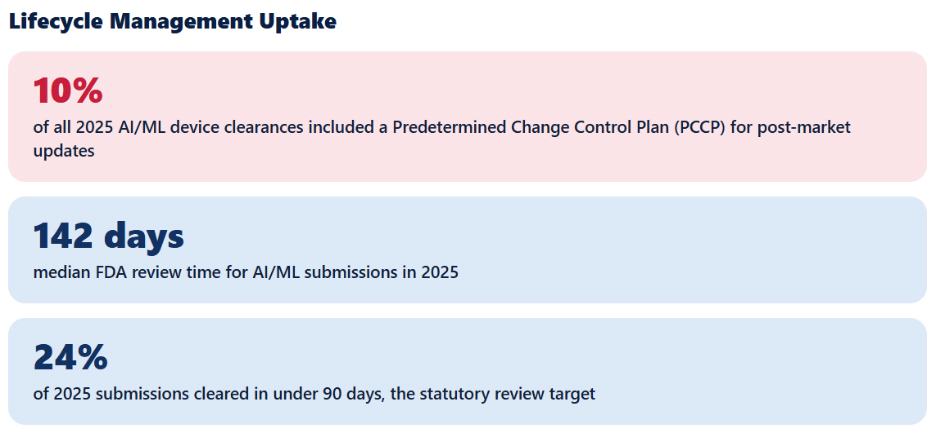
In effect, manufacturers gain approval not only for the current algorithm but also for a defined pathway of future improvements.
Each PCCP includes three core components:
- Planned modifications: Clearly defined and scientifically justified changes.
- Modification protocol: Procedures for developing, validating, testing, and documenting updates.
- Impact assessment: Evidence showing that the modifications will maintain safety, effectiveness, and clinical performance.
For companies developing adaptive AI systems, PCCPs provide a more predictable framework for innovation while preserving regulatory oversight.
Good Machine Learning Practice: The Blueprint for Trustworthy AI
Recognizing that AI development requires consistent international standards, the FDA collaborated with Health Canada and the UK Medicines and Healthcare products Regulatory Agency (MHRA) to publish the Good Machine Learning Practice (GMLP) Guiding Principles.
Rather than prescribing technical requirements, GMLP establishes ten foundational principles that encourage manufacturers to build AI systems that are reliable, reproducible, and clinically meaningful.
Some of the most important principles include:
| GMLP Principle | Why It Matters |
| Use multidisciplinary expertise | AI development should involve clinicians, software engineers, regulatory experts, statisticians, and quality professionals. |
| Ensure representative datasets | Training data should reflect the intended patient population to reduce bias and improve generalizability. |
| Separate training and testing data | Independent validation helps prevent overly optimistic performance claims. |
| Focus on clinically relevant outcomes | AI should improve patient care, not simply perform well on technical benchmarks. |
| Design for human-AI interaction | Clinicians must understand when and how to rely on AI outputs. |
| Monitor performance after deployment | Continuous surveillance helps detect performance degradation and emerging risks. |
These principles reinforce that regulatory compliance begins long before a marketing submission. It starts during product design, data collection, and software development.
Transparency: One of AI’s Biggest Challenges
Artificial intelligence has often been criticized as a “black box,” where clinicians receive predictions without understanding how they were generated.
To address this concern, regulators increasingly expect manufacturers to provide clear information about:
- The intended use of the AI model
- Clinical limitations
- Training data characteristics
- Performance metrics
- Appropriate patient populations
- Known risks
- Human oversight requirements
Transparency is not only important for regulators but also for clinicians making treatment decisions and patients placing trust in AI-assisted healthcare.
The Evidence Gap: What the JAMA Study Revealed
Despite the rapid increase in FDA-authorized AI-enabled medical devices, independent researchers have identified important gaps in publicly available evidence.
A widely cited JAMA Network Open analysis of 691 FDA-cleared AI and machine learning-enabled medical devices found that while regulatory approvals have increased substantially, reporting practices remain inconsistent.
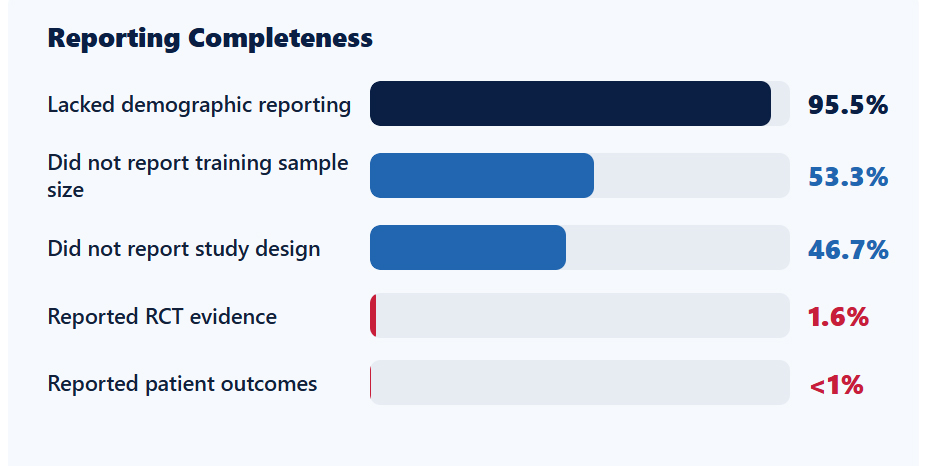
Some of the study’s most striking findings include:
- 36.8% of devices were cleared in or after 2021, highlighting the recent acceleration in AI adoption.
- 53.3% of manufacturers did not report the size of their training datasets.
- 95.5% did not disclose demographic characteristics of patients used to train their algorithms.
- Only 7.7% reported results from prospective clinical studies.
- Only 1.6% referenced randomized clinical trials.
- Approximately 24% reported sensitivity values.
- Around 22% reported specificity.
- Fewer than 1% published evidence demonstrating improvements in patient outcomes.
These findings do not necessarily indicate that FDA-authorized devices are unsafe. Instead, they highlight the growing need for greater transparency, stronger evidence generation, and standardized reporting.
The FDA’s recent regulatory initiatives, particularly around lifecycle monitoring and Good Machine Learning Practice, directly address many of these concerns.
Why Real-World Performance Monitoring Matters
Unlike traditional software, AI-enabled medical devices are not immune to changes after they are deployed. Their performance can decline over time as real-world conditions evolve, even if the algorithm performed well during initial testing.
Several factors can contribute to this, including changes in patient demographics, disease patterns, clinical workflows, or the introduction of new imaging equipment and medical technologies. These shifts can lead to model drift, where an AI system gradually becomes less accurate or reliable.
Recognizing this risk, the FDA has made continuous post-market monitoring a key part of its regulatory approach. Rather than evaluating AI systems only before approval, the FDA expects manufacturers to monitor their real-world performance throughout the product lifecycle. This includes tracking clinical accuracy, identifying adverse events, detecting model drift, evaluating software updates, assessing performance across diverse patient populations, and documenting all changes.
Continuous monitoring allows manufacturers to identify problems early, implement corrective actions, and maintain the safety and effectiveness of AI-enabled devices over time.
Addressing Bias Starts with Better Data
One of the most significant challenges in medical AI is algorithmic bias.
If training datasets fail to adequately represent different populations, AI systems may perform inconsistently across age groups, ethnicities, geographic regions, or healthcare settings.
For example, an algorithm trained primarily using images from one region may not generalize well to hospitals serving different patient populations.
Recognizing these risks, regulators increasingly expect manufacturers to demonstrate:
- Diverse training datasets
- Representative patient populations
- Multi-site validation
- Fairness assessments
- Consistent clinical performance across intended users
Bias mitigation has become both a regulatory expectation and a commercial necessity.
Cybersecurity Is Now a Core Regulatory Expectation
AI-enabled medical devices operate within increasingly connected healthcare ecosystems. Many communicate with hospital networks, cloud platforms, electronic health records, or remote monitoring systems.
As connectivity increases, so do cybersecurity risks.
The FDA now encourages manufacturers to integrate cybersecurity throughout the software lifecycle rather than treating it as a post-development activity.
Key expectations include:
- Secure software development practices
- Threat modeling during design
- Vulnerability disclosure processes
- Software Bill of Materials (SBOM)
- Secure software update mechanisms
- Patch management
- Continuous cybersecurity monitoring
For AI-enabled software, cybersecurity is no longer simply an IT responsibility. It is increasingly viewed as a patient safety issue.
AI Regulation Is Becoming Global
The FDA’s evolving framework aligns with broader international efforts to regulate artificial intelligence.
The International Medical Device Regulators Forum (IMDRF) continues to develop globally harmonized guidance for Software as a Medical Device (SaMD), including risk categorization and clinical evaluation principles.
Meanwhile, the European Union AI Act, which entered into force in 2024, classifies many AI-enabled medical devices as high-risk AI systems.
While the FDA and the EU have different legal frameworks, their priorities increasingly overlap.
| FDA Focus | EU AI Act Focus |
| Total Product Lifecycle oversight | Continuous lifecycle governance |
| Predetermined Change Control Plans | Management of substantial AI modifications |
| Real-world performance monitoring | Mandatory post-market monitoring |
| Cybersecurity throughout development | Quality management and cybersecurity requirements |
| Transparency for clinicians | Transparency and human oversight obligations |
This convergence suggests that lifecycle governance is becoming the global standard for AI-enabled healthcare technologies.
What MedTech Companies Should Do Now
For manufacturers, regulatory success increasingly depends on integrating compliance into every stage of AI development.
Key priorities include:
- Build regulatory strategy early rather than after product development.
- Develop comprehensive data governance and documentation practices.
- Use representative, high-quality datasets.
- Design robust validation protocols that extend beyond technical accuracy.
- Establish continuous post-market performance monitoring.
- Prepare Predetermined Change Control Plans where appropriate.
- Integrate cybersecurity into software development from the outset.
- Regularly assess algorithm bias and fairness.
- Monitor evolving FDA, IMDRF, and international guidance.
Companies that adopt these practices early will likely experience smoother regulatory reviews and greater confidence from healthcare providers and patients.
Looking Ahead
Artificial intelligence is transforming healthcare, but its ability to evolve continuously also creates new regulatory challenges. In response, the FDA has shifted from treating AI as static software to adopting a lifecycle-based approach centered on continuous oversight.
Predetermined Change Control Plans (PCCPs), Good Machine Learning Practice (GMLP), post-market monitoring, cybersecurity, and transparency have become essential elements of AI medical device regulation. As regulators worldwide embrace similar frameworks, companies that prioritize strong governance and continuous performance monitoring will be best positioned for long-term success.
In the era of adaptive AI, regulatory compliance is no longer a one-time achievement but an ongoing commitment to safety, effectiveness, and trust.
Source Links
- https://www.fda.gov/medical-devices/software-medical-device-samd/artificial-intelligence-enabled-medical-devices
- https://www.fda.gov/medical-devices/software-medical-device-samd/artificial-intelligence-software-medical-device
- https://www.fda.gov/regulatory-information/search-fda-guidance-documents/marketing-submission-recommendations-predetermined-change-control-plan-artificial-intelligence
- https://www.fda.gov/medical-devices/software-medical-device-samd/predetermined-change-control-plans-machine-learning-enabled-medical-devices-guiding-principles
- https://www.fda.gov/medical-devices/software-medical-device-samd/good-machine-learning-practice-medical-device-development-guiding-principles
- https://www.fda.gov/medical-devices/digital-health-center-excellence/guidances-digital-health-content
- https://www.imdrf.org
- https://www.who.int/publications/i/item/9789240029200
- https://eur-lex.europa.eu/eli/reg/2024/1689/oj
- https://jamanetwork.com/journals/jamanetworkopen/fullarticle/2825397
- https://link.springer.com/article/10.1007/s12553-026-01077-8