

The EU has introduced numerical PFAS limits for food-contact packaging. The U.S. has upheld Superfund liability for PFOA and PFOS. For chemical and consumer-goods companies, the next battle may be over who develops, owns and commercializes PFAS replacement chemistry.
PFAS regulation has entered a new phase.
On August 12, 2026, the European Union’s Packaging and Packaging Waste Regulation (PPWR) began applying, bringing specific PFAS limits for food-contact packaging. Just six days later, on August 18, the U.S. Court of Appeals for the D.C. Circuit upheld the Environmental Protection Agency’s designation of PFOA and PFOS as hazardous substances under the U.S. Superfund law.
These developments look different, but they point in the same direction: PFAS is moving from an environmental concern into a product, supply-chain and financial risk.
And that creates another question that is becoming increasingly important for chemical companies and FMCG manufacturers:
If PFAS is being phased out, who owns the chemistry that replaces it?
Two August developments changed the business equation
| Development | What changed | Business implication |
| EU, Aug. 12, 2026 | PPWR PFAS limits became applicable to food-contact packaging | Packaging must meet defined chemical thresholds |
| U.S., Aug. 18, 2026 | Court upheld PFOA/PFOS as CERCLA hazardous substances | Potential cleanup and Superfund liability remains |
| U.S. FDA, 2025 | 35 PFAS food-contact notifications became ineffective | Existing PFAS packaging uses are disappearing |
| U.S. EPA, 2026 | TRI coverage reached 206 PFAS | Corporate reporting obligations continue expanding |
The significance is that PFAS exposure is no longer one problem.
For an FMCG company, it can mean product compliance.
For a chemical manufacturer, it can mean formulation and portfolio decisions.
For an owner of a contaminated site, it can mean environmental liability.
And for an R&D organization, it can mean a race to develop PFAS replacement chemistry and alternative materials.
Europe has put numbers on PFAS compliance
The EU’s PPWR does not simply say that companies should “reduce PFAS.”
It establishes specific thresholds for PFAS in food-contact packaging.
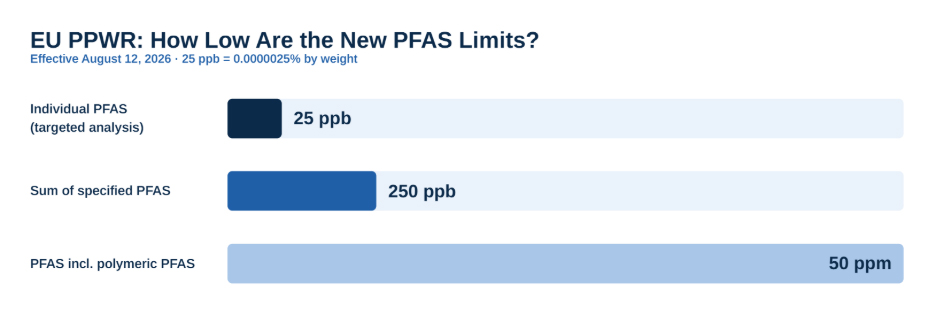
From August 12, 2026, packaging cannot be placed on the EU market when PFAS concentrations are at or above:
- 25 ppb for any individual PFAS under the specified targeted analysis
- 250 ppb for the sum of specified PFAS
- 50 ppm for PFAS including polymeric PFAS
That means a packaging supplier now has to understand much more than whether PFAS was intentionally added.
It needs visibility into the actual chemical composition of the material, testing methodology and supply-chain documentation.
This is important for FMCG companies because the brand owner may not manufacture the packaging itself.
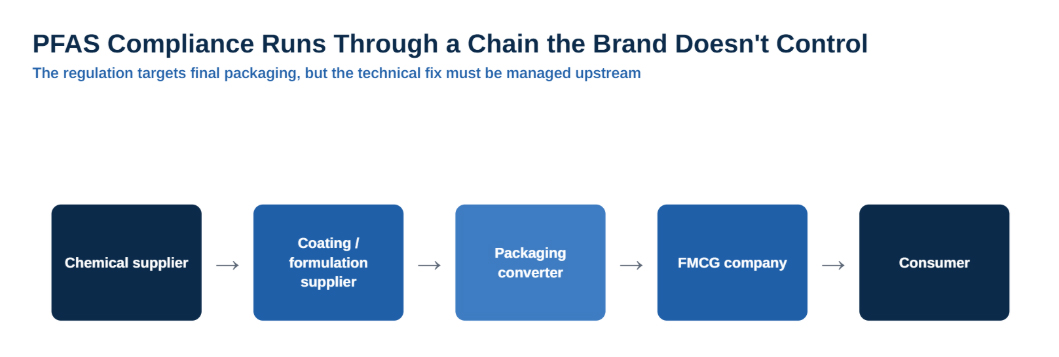
The regulation may apply to the final packaging, but the technical solution has to be managed across the supply chain.
The interesting part: 25 ppb is tiny
To put the EU threshold into perspective:
25 ppb = 0.0000025%
The regulation is therefore pushing companies toward extremely low levels of certain PFAS in food-contact packaging.
This is no longer simply a product-development question.
It is also an analytical testing, supplier qualification and documentation question.
For many companies, this creates a direct incentive to invest in PFAS replacement chemistry that can deliver required performance without relying on fluorinated substances.
The U.S. is creating a different kind of PFAS risk
The August 18 U.S. court decision moves the discussion from what goes into products to what happens when PFAS contamination already exists.
The D.C. Circuit upheld EPA’s designation of PFOA and PFOS as hazardous substances under CERCLA, the federal Superfund law. The court rejected challenges brought by seven business groups.
The distinction is important.
EU risk
Can this packaging be placed on the market?
U.S. Superfund risk
Who could be financially responsible for contamination and cleanup?
That creates a potentially significant issue for chemical companies, manufacturers and businesses involved in acquisitions.
A company’s PFAS exposure can therefore extend beyond its current product portfolio into:
- Historical manufacturing
- Contaminated facilities
- Waste streams
- Former operations
- Environmental due diligence
- M&A transactions
PFAS is consequently becoming both a forward-looking product risk and a backward-looking legacy liability.
The U.S. regulatory net is also getting wider
The EPA’s Toxics Release Inventory provides another useful signal.
For reporting year 2026, the number of PFAS subject to TRI reporting reached 206 after EPA added PFHxS-Na.
That number matters because it shows that PFAS oversight is not static.
It is expanding.
| U.S. PFAS regulatory signal | Number |
| PFAS on TRI for 2026 | 206 |
| PFOA/PFOS designated under CERCLA | 2 |
| PFAS food-contact notifications made ineffective by FDA | 35 |
| FDA food samples tested | 1,900+ |
The direction is therefore clear even though different U.S. programs regulate different chemicals and uses.
More PFAS are being identified, tracked and scrutinized.
That expanding regulatory environment increases the commercial importance of scalable PFAS replacement chemistry.
FDA has already forced a packaging transition
The food-packaging sector shows what happens when regulation meets product chemistry.
In February 2024, FDA announced that PFAS-containing grease-proofing substances were no longer being sold in the United States for food-contact use. These materials had been used in applications such as fast-food wrappers, microwave popcorn bags, take-out containers and pet-food bags.
Then, in January 2025, FDA determined that 35 PFAS-related food-contact notifications were no longer effective because manufacturers or suppliers had abandoned the relevant uses.
FDA also reports having tested more than 1,900 food samples from the U.S. market for PFAS.
The commercial message is straightforward:
PFAS-free food packaging is not a future concept. The transition is already underway.
That transition is creating demand for new coatings, polymers and material systems capable of replacing the functions that PFAS previously delivered.
But replacing PFAS is much harder than removing it
This is where the chemical industry enters the story.
PFAS became valuable because fluorinated chemistry can deliver a difficult combination of properties:
- Grease and oil resistance
- Water resistance
- Chemical resistance
- Heat resistance
- Low surface energy
- Low friction
So companies are not simply replacing a chemical.
They are trying to replace performance.
That changes the R&D challenge for PFAS replacement chemistry.
A material that provides excellent grease resistance might have poor moisture resistance.
A bio-based coating might have attractive sustainability credentials but insufficient heat resistance.
A polymer laminate might improve barrier performance but complicate recycling.
The question is therefore not:
“What is the PFAS replacement?”
It is:
“What combination of chemistry and material architecture can deliver the same commercial function without creating another regulatory or lifecycle problem?”
That is why the market for PFAS replacement chemistry is likely to be fragmented across different technologies rather than dominated by one universal substitute.
This is where the IP race begins
The regulatory pressure is creating an obvious incentive for companies to develop proprietary alternatives.
Patent activity already shows examples of this transition.
A 2026 U.S. patent application describes lignin-based resins designed for oil-resistant paper packaging while avoiding PFAS.
Other patent filings describe fluorine-free coating systems designed to provide water and oil resistance using combinations of polymers, crosslinkers, nanoparticles and other additives.
The important point is not whether any one of these patents becomes the market standard.
The important point is that PFAS replacement chemistry itself can become valuable intellectual property.
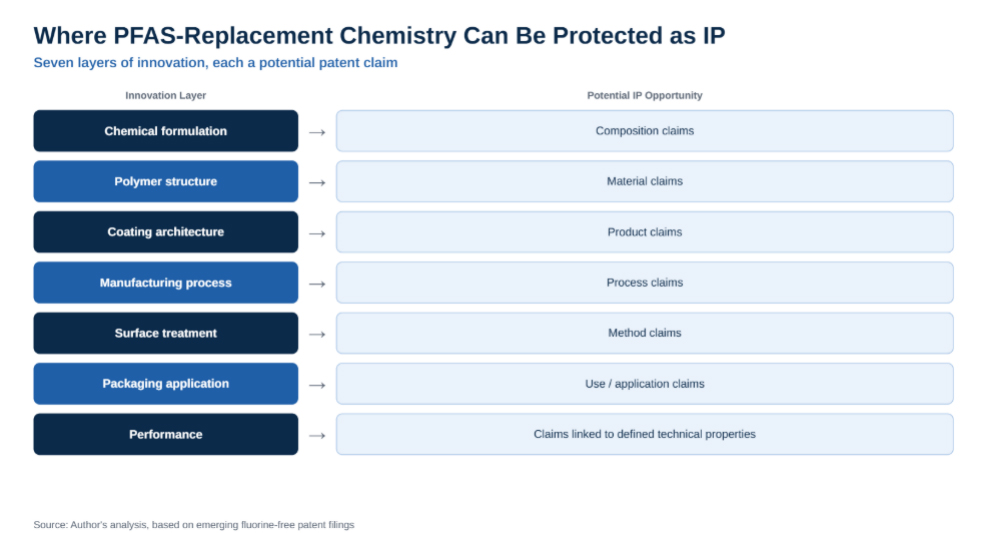
The strategic shift is significant.
The value may move from owning a fluorinated chemistry platform to owning the technology that eliminates the need for it.
For chemical companies, this makes patent strategy an increasingly important part of the transition away from PFAS.
3M shows the size of the disruption
The PFAS transition is not hypothetical for chemical companies.
In 2022, 3M announced that it would exit PFAS manufacturing by the end of 2025.
At the time, 3M estimated that manufactured PFAS represented approximately:
$1.3 billion
in annual net sales.
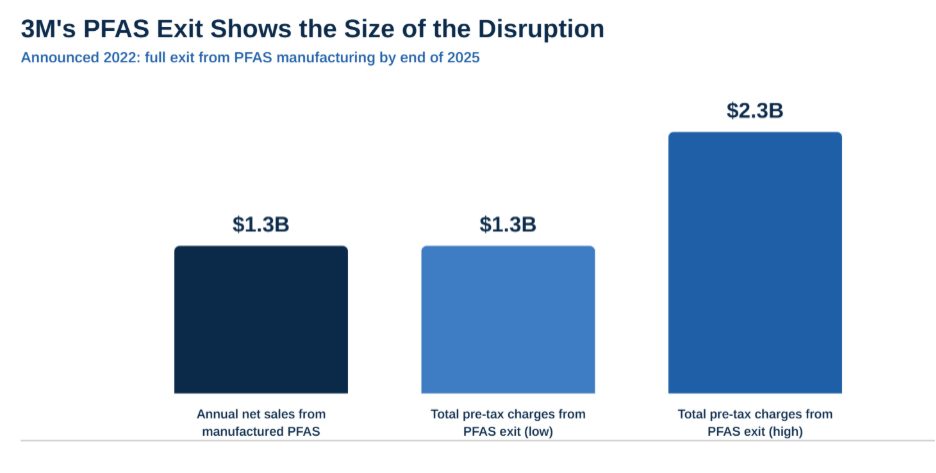
That is an extraordinary illustration of how regulation can affect an established chemical portfolio.
PFAS is therefore not simply an environmental compliance line item.
It can affect revenue, manufacturing assets, R&D priorities and capital allocation.
And the opposite is also true.
Where one company’s established chemistry becomes commercially constrained, another company’s PFAS replacement chemistry can become more valuable.
The biggest opportunity may be upstream
Consider the implications for a specialty-chemicals supplier.
The opportunity is not necessarily to sell “PFAS-free” as a marketing label.
It is to develop materials that solve the underlying performance problem.
For example:
PFAS → grease resistance
could become:
New polymer + additive system + coating architecture → equivalent grease resistance
If the replacement provides superior performance, lower lifecycle risk or better recyclability, it can become more than a regulatory substitute.
It can become a new technology platform.
For FMCG companies, the strategic issue is slightly different.
They need to determine whether the new chemistry should be:
- Developed internally
- Sourced from suppliers
- Licensed
- Jointly developed
- Acquired through technology partnerships or M&A
Each route creates different IP and freedom-to-operate considerations.
The real competitive question: Who owns the replacement?
PFAS regulation is creating a new race in chemical innovation.
As companies move away from fluorinated materials, the value may shift to the technologies that can replace their performance.
For chemical and FMCG companies, developing PFAS replacement chemistry is only the first step.
The bigger question is whether that technology can be protected, scaled and used without infringing existing rights.
That makes IP strategy part of the substitution process from the start.
Companies need to know:
- Is the new formulation patentable?
- Who else has patented similar chemistry?
- Are there existing patents that could restrict its use?
- Can the technology be commercialized across key markets?
- Can competitors develop around the claims?
- Is licensing more practical than developing the chemistry in-house?
The companies that solve the PFAS problem may not necessarily gain the most.
Those that develop commercially viable PFAS replacement chemistry and secure the IP around it could.
That is where the PFAS story moves beyond regulation and into chemical innovation, FMCG strategy and intellectual property.
What companies should be watching now
The next phase of the PFAS transition will likely be defined by five developments.
- Regulatory divergence
The EU, U.S. and other jurisdictions will not necessarily regulate every PFAS or application in the same way.
Companies selling globally will need jurisdiction-specific compliance strategies.
- PFAS replacement chemistry
Watch patents and product launches around:
- Bio-based polymers
- Cellulose and lignin
- Water-based coatings
- Fluorine-free barrier coatings
- Polymer blends
- Surface treatments
These technologies could form the foundation of the next generation of PFAS replacement chemistry.
- Performance data
“PFAS-free” alone will not determine commercial success.
The important numbers will increasingly be:
Grease resistance + water resistance + oxygen barrier + heat resistance + recyclability + cost
The winning technologies will need to demonstrate commercial performance, not simply regulatory compliance.
- Supply-chain ownership
The company selling the consumer product may not own the relevant chemistry.
Understanding supplier IP and freedom to operate will become increasingly important.
As PFAS replacement chemistry becomes more proprietary, supply agreements and technology partnerships could become strategic assets.
- Patent portfolio shifts
The strategic question will move from:
“What PFAS patents do we own?”
toward:
“What technologies will protect our position in a post-PFAS market?”
Companies that are building portfolios around PFAS replacement chemistry may be establishing competitive positions that extend well beyond immediate regulatory compliance.
Conclusion
PFAS regulation is creating a rare convergence of chemistry, regulation, manufacturing, consumer goods and intellectual property.
The companies that benefit most may not simply be those that comply fastest. They may be the companies that develop better PFAS replacement chemistry, secure strong patent positions, qualify scalable supply chains and commercialize those technologies before competitors do.
PFAS regulation may therefore be remembered not only as the story of the decline of “forever chemicals.”
It could also become the story of who owns the materials that come after them.
Sources
- EU PPWR – Official Regulation
- EPA – PFOA/PFOS CERCLA Designation
- Reuters – August 18, 2026 PFAS Ruling
- EPA – PFAS TRI
- FDA – PFAS in Food
- FDA – 35 PFAS Food Contact Notifications
- OECD – PFAS and Alternatives in Food Packaging
- 3M – PFAS Manufacturing Exit
- Google Patents
- Federal Register – PFOA/PFOS CERCLA Rule