

The European Patent Office (EPO) has revoked another Novo Nordisk patent related to semaglutide, the active ingredient in its blockbuster medicines Ozempic and Wegovy. The decision removes a layer of intellectual property protection that could have lasted until 2037, potentially giving generic drug manufacturers greater freedom to challenge Novo Nordisk’s market position.
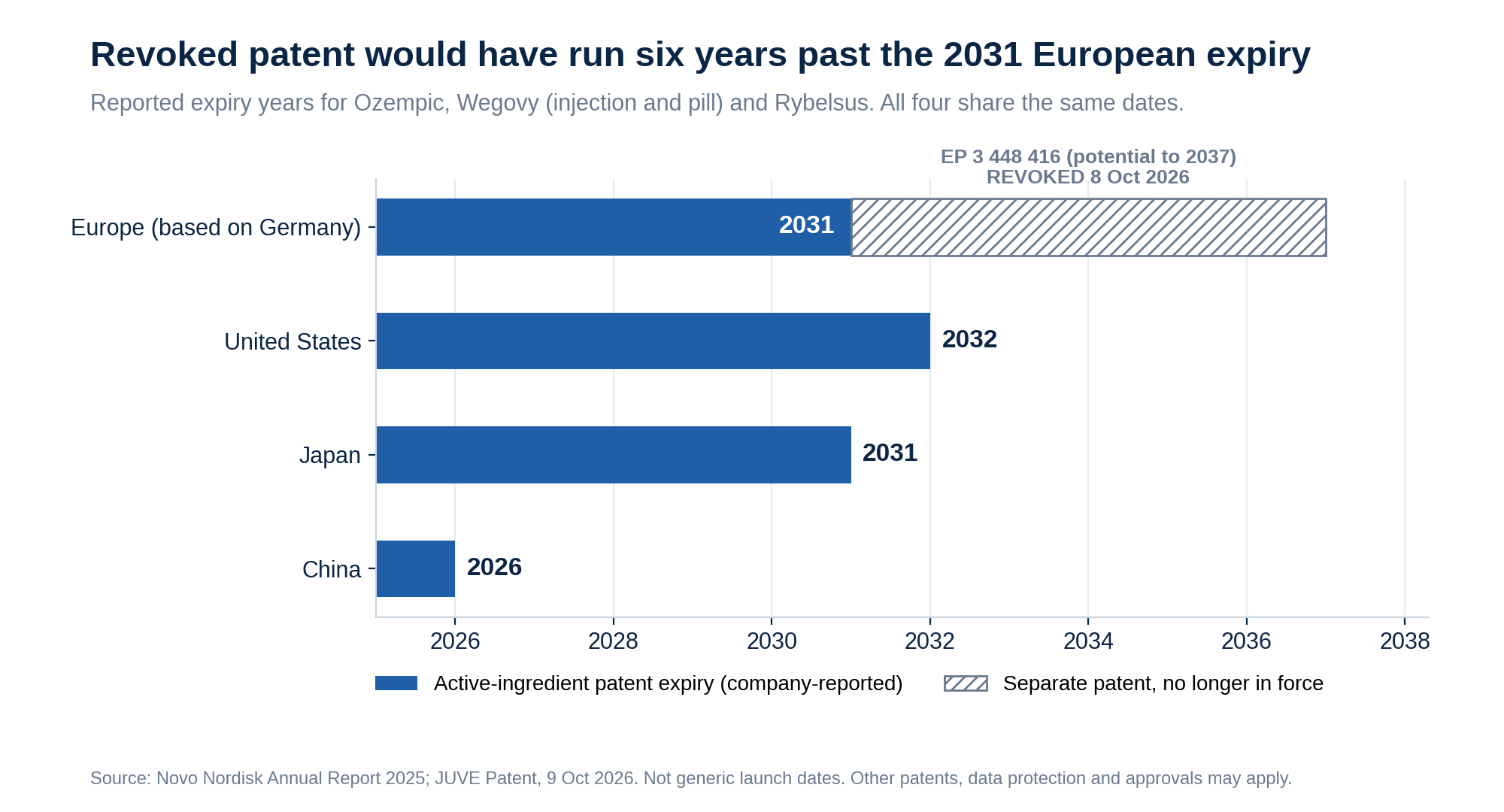
Reported by JUVE Patent on 9 October 2026, the decision concerns European patent EP 3 448 416, titled Semaglutide in cardiovascular conditions. The ruling is significant because Novo Nordisk’s annual report lists 2031 as the expiry year for active-ingredient patent protection for Ozempic and Wegovy in Europe, based on Germany. Losing a separate patent that could have provided protection until 2037 changes the broader patent landscape, although it does not automatically permit generic manufacturers to launch their products.
The case highlights how pharmaceutical companies protect medicines through multiple patents covering active ingredients, formulations and specific medical uses, and why the loss of one patent does not necessarily eliminate the protection provided by the others.
What Happened in the EPO Case?
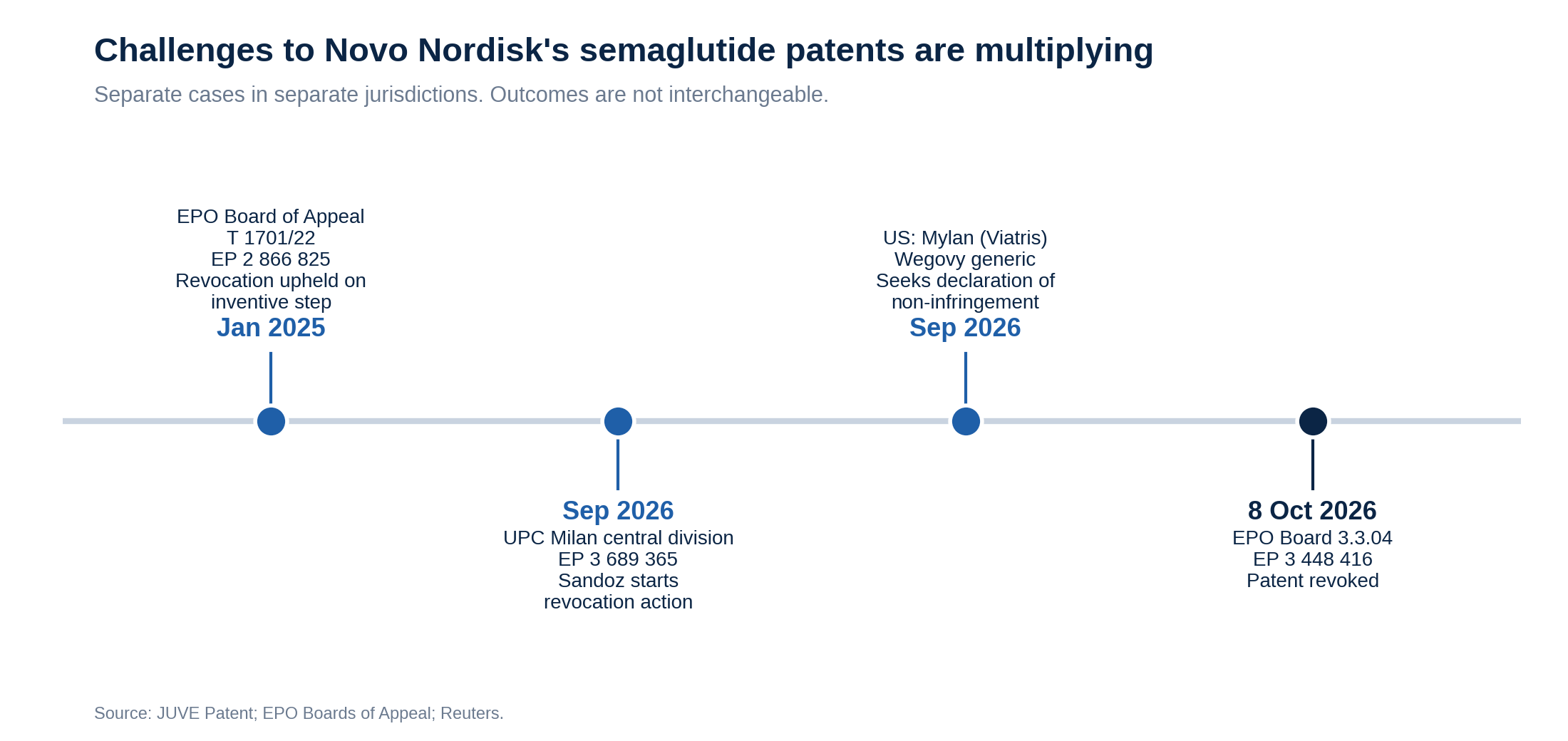
On 8 October 2026, EPO Board of Appeal 3.3.04 revoked Novo Nordisk’s European patent EP 3 448 416, according to JUVE Patent. The board’s decision differed from its preliminary opinion issued before the hearing.
JUVE reported that the hearing focused on issues including the relationship between the claimed invention and the formulation described in the patent, as well as the assessment of a study published before the patent application.
The revocation of EP 3 448 416 removes a separate layer of patent protection that could have lasted until 2037, according to JUVE Patent. Novo Nordisk’s 2025 annual report lists 2031 as the expiry year for active-ingredient patent protection in Europe, based on Germany. These dates concern different patents and are not guaranteed dates for generic market entry. The timing of competition will depend on the scope and status of surviving patents, applicable regulatory exclusivity and marketing authorisation requirements in each jurisdiction.
Its revocation removes that particular layer of protection. However, the precise legal grounds and their application to individual claims should be confirmed against the board’s written decision before being described as established findings.
Several generic drug companies, including Stada, Teva, Generics, Sandoz and Adalvo, were identified in the opposition proceedings reported by JUVE.
What Did the Revoked Patent Actually Protect?
Semaglutide belongs to a class of medicines called glucagon-like peptide-1 (GLP-1) receptor agonists. These medicines act on receptors involved in glucose regulation and appetite.
Novo Nordisk markets semaglutide in several products:
- Ozempic: An injectable medicine for type 2 diabetes, with additional approved indications in certain jurisdictions.
- Wegovy: A medicine for weight management, available as an injection and, in the United States, an oral formulation.
- Rybelsus: An oral semaglutide medicine for type 2 diabetes.
Although these products share an active ingredient, their formulations, doses, approved indications and relevant patent claims can differ.
The revoked patent’s title, Semaglutide in cardiovascular conditions, is particularly important. It concerns a specific therapeutic area rather than automatically covering every use of semaglutide or every product sold under the Ozempic and Wegovy brands.
The European Medicines Agency authorizes Wegovy for weight management alongside a reduced-calorie diet and increased physical activity in eligible adults and adolescents. The specific eligibility criteria depend on age, body mass index and associated health conditions.
Why Do Patent Claims and Prior Art Matter?
Under the European Patent Convention, patents must meet requirements including novelty, inventive step and industrial applicability. Prior art includes publicly available information predating the relevant filing or priority date. Earlier disclosures may undermine a claim’s novelty or inventive step, while clarity, support and disclosure requirements must also be satisfied.
JUVE’s account of the October hearing identifies the patent’s formulation and a previously published study as important subjects of discussion. However, without the written decision, it would be premature to assign a specific legal ground, such as lack of novelty or inventive step, to the revocation.
The distinction is important: a patent being revoked does not mean the medicine itself has been found ineffective or unsafe. It means the particular patent has lost legal protection following the relevant proceedings.
For pharmaceutical innovators, the case underlines the importance of drafting claims that accurately reflect the technical contribution, documenting supporting evidence and assessing relevant scientific publications before filing.
Why 2031 Matters More Than 2037
The key commercial question is how the revoked patent relates to the patents that remain in force.
Novo Nordisk’s 2025 annual report lists the following expiry years for active-ingredient patent protection:
| Product | Europe* | United States | Japan | China |
| Ozempic | 2031 | 2032 | 2031 | 2026 |
| Wegovy injection | 2031 | 2032 | 2031 | 2026 |
| Wegovy pill | 2031 | 2032 | 2031 | 2026 |
| Rybelsus | 2031 | 2032 | 2031 | 2026 |
*European dates are based on Germany. Source: Novo Nordisk Annual Report 2025. These are company-reported patent expiry dates, not guaranteed generic launch dates.
The difference between 2031 and 2037 is six years. For a medicine with substantial sales, an additional period of protection may be commercially valuable. However, the dates refer to different layers of protection and should not be treated as interchangeable.
The expiry of an active-ingredient patent does not necessarily mean that every formulation or medical use becomes free of patent restrictions. Other patents, regulatory data protection, marketing authorisation requirements and country-specific rules can affect the timing of competition.
Similarly, revocation of EP 3 448 416 does not establish that generics can immediately enter Europe. The effect depends on the scope of the revoked claims, the patents that remain valid and the products a generic manufacturer intends to sell.
Novo Nordisk cautions in its annual report that other patents covering manufacturing processes, formulations or uses may provide protection beyond the active-ingredient patent expiry. It also notes that regulatory data protection and other forms of exclusivity may apply.
The Commercial Stakes: Billions in Annual Sales
The patent dispute matters because semaglutide products are central to Novo Nordisk’s business.
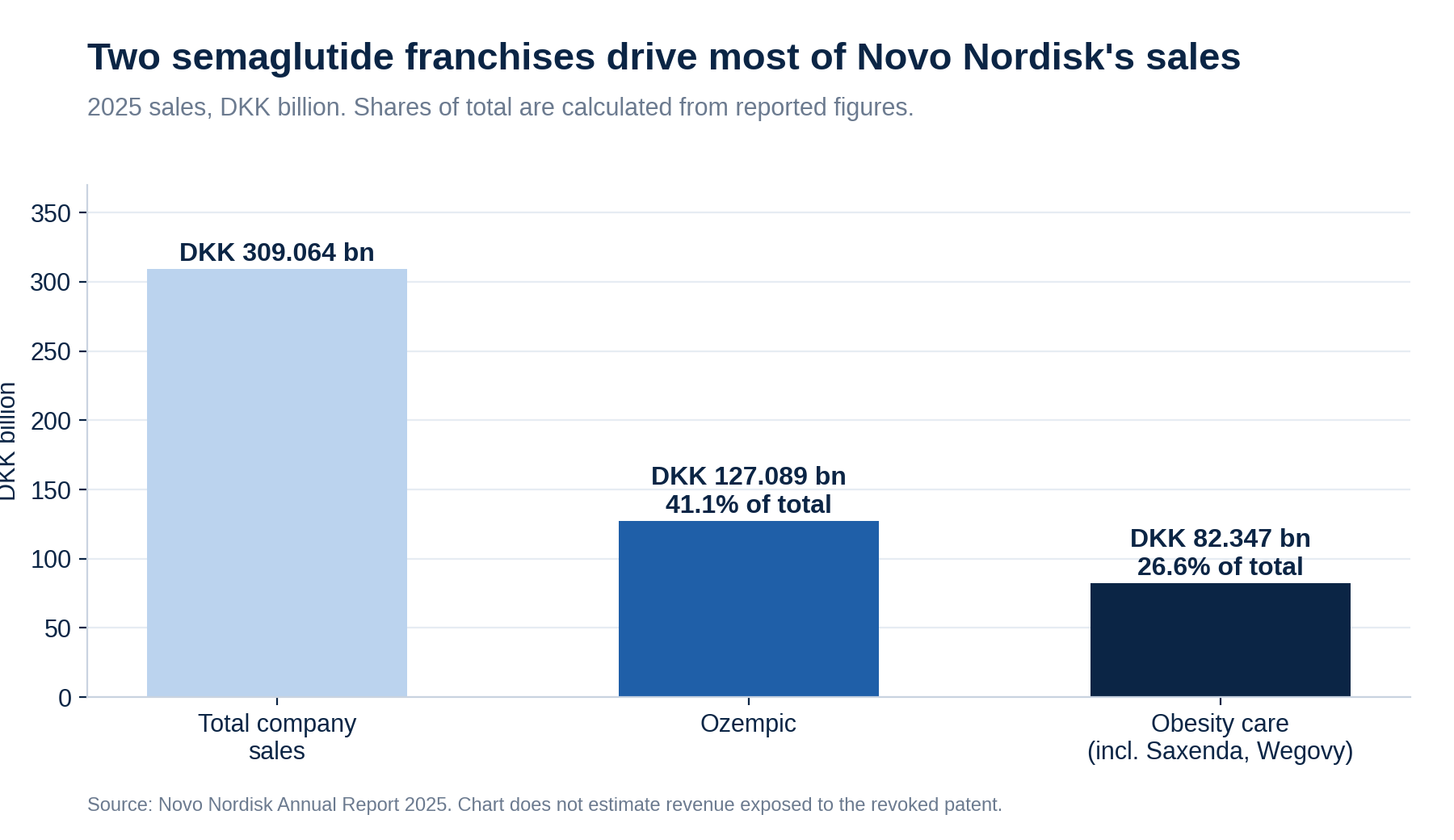
According to the company’s 2025 annual report:
- DKK 309.064 billion: Total company sales in 2025.
- DKK 127.089 billion: Ozempic sales, up 6% in Danish kroner and 10% at constant exchange rates.
- DKK 82.347 billion: Sales of obesity-care products, including Saxenda and Wegovy, up 26% in Danish kroner and 31% at constant exchange rates.
- 104%: Reported volume growth in the global branded GLP-1 obesity market.
- 59.6%: Novo Nordisk’s reported share of branded GLP-1 obesity-market volume in the company’s specified measurement period.
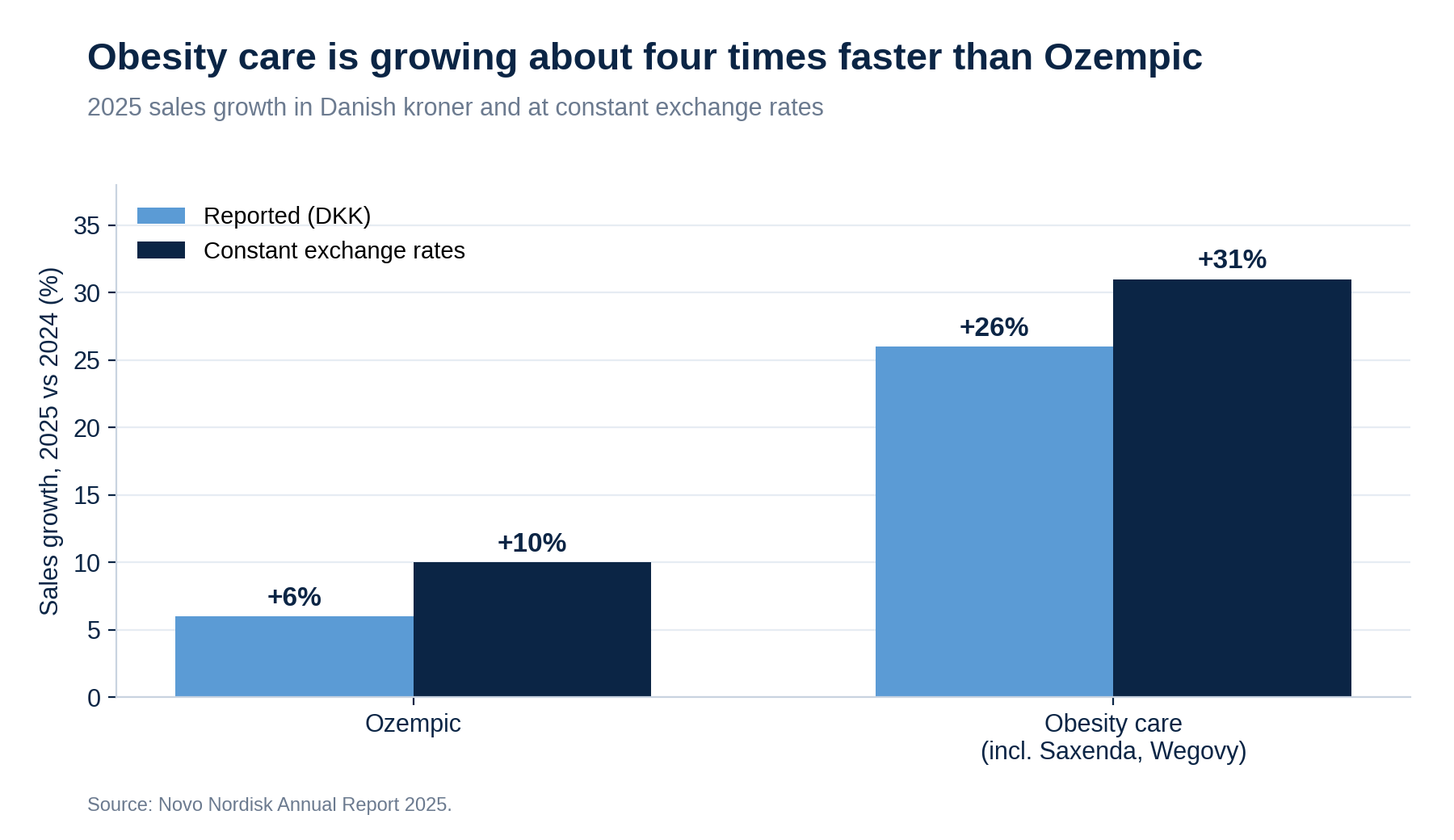
These figures illustrate the size of the market, but they are not estimates of the revenue directly threatened by the revoked patent. The patent concerns a particular area of protection, and its financial impact depends on how its claims relate to competing products and surviving rights.
Generic competition can put pressure on prices and market share when competitors are legally and regulatorily able to launch. Yet a patent revocation alone does not establish that a competitor’s product will be approved, that it will infringe no other patent or that it will gain a particular market share.
The most defensible conclusion is that the revocation removes one potential obstacle to competition, while the overall commercial impact remains dependent on the wider patent and regulatory landscape.
The Wider Patent Battle: Europe and the United States
The October 2026 decision is part of a broader series of challenges to Novo Nordisk’s semaglutide-related patents.
In January 2025, the EPO Board of Appeal dismissed Novo Nordisk’s appeal concerning a different patent, EP 2 866 825. In decision T 1701/22, the board upheld the revocation on inventive-step grounds. The case illustrates how earlier technical disclosures can undermine a patent even when the underlying medicine remains commercially important.
Another dispute involves European patent EP 3 689 365. JUVE Patent reported in September 2026 that Sandoz had initiated revocation proceedings before the Unified Patent Court’s Milan central division. This is a separate case, and its outcome should not be confused with the revocation of EP 3 448 416.
In the United States, Reuters reported in September 2026 that Mylan, part of Viatris, was seeking a declaration that its proposed generic Wegovy would not infringe Novo Nordisk’s patents.
These proceedings highlight an important regulatory and legal distinction: European patent decisions do not automatically determine the validity of US patents. Each jurisdiction has its own patent rights, litigation procedures and regulatory requirements.
For generic manufacturers, challenging patents before an anticipated expiry date can help clarify the legal barriers to future entry. For Novo Nordisk, defending the remaining patent portfolio is important to maintaining protection across different markets.
What the Decision Means for Pharmaceutical Patent Strategy
The case offers three lessons for pharmaceutical innovators and intellectual property teams.
Patent portfolios must be assessed claim by claim. A company may hold multiple patents covering a medicine, but the validity, scope and expiry of each right can differ. The revocation of one patent does not establish that all related patents are invalid.
Regulatory approval and patent protection are separate requirements. A generic manufacturer may need to resolve patent barriers and obtain the necessary marketing authorisation before launching a competing medicine. Patent expiry alone does not guarantee immediate entry.
Patent challenges can have commercial consequences years before a medicine loses all protection. A revocation can remove a specific legal obstacle, influence litigation strategy and change the range of options available to competitors. Its financial effect, however, must be assessed against the actual claims and remaining rights.
Conclusion
The revocation of EP 3 448 416 removes one layer of protection from Novo Nordisk’s semaglutide portfolio and adds to the patent disputes surrounding Ozempic and Wegovy.
The company reported 2025 sales of DKK 127.089 billion for Ozempic and DKK 82.347 billion across its obesity-care portfolio. These figures demonstrate the commercial importance of the medicines, although they do not measure the direct financial effect of the ruling.
The decision does not eliminate all semaglutide patents or establish an immediate date for generic entry. Instead, it highlights the importance of patent scope, prior art, regulatory requirements and country-specific exclusivity in determining when competition can begin.
For pharmaceutical companies, the central lesson is that protecting a blockbuster medicine requires more than securing a single patent. It requires a defensible portfolio whose individual claims can withstand legal scrutiny throughout the product’s commercial life.
Sources and References
- Novo Nordisk loses another patent behind Ozempic and Wegovy drugs
- Boards of Appeal decisions
- Official patent register
- EP 3 448 416: Semaglutide in cardiovascular conditions
- Annual Report 2025: Commercial execution and patent status
- Annual Report 2025: Financial performance
- Novo Nordisk 2025 annual filing
- Wegovy: European Public Assessment Report
- Boards of Appeal decisions database
- “Divisional game” under scrutiny as UPC proceedings over semaglutide kick off in Milan
- Mylan asks US court to clear Wegovy generic from Novo patent claims