

How leading medical-device companies are redesigning bone integration through lattice structures, additive manufacturing and surface engineering, and what their patent activity reveals about the technology.
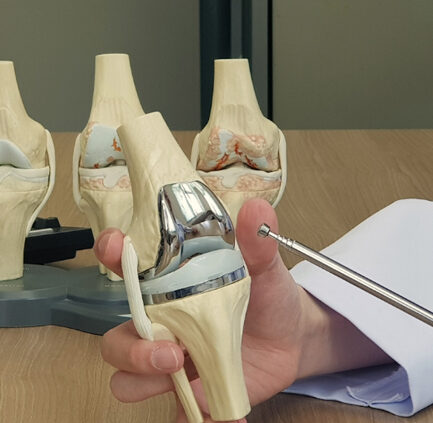
An orthopaedic implant may look like a solid piece of metal, but some of the most interesting engineering is happening in the spaces inside it.
Manufacturers are developing titanium implants with intricate, interconnected structures designed to support bone ingrowth, influence load transfer and improve fixation. Advances in metal additive manufacturing make it possible to produce geometries that would be difficult to create using conventional machining.
The innovation goes beyond making metal porous. Engineers can now manipulate internal architecture, vary porosity across different regions and integrate porous structures with solid components. Each decision affects the balance between stiffness, strength, biological integration and long-term durability.
Companies including Zimmer Biomet, Stryker and Enovis have commercialised different approaches to this technology. Their products illustrate a broader shift in orthopaedic engineering: the competitive advantage increasingly lies in how the implant’s architecture is designed, manufactured and integrated, not simply in the material itself.
The First Challenge: Stronger Than Bone, but Not Too Stiff
Titanium-6 aluminium-4 vanadium (Ti-6Al-4V) is widely used in orthopaedic implants because of its strength, corrosion resistance and established medical applications. Its elastic modulus is approximately 110 GPa, compared with roughly 7–30 GPa for cortical bone.
This difference creates a mechanical challenge. When a much stiffer implant carries a disproportionate share of the load, the surrounding bone may experience reduced mechanical stimulation. This phenomenon, known as stress shielding, can contribute to bone remodelling and bone loss.
Rather than replacing titanium with a weaker material, engineers can modify its structure.
| Material | Approximate elastic modulus |
| Cortical bone | 7–30 GPa |
| Solid Ti-6Al-4V | 110 GPa |
| Porous titanium | Depends on architecture |
Introducing pores reduces the amount of solid material carrying the load and changes the implant’s effective stiffness. However, increasing porosity can also reduce strength and fatigue resistance.
The goal is therefore not maximum porosity. It is an architecture that balances mechanical compatibility with the ability to withstand repeated loading.
How leading companies approach the problem
Zimmer Biomet’s OsseoTi uses additively manufactured titanium alloy with a company-reported porosity of approximately 70% and an average pore size of 475 micrometres. Its three-dimensional architecture is designed to resemble cancellous, or spongy, bone.
Stryker’s Tritanium technology uses additively manufactured titanium structures in joint-replacement applications. The Trident II Tritanium acetabular shell has reported average porosity of 60% and an average pore size of approximately 434 micrometres.
Enovis’s Trabecular Titanium, originally developed by LimaCorporate, uses an interconnected three-dimensional hexagonal-cell architecture. The company reports approximately 65% porosity and an average pore diameter of 640 micrometres.
These figures are product-specific, not a direct performance comparison. Different architectures, applications and measurement methods influence what the numbers mean.
The patent landscape reflects the same differentiation. Innovation extends beyond the broad concept of porous metal to specific architectures, integrated porous and solid regions, surface designs and manufacturing methods. The important question is increasingly how a particular structure solves an engineering problem.
The Second Challenge: Designing the Right Kind of Porosity
Two implants can have the same percentage of empty space yet behave very differently under load.
Pore connectivity affects whether tissue can access the internal network. Strut thickness and orientation influence stiffness, deformation and local stress concentrations. Cell geometry determines how forces travel through the structure.
This makes lattice design a complex engineering discipline rather than a cosmetic feature.
A 2026 review of additively manufactured porous titanium examined how pore size, porosity, feature thickness and lattice type affect fatigue performance. Its findings highlight the difficulty of matching natural bone’s mechanical behaviour without compromising structural reliability.
The review reported that only one sample in its analysed dataset matched both the cited cortical-bone elastic-modulus range of 15–20 GPa and fatigue strength of 40–60 MPa. These are findings from a specific review, not universal performance limits for porous implants.
The takeaway is significant: matching bone stiffness is not enough if the structure cannot withstand repeated loading.
Commercial designs illustrate different ways to address this challenge. OsseoTi uses an architecture inspired by cancellous bone, Tritanium incorporates porous structures into cementless implant designs, and Trabecular Titanium uses a repeating hexagonal-cell network.
These approaches point to several areas of patent activity: lattice geometry, pore distribution, graded porosity, transitions between porous and solid regions, and the integration of the architecture into specific implant forms.
A publicly available Kyocera Medical Technologies patent family, Surgical implant device incorporating a lattice volume and associated method of manufacture, addresses lattice structures and their integration into surgical implants. The US patent US12251318B2, granted in March 2025, provides one example of this more specific engineering focus. It does not imply ownership of the entire field of porous implant design.
The Third Challenge: Turning a Digital Design into a Reliable Implant
Metal additive manufacturing allows complex structures to be built layer by layer. In laser powder bed fusion, a laser selectively fuses metal powder to produce the component, enabling intricate lattices and integrated porous regions.
But a digital design does not guarantee a perfectly manufactured implant.
Build orientation, melt behaviour, residual stresses, surface roughness and internal defects can affect the finished component. Small defects may become sites for fatigue-crack initiation under repeated loading, even when the implant performs well in a static test.
The engineering process must therefore connect four stages:
Digital architecture → Manufacturing process → Verification and testing → Implant performance
The design determines pore geometry and load paths. Manufacturing introduces variables such as powder characteristics and process parameters. Verification evaluates geometric accuracy, defects and mechanical performance. Together, these factors determine whether the intended structure can be produced consistently.
A 2026 review of metal additive manufacturing for orthopaedic implants identifies the trade-off between design freedom and clinical reliability as a central challenge. Process variability, anisotropy, defects, post-processing and qualification remain important considerations.
Why manufacturing patents matter
Innovation is not confined to the final implant shape. Patent disclosures can also address how porous regions are formed, how they connect to a solid substrate, how structures are produced and how the intended mechanical characteristics are achieved.
This matters commercially because two implants may appear similar while relying on different manufacturing approaches or structural configurations. Patent intelligence can help distinguish these approaches, although patent documents alone cannot establish a competitor’s complete manufacturing process or the scope of all its rights.
The Fourth Challenge: Engineering the Bone–Implant Interface
The internal lattice influences mechanical behaviour, but the surface determines the immediate environment encountered by proteins, cells and developing tissue.
Surface texture and chemistry can affect early biological interactions. Meanwhile, the porous network provides pathways and space for tissue development. A coating, a roughened surface and an interconnected lattice are different engineering strategies, even when they share the objective of improving fixation.
Zimmer Biomet’s Trabecular Metal technology offers a useful comparison. Unlike additively manufactured porous titanium, it uses a porous tantalum structure produced through a different manufacturing route. Its existence demonstrates that engineering interconnected, bone-compatible structures predates the current expansion of metal 3D printing.
Material, manufacturing route and architecture jointly influence the structures that can be produced and their resulting properties.
Patent activity in this area includes porous coatings, surface protrusions, chemical modification and combinations of surface and internal architectures. A Kyocera Medical Technologies patent family titled Surgical implant devices incorporating porous surfaces and associated method of manufacture describes porous surface structures and needle-like protrusions.
The broader trend is that innovation is occurring at multiple scales: the internal lattice, the outer surface and the connection between porous and solid regions. These features interact, making it important to assess them together rather than as isolated technologies.
What the Patent Landscape Reveals
The commercial and technical developments point to four connected areas of innovation.
| Technology area | What is changing | Why it matters |
| Material and stiffness | Combining material properties with structural design | Helps address stiffness mismatch |
| Lattice architecture | Refining pore geometry, connectivity and density | Influences load transfer and tissue access |
| Surface engineering | Integrating porous surfaces and other interface features | Affects the bone–implant interface |
| Manufacturing | Controlling build processes, defects and structural consistency | Supports reproducible performance |
Patent counts alone can be misleading. A single invention may generate multiple publications across jurisdictions, while an important technical development may be represented by only a few documents. Priority dates, patent-family relationships, current legal status and technical scope all matter.
A useful assessment combines patent records with product specifications, scientific literature and available clinical evidence. It distinguishes a manufacturer’s stated design objectives from independently demonstrated performance and avoids treating a patent publication as proof of clinical superiority or freedom to operate.
For medical-device companies, this approach provides a clearer view of how competitors are addressing unresolved engineering problems, where technical approaches overlap and which aspects of the technology are evolving most rapidly.
The Next Competitive Frontier
Porous orthopaedic implants are no longer defined simply by a rough surface or an open metal structure. Their development increasingly involves the integration of mechanical design, biological interface engineering, additive manufacturing and quality control.
Zimmer Biomet, Stryker and Enovis demonstrate different ways of translating porous architecture into commercial technologies. Patent records from companies such as Kyocera Medical Technologies illustrate how the underlying engineering challenges also generate more specific innovation in lattice structures, surface designs and manufacturing methods.
The next advances will depend on achieving a reliable combination of bone integration, fatigue resistance and reproducible manufacturing.
The real innovation is not the empty space inside an implant. It is the engineering that makes that space useful, mechanically reliable and biologically compatible.
Sources
- https://www.zimmerbiomet.com/en/products-and-solutions/specialties/hip/osseoti-porous-metal-technology.html
- https://www.zimmerbiomet.com/en/products-and-solutions/specialties/hip/trabecular-metal-technology.html
- https://www.stryker.com/de/en/joint-replacement/products/trident-ii.html
- https://enovis-surgical.com/en/discovering-trabecular-titanium.html
- https://patents.google.com/patent/US12251318B2/en
- https://patents.google.com/patent/US20240099849A1/en
- https://www.sciencedirect.com/science/article/pii/S1751616126000627
- https://www.sciencedirect.com/science/article/pii/S2238785426018557
- https://pubmed.ncbi.nlm.nih.gov/30825316/
- https://www.zimmerbiomet.com/content/dam/zb-corporate/en/corporate/patents/Patent-Marking-List-for-Website-Q3-2024.pdf