


In modern warfare, survival often depends on speed, precision, and technological superiority. Nowhere is this more evident than in the evolution of US defense technology, where advanced sensing systems are increasingly determining the outcome of high-risk rescue missions. In early 2026, reports surfaced of a dramatic military rescue operation in southern Iran that showcased what may be one of the most advanced tools ever deployed within US military innovation, a classified detection platform reportedly known as Ghost Murmur.
According to multiple reports, the system helped locate a stranded U.S. airman hiding deep inside hostile territory, not through traditional visuals, radio triangulation, or thermal imagery alone, but by detecting faint electromagnetic signals associated with his heartbeat. If verified, Ghost Murmur represents far more than a successful rescue. It signals the arrival of a new class of US national security technology built at the intersection of quantum sensing, artificial intelligence, and biometric detection.
For the US aerospace and defense market, the implications are significant. Technologies like Ghost Murmur suggest that the next phase of US military capability will not be defined solely by firepower, but by sensing precision, algorithmic intelligence, and deep integration across advanced hardware and software systems.
Understanding Ghost Murmur requires examining the mission itself, the technology believed to power it, and the broader implications for US defense contractors, Pentagon research programs, and the emerging US quantum technology ecosystem.
The Incident That Triggered the Deployment of Advanced US Military Rescue Technology
The mission reportedly began when a U.S. military aircraft operating in the region encountered hostile action that forced an emergency ejection. The airman survived the crash but landed deep inside rugged terrain in southern Iran, far from friendly forces. The operational environment presented severe challenges, including mountainous geography, extreme temperatures, limited visibility, and the presence of enemy search teams actively scanning the area.
For nearly two days, the stranded pilot remained hidden in a confined location, following standard US military survival protocols designed to minimize detection. Traditional US search and rescue systems, including locator beacons and aerial reconnaissance tools, were deployed. However, locating a signal in hostile terrain is not simply a matter of detection. It requires confirmation, precision, and speed.
This is particularly critical for US combat search and rescue (CSAR) missions, where delays increase operational risk and reduce survival probability.
Traditional rescue operations rely heavily on radio triangulation, infrared detection, and visual scanning technologies developed within decades of US defense system engineering. In rugged terrain, however, signals can be blocked, reflected, or distorted. In hostile territory, every additional minute increases the probability of interception by adversarial forces.
At a critical moment, the pilot activated a locator beacon, transmitting a short signal intended to guide rescue teams. This brief signal created an opportunity but did not provide definitive location accuracy. That signal required validation through additional detection mechanisms.
This is where Ghost Murmur reportedly entered the operational workflow, demonstrating the evolving capabilities of next generation US military detection systems.
How the Rescue Was Executed Using Advanced US Military AI Systems
Although many operational details remain classified, available reporting and known US defense technology frameworks suggest a coordinated sequence involving aerial platforms, signal intelligence assets, and advanced sensing infrastructure.
The environmental conditions played a decisive role. Desert and mountainous regions, particularly those with low electromagnetic interference, are favorable environments for high-sensitivity signal detection. Such conditions allow advanced sensing systems developed within US Department of Defense research programs to isolate faint signals more effectively.
Once the locator’s beacon signal was identified, advanced sensing tools began scanning surrounding areas. Instead of relying solely on traditional detection signals, the system reportedly searched for biological signatures associated with cardiac activity. The human heart generates electrical impulses with each beat. These impulses create minute magnetic fields that propagate outward into surrounding space. Under typical conditions, these signals are extremely weak and difficult to measure outside controlled laboratory environments. However, emerging US quantum sensing technologies are designed to detect extremely small electromagnetic signals that were previously undetectable using legacy systems.
Artificial intelligence played a central role in the mission. Incoming signal data streams were processed using advanced US military AI systems capable of filtering noise, isolating signal patterns, and identifying consistent biological rhythms.
The objective was not simply detecting any electromagnetic activity. It was isolating a consistent heartbeat rhythm corresponding to a single human subject in a defined geographic location.
Once confidence thresholds were reached, coordinates were transmitted to rescue aircraft. The extraction sequence followed established US combat rescue protocols, enabling the pilot to be safely recovered from hostile territory. The mission reportedly concluded successfully, marking what could be one of the earliest operational uses of advanced biometric sensing within US defense operations.
The Technology Behind Ghost Murmur and Its Role in US Quantum Sensing Leadership
At the core of Ghost Murmur lies a rapidly advancing field known as quantum sensing, an area receiving substantial investment across US government research agencies and private sector innovators.
Quantum sensing involves detecting extremely small physical changes, including minute magnetic fields that cannot be measured by conventional instruments. Within the US quantum technology ecosystem, one of the most promising sensing mechanisms involves nitrogen vacancy centers embedded in synthetic diamonds.
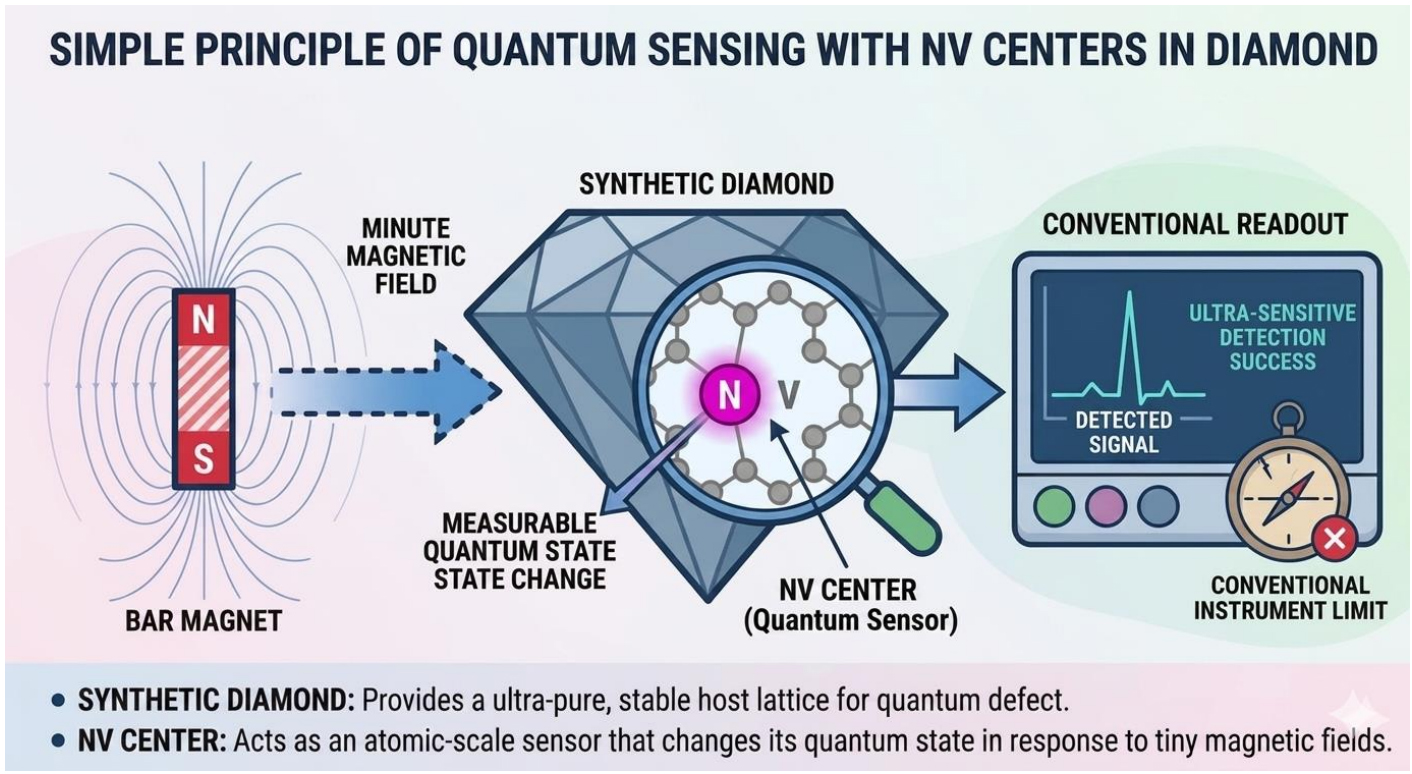
These nitrogen vacancy centers are atomic-scale defects inside diamond structures that exhibit unique quantum behavior. When illuminated using laser systems, they respond to nearby magnetic fields by producing measurable optical signals. This allows the diamond to function as an ultra-sensitive magnetometer.
Within US biomedical research programs, similar technologies are already being explored for medical imaging, neurological diagnostics, and cardiac monitoring. However, adapting such technologies for field deployment within US defense systems introduces enormous engineering complexity.
Outdoor environments introduce unpredictable interference, movement dynamics, and environmental noise. Translating laboratory-grade sensitivity into field-ready hardware is a major focus within Pentagon-funded research initiatives and US defense innovation programs.
Artificial intelligence completes the technological chain. Raw signal data collected through quantum sensors contains enormous noise levels. Environmental conditions such as geological structures, atmospheric fluctuations, and solar interference complicate signal interpretation.
Machine learning models trained on biological signal datasets allow systems to recognize repeating waveform patterns consistent with cardiac rhythms. These models improve accuracy over time and enable real-time decision support within US military operations.
Together, these components form a layered architecture where quantum hardware captures signals, AI systems interpret them, and integrated navigation frameworks convert findings into actionable coordinates.
Scientific Skepticism and the Debate Within the US Research Community
Despite the compelling narrative, many scientists within the US research community have expressed caution regarding the reported capabilities of long-range heartbeat detection.
Physics imposes strict limits on magnetic signal propagation. In current US medical and research laboratories, heart-generated magnetic fields are typically detectable only at very short distances using highly controlled equipment.
Some experts believe that Ghost Murmur may combine multiple detection techniques rather than relying exclusively on heartbeat sensing. These techniques could include beacon signal enhancement, movement analysis, and environmental modeling.
Others suggest that classified US defense research programs may have achieved performance breakthroughs that have not yet been disclosed to the public.
This dynamic is not new. Technologies such as radar, stealth materials, and satellite navigation were developed within US defense laboratories long before their public release.
Ghost Murmur may represent a similar case where classified innovation within US national security programs has advanced beyond publicly available research data.
Intellectual Property and US Defense Patent Strategy Implications
From an intellectual property perspective, Ghost Murmur reflects the complexity of modern US defense patents, where value lies not in single inventions but in integrated technological ecosystems.
One major patent domain likely involves quantum sensing hardware. This includes diamond-based magnetometers, laser excitation mechanisms, and fabrication processes associated with nitrogen vacancy center stability. Numerous US defense contractors and research institutions have filed patents related to these technologies, reflecting the strategic importance of quantum detection within US national defense planning.
Another significant patent domain involves artificial intelligence. Detecting biological signals within noisy environments requires advanced algorithms capable of adaptive filtering, waveform recognition, and predictive modeling. These technologies form a critical part of US AI patent portfolios, particularly within companies supporting military and aerospace programs.
Sensor fusion architecture represents a third key domain. Modern US military systems rely on combining multiple data sources including radio signals, thermal imaging, magnetic detection, and navigation data. Integrating these inputs into unified decision frameworks represents a major area of patent activity across the US aerospace and defense industry.
Deployment architecture forms a fourth layer. This includes airborne sensor mounting, power optimization, and signal routing systems designed for operational durability. Such integration patents often provide the highest strategic value because they define how components function together in mission-critical scenarios.
Many US defense-related patents exist within restricted or classified frameworks. Some are filed under secrecy orders. Others are published with limited technical disclosure. This creates hidden intellectual property landscapes that remain invisible to commercial competitors but critical to national security leadership.
Ghost Murmur, if validated, likely exists within such a layered US defense patent ecosystem, protected through a network of interdependent innovations.
Impact on the US Aerospace and Defense Market
The emergence of technologies like Ghost Murmur carries significant implications for the US aerospace and defense market, particularly as global defense spending continues to increase.
Precision sensing technologies reduce mission risk and improve operational efficiency. Faster localization reduces exposure time and enhances survivability in hostile zones. For US military planning, this translates directly into improved operational success rates.
For US defense contractors, the market opportunity is substantial. Companies involved in quantum sensing, advanced materials, and AI analytics stand to benefit from increased government investment in next-generation sensing infrastructure.
Major players within the US defense technology sector are already investing heavily in quantum research, AI development, and integrated battlefield systems. The commercialization of related technologies may extend into civilian sectors such as healthcare diagnostics, disaster rescue operations, and critical infrastructure monitoring.
These dual-use applications strengthen the economic case for sustained funding across US national security technology programs.
The Larger Shift in US Military Technology Strategy
Ghost Murmur reflects a broader transformation occurring across US military technology strategy, where detection is shifting from physical observation to biological sensing.
Historically, surveillance focused on tracking vehicles, aircraft, and visible movement patterns. Today, the objective is expanding toward detecting physiological signals and biological presence.
Quantum sensing is rapidly becoming a priority area within US defense modernization efforts. Applications extend beyond search and rescue into navigation, underground mapping, submarine detection, and border security.
Artificial intelligence amplifies these capabilities by transforming massive data streams into actionable intelligence. Without advanced AI frameworks, quantum sensors would produce unmanageable volumes of raw information. With AI integration, those signals become meaningful operational insights.
This convergence is creating a new category of US military intelligence systems, capable of interpreting life signals rather than merely observing environmental patterns.
Conclusion: The Future of US Defense Innovation Lies in Biological Detection
Whether every reported detail surrounding Ghost Murmur proves accurate or not, the mission highlights a defining trend within US defense innovation, the transition from machine-based detection toward biological sensing systems.
The fusion of quantum sensing, artificial intelligence analytics, and integrated platform engineering is redefining how humans are located, tracked, and protected in hostile environments. In earlier generations of warfare, survival depended on communication and visibility. In emerging US military strategy, survival may increasingly depend on controlling detectable biological signals.
From a technology standpoint, Ghost Murmur represents a glimpse into the future of US national security infrastructure, where machines can identify life signatures even when movement and communication are minimized.
From an intellectual property perspective, it reinforces the importance of protecting integrated technological ecosystems within US defense patent portfolios. The most valuable innovations of the coming decade will not exist as isolated components. They will emerge as interconnected networks of hardware, software, and algorithmic intelligence.
Ultimately, Ghost Murmur is more than a rescue story. It is an early indicator of how US defense technology leadership is evolving toward deeper sensing, higher precision, and intelligent automation. As quantum technologies mature and artificial intelligence systems continue to scale, the battlefield of the future may not be defined by what can be seen, but by what can be sensed across invisible biological signatures.