

Intuitive Surgical’s da Vinci system went unchallenged in soft-tissue robotic surgery for two decades. In the last five months, that monopoly has cracked open three deep-pocketed rivals now have FDA clearance or a live submission on the table. Here’s what the numbers say about who’s winning, who’s bluffing, and when it will matter.
The Monopoly, By the Numbers
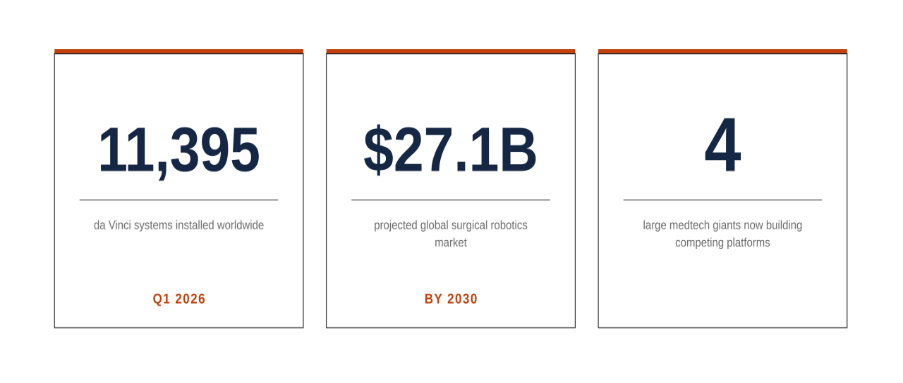
Before dissecting the disruption, it’s worth sitting with how complete Intuitive’s grip actually was. By the end of 2025, the company had placed more than 10,670 da Vinci systems in hospitals worldwide, shipping 532 systems in the fourth quarter alone, including 303 units of its latest da Vinci 5 platform.
The financial architecture behind that installed base is the real story. Only a quarter of Intuitive’s revenue comes from selling new robot sales, with the remainder from parts and services, creating a stable income stream. That is the razor-and-blade model executed about as well as it can be in medical devices, recurring revenue from instruments and accessories accounted for 61% of the company’s revenue in 2024 and instrument revenue per procedure has settled around $1,800 per case, a figure that barely moves regardless of hospital or geography.
Intuitive backed this moat with intellectual property depth few medtech challengers could match over 4,500 granted patents covering instruments, imaging, and user interfaces, plus training programs for over 76,000 surgeons on da Vinci systems, a workforce lock-in that made switching platforms almost as costly as switching languages mid-career. The result: a market cap north of $174 billion.
Four companies, four completely different bets
Nothing about Intuitive’s technology failed. What changed is regulatory clocks finally ran out for three separate challengers in the same twelve-month window. Each challenger picked a different way to attack Intuitive’s da Vinci. None of them are copying it directly.
| PLATFORM | STATUS (MID 2026) | THE BET |
|
da Vinci 5 |
Incumbent |
Two-decade head start, 4,200+ active patents, and a surgeon-training ecosystem rivals can’t shortcut.
|
|
Hugo™ RAS |
FDA cleared, Dec 2025 |
Modular carts instead of one boom arm, cheaper to deploy, open surgeon console, live in 35+ countries already.
|
|
Ottava™ |
FDA de novo filed, Jan 2026 |
OTTAVA™ integrates robotic arms into the operating table, allowing them to be stowed away when not in use, so the same Operating room can support both robotic and conventional surgery.
|
|
Mako SmartRobotics |
Category leader (ortho) |
Not fighting da Vinci at all, owns orthopaedic joint replacement outright, with 1.5M+ procedures across 45 countries.
|
|
Versius / Dexter |
FDA cleared, late 2024–2025 |
Both systems are designed for smaller, more flexible surgical settings, including ambulatory surgery centers (ASCs)
|
The incumbent isn’t just bigger. It’s still accelerating.
The most counterintuitive fact in this whole story: da Vinci’s growth rate hasn’t slowed down as competitors arrived, it’s the fastest it’s been in years, according to Intuitive’s own 2025 10-K filing.

Note: these figures use different bases (annual vs. lifetime cumulative) because that’s what each company discloses.
That gap in disclosure is itself informative, companies confident in early traction tend to publish procedure counts quickly. Ion’s 51% growth is arguably the more interesting number here: Intuitive’s newer lung-biopsy platform is still accelerating even as the company fights a two-front competitive battle on its flagship product.
Revenue: Intuitive’s growth is re-accelerating, not slowing down
If competition were denting Intuitive’s business, you’d see it in quarterly revenue growth first. Instead, growth has widened every quarter since Medtronic’s Hugo cleared the FDA from Intuitive’s own Q1 2026 earnings release.
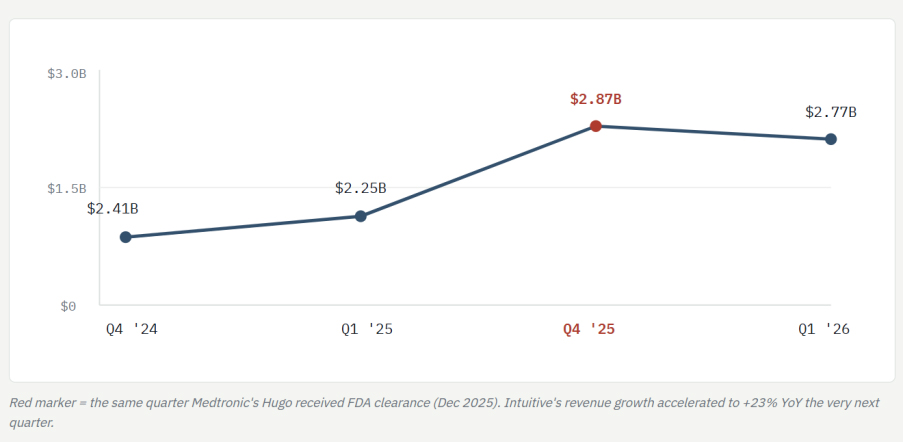
Red marker = the same quarter Medtronic’s Hugo received FDA clearance (Dec 2025). Intuitive’s revenue growth accelerated to +23% YoY the very next quarter.
To be fair to the bears, this doesn’t prove competition can’t hurt Intuitive, it proves it hasn’t yet. Hugo’s US commercial rollout only began in February 2026, and hospital capital-equipment sales typically take 12–24 months to show up in an incumbent’s growth numbers. The honest read here is “no visible impact yet,” not “no impact ever.”
How the last 18 months played out
Late 2024
CMR Surgical & Distalmotion get in first
Versius (gallbladder removal) and Dexter (outpatient hernia repair) both quietly win FDA de novo clearance, smaller companies moving faster than the giants.
December 3, 2025
Medtronic’s Hugo clears the FDA
First large medtech company to bring a soft-tissue robot to the US market since Intuitive’s arrival more than two decades earlier. Cleared for prostatectomy, nephrectomy, and cystectomy, procedures covering roughly 230,000 US surgeries a year.
January 7, 2026
J&J formally enters the race
Files Ottava for FDA de novo classification, five weeks after Medtronic’s clearance, the culmination of a program that started in 2020 and was delayed roughly two years along the way.
February 17, 2026
First US Hugo surgery
Performed at Cleveland Clinic, a prostatectomy, patient discharged the next day. Duke and Atrium Health among the first hospitals to install the system commercially.
May 2026
Ottava clears its first real clinical hurdle
A 30-patient bariatric surgery study hits its safety and performance endpoints, every procedure completed robotically with zero conversions to open surgery, and 30 lbs average weight loss at 30 days.
What everyone is actually fighting over
Even a modest dent in Intuitive’s roughly 80% share of soft-tissue robotic surgery would mean billions in reallocated revenue over the next five years, the actual reason four multi-billion-dollar companies decided this fight was worth the capital cost and regulatory risk. It’s also worth remembering that “the market” isn’t one thing: hardware sales, per-procedure instrument and accessory fees, and ongoing service contracts are three separate revenue streams with very different margins, and Intuitive’s most durable advantage has always been the recurring instrument-and-service business layered on top of the initial console sale, not the console itself.
This fight looks completely different outside America
Nearly all of the coverage of this rivalry including most of this briefing is implicitly a US story, because that’s where the FDA clearance drama plays out and where Intuitive generates the bulk of its revenue. But Hugo has been commercially available in Europe, Latin America, and parts of Asia for several years already, well before its US clearance, and CMR Surgical’s Versius was designed from the outset around markets where da Vinci’s price point was simply unaffordable for many hospital systems.
That matters for how this rivalry actually resolves. In markets like India and parts of Southeast Asia, the competitive question was never “will a challenger displace Intuitive”, Intuitive was often never the dominant option to begin with, given system costs that put it out of reach for all but the wealthiest private hospitals. Lower-cost modular systems have had years to build market share in exactly the segments where price sensitivity is highest, which means Medtronic and CMR Surgical arrive in the US fight with commercial experience, supply-chain relationships, and service-network infrastructure that a purely domestic reading of “FDA clearance date” badly understates.
China represents a related but distinct case: domestic robotic-surgery manufacturers, operating with strong government backing and a large addressable hospital market, have been scaling quickly with minimal Western press coverage. If any of these platforms eventually mounts a serious global challenge to Intuitive’s overall market position as opposed to just its US market share, it’s as likely to come from a company barely mentioned in this briefing as from Medtronic or J&J.
What the data still can’t tell you
Whether “modular” wins. Hugo and Versius both bet that cart-based, roll-in-when-needed arms beat Intuitive’s integrated boom design on flexibility and cost. Early clinical comparisons are described as “mixed but acceptable” not yet a clear verdict either way, and surgeon feedback on console feel is still too thin and too self-selected (early adopters tend to be enthusiasts) to generalize from.
Whether Ottava’s table-integration is a real workflow win or an expensive gimmick. J&J’s pitch is that hospitals stop needing rooms dedicated only to robotic surgery. That’s a genuine structural cost advantage if hospitals actually reorganize their OR scheduling and staffing around it, unproven at scale, and hospital administrators have historically been slow to redesign workflows around a single vendor’s hardware assumptions, especially before a system has years of uptime data behind it.
Where the fight actually gets fought. Industry advisers increasingly expect the real battleground to be hospitals with no existing robotics program at all, not head-to-head displacement of installed da Vinci systems meaning market share numbers alone may understate how contested this actually becomes, since greenfield wins don’t show up as losses in Intuitive’s existing-customer retention data.
Whether “second platform” becomes the norm rather than “replacement platform.” A scenario largely missing from the coverage so far: hospital systems running da Vinci for established surgeons while adding Hugo or Ottava for one service line or a satellite campus. If that’s the dominant pattern rather than outright displacement, the market simply gets bigger for everyone, a genuinely different outcome than the “wars” framing suggests.
Whether the US fight is even the right one to watch. Intuitive’s global dominance is far less total outside the US than inside it, and this briefing like most coverage is heavily US-weighted because that’s where the clearest, best-documented data exists. A slower-moving, less-covered global share shift may ultimately matter more to Intuitive’s long-term position than anything happening in an American operating room this year.
The Bottom Line
The most useful way to read 2025–2026 is not “Intuitive’s dominance is over,” but “Intuitive’s dominance is now contested at the margin for the first time since the company existed.” The company that invented a category is still the company that owns it. But for the first time in twenty years, hospitals evaluating a robotics purchase in 2026 have genuine, FDA-recognized alternatives to compare against a da Vinci quote — and that single fact, more than any single product feature, is the actual headline.