

Predictive mobility in 5G is emerging as an important development in cellular network management. As connected vehicles, industrial automation, extended reality and emergency communications demand uninterrupted connectivity, AI-driven mobility prediction is helping networks anticipate changing radio conditions, prepare handovers and maintain service continuity.
By introducing predictive mobility in 5G, network operators can use historical measurements and machine-learning models to anticipate potential handover events and improve mobility management under changing radio conditions.
For years, handover was the quiet part of a cellular network. A device drifted out of one cell, the network moved it into the next, and nobody noticed. That assumption is now being tested. Connected vehicles, industrial automation, extended reality and emergency communications need the data path to stay uninterrupted and the computing behind the application to stay close, not merely the radio link to stay up.
The industry response has three strands: AI/ML-assisted prediction of radio conditions, lower-interruption execution of cell changes, and orchestration that prepares edge resources before the device arrives. Each moves at a different pace and leaves a different trail. Standards documents show where the industry is heading. Trials show what works in the field. The patent record shows where companies are placing their bets. This article reads all three, with particular attention to the last.
| Steep
rise in filings since 2020 across predictive mobility |
Global
activity led by US, European, Korean and Chinese players |
Pending
most families still await examination |
Thin
claims on edge and service-migration orchestration |
Where the standards and the field stand
Conventional mobility is reactive. A device measures radio conditions, reports them, and the network moves it when configured events are met. That works well until speeds rise, small cells densify or conditions change quickly, at which point the network has little time to prepare. Machine-learning models offer earlier warning: they can estimate when a neighbouring cell will become suitable, or flag conditions that tend to precede handover or radio link failure. The aim is not an autonomous AI decision-maker but better information for decisions the network already makes, checked continuously against real measurements.
The standards process is catching up. Release 19 laid the foundation with the TR 38.744 study on AI/ML for mobility in NR. Release 20 carries it forward in the NR_AIML_Mob work item, covering prediction of radio-resource-management measurements across time and frequency, prediction of measurement events, device-side and network-side models, and lifecycle management signalling. It was reported at 65% progress at the September 2026 RAN Plenary, with a companion NG-RAN study (TR 38.745) under change control. Progress is not completion, and neither is deployment. 3GPP also does not prescribe a single algorithm: vendors build their own models while standardised procedures provide the common frame. Release 21, opened in November 2025, widens the lens to early 6G, but has not yet defined a predictive handover procedure.
Execution is the second strand. L1/L2 Triggered Mobility (LTM), introduced in Release 18, uses lower-layer signalling to shorten the interruption when a cell change happens. It does not remove handover, it makes the transition less disruptive. Field results are encouraging. Ericsson, KDDI and MediaTek reported a 25% reduction in data interruption against legacy Layer 3 mobility in February 2026, and a July trial with AT&T and MediaTek reported up to 25% less data interruption and up to 40% less handover interruption time. Those figures belong to specific trial conditions, and the trials do not show that LTM itself relies on AI prediction.
The third strand sits beyond the radio. A handover can succeed while the application keeps talking to an edge server that is no longer nearby, lengthening the round trip. Recent research, including a January 2026 study on mobility-aware service deployment and a November 2026 paper on dynamic edge orchestration, prepares resources along the expected route through reservation, replication or migration. An IEEE IFIP Networking 2026 paper on LSTM-based prediction for proactive service migration reports clear round-trip gains, but also shows that wrong predictions can hurt disproportionately. Prediction only pays when accuracy, preparation time and idle-resource cost work in its favour.
What the patent record adds
The growing interest in predictive mobility in 5G is also reflected in patent activity, particularly in AI-assisted handover, radio measurement prediction and mobility optimisation.
Standards and trials tell us what the industry intends to build. Patent filings tell us who intends to own parts of it. To read that signal, we looked at a deliberately narrow slice of the global patent record: filings from 2020 onwards that relate to predictive mobility, AI-assisted handover and the closely connected areas of measurement prediction, conditional and lower-layer mobility, and edge-aware service continuity.
Filing momentum: a field that has changed gear
Annual filings have risen steeply since 2020, with volumes in 2025 many times higher than at the start of the period. The handover and mobility core grew at a similar pace, and accelerated sharply between 2023 and 2025. The partial 2026 volume is a floor, not a result: applications typically publish about eighteen months after filing, so the most recent year is materially undercounted. The curve steepens as Release 18 matured and the Release 19 AI/ML mobility study took shape, which is consistent with 3GPP contributions turning into filings.
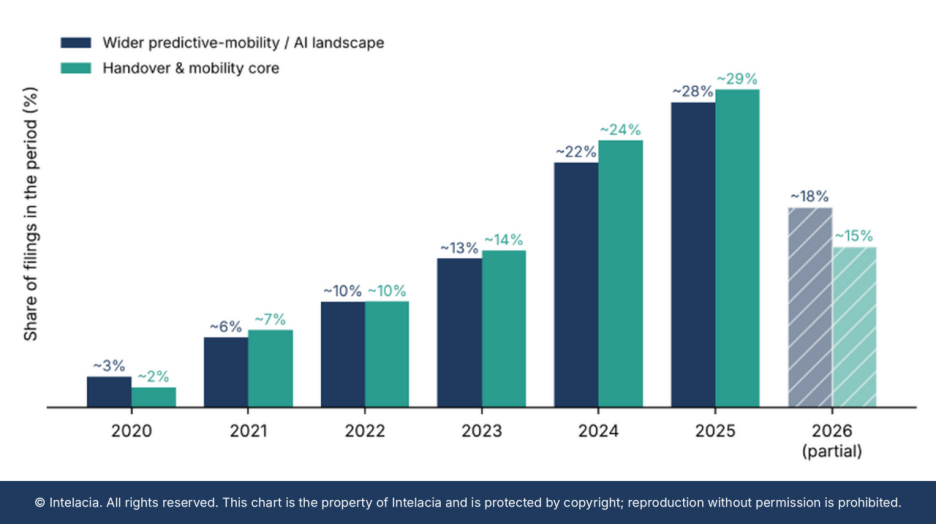
Figure 1. Share of filings by year, as an approximate percentage of all filings in the period. 2026 is partial because of publication lag.
Who is filing: concentrated at the top, wide at the base
Qualcomm, Samsung, Ericsson, InterDigital and Nokia lead. Together the top five hold a meaningful share of families, and the top ten a larger one. That is real concentration, but far from a closed field: hundreds of distinct owners appear. The next tier is strongly Chinese, with the BBK group, Huawei, Xiaomi, ZTE and China Telecom, and China and the United States are the two largest publication jurisdictions, with China slightly ahead.
Two quieter signals stand out. Network operators account for a visible share of families, led by China Telecom and China Mobile and followed by AT&T, Deutsche Telekom, Verizon and Reliance. Operators filing at this volume suggests mobility prediction is being treated as an operational differentiator, not only an equipment matter. Universities and research institutes add a smaller but steady share of families, a sign of activity beyond the commercial majors.
What is being claimed
Within the mobility core, about two-thirds of publications involve AI or machine learning. Classification data tells the same story: handover (H04W 36) and network-monitoring (H04W 24) classes overlap heavily with machine-learning classes (G06N 3 and G06N 20). These are mostly AI methods applied to mobility procedures, not generic AI. By theme, using keyword screening that is indicative rather than exact, the largest clusters address handover failure, radio link failure and interruption, measurement and beam prediction, conditional and predictive handover, and LTM, each making up a comparable slice of the mobility core.
These developments highlight how predictive mobility in 5G is moving beyond conventional handover management towards increasingly intelligent, data-driven network operations.
Start with the balance of the field, which is overwhelmingly radio-side. Edge, MEC and service-migration filings make up well under a tenth of the mobility core. Orchestration is prominent in the research literature but thin in the patent record, and a gap between research attention and claimed territory is where a careful observer looks for room to manoeuvre, and for later entrants.
Common building blocks, and a few distinctive moves
Reading the abstracts, a handful of technical building blocks recur. The most common is temporal prediction on the device: using time series of signal measurements, often with recurrent models such as LSTM, to forecast signal strength, beam quality or the moment a measurement event will fire. Closely related is trajectory prediction, where expected movement or likely serving cells are shared between network nodes. Reinforcement learning appears in a smaller but steady group, typically to learn handover policies in dense or non-terrestrial deployments. Federated learning, graph models and digital twins appear only occasionally, a sign of how early the field still is.
These technical approaches form an important part of predictive mobility in 5G, combining radio measurements, movement forecasting and machine-learning techniques to support more responsive network decisions.
The more interesting filings deal with the awkward cases. Nokia’s family on early handover preparation and cancellation lets a device prepare a transition from a predicted measurement event, then cancel it if the prediction proves wrong, which speaks directly to the misprediction cost that the research literature highlights. InterDigital claims prediction-driven recovery, using radio link failure prediction to enable conditional dual active protocol stack operation and recovery without random access. Ericsson has filings on passing a predicted device trajectory to another node with a request for feedback, and on building a graph of cells from measurement reports to decide which target cells are legitimate.
A third pattern is model lifecycle management claimed as invention in its own right: InterDigital on applicability determination and activation, Ericsson on applicability reporting inside an LTM cell switch, and BBK on activating and deactivating a measurement prediction function. This is where AI mobility and LTM visibly meet, and it tracks 3GPP’s decision to standardise the framework around the model, not the model itself. Qualcomm’s filings on interruption-time requirements for predictive mobility, and on beam prediction feedback to a target cell in LTM, sit at the same junction. Further out, application-layer filers apply the same ideas, as with a Shenzhen research laboratory using LSTM-predicted handover risk to steer multipath video from low-altitude platforms.
Legal status: largely unproven ground
Most of the filings we reviewed are still pending applications, a smaller group has been granted, and only a small minority are inactive through expiry, withdrawal, refusal or non-payment. At family level, almost all remain alive. Outright refusal is uncommon and mostly seen in China. Many records marked as expired relate to PCT publications whose international phase has ended without national-phase protection being pursued.
The pending share is largely a function of age. Among the earliest filings, a large share is already granted; among filings from 2024 onwards, only a small fraction is. For most of this field, claim scope has not yet been settled by examination, and applicants can still reshape claims or pursue continuations. A pending application signals intent, not an enforceable right. Grant shares also differ by office: highest in the United States, somewhat lower in China and lowest at the European Patent Office. These reflect examination pace and filing-date mix, not quality.
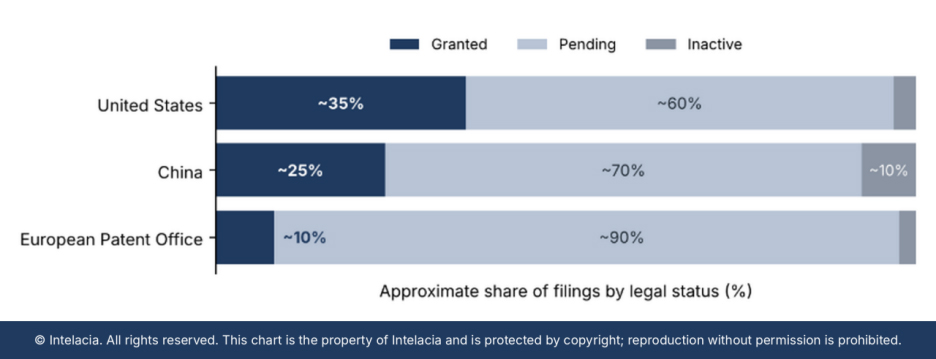
Figure 2. Approximate legal status mix by publication office, in percent.
What this means
Three readings stand out. Radio-side prediction is crowded and starting to move towards grant, so entering it means mapping prior art carefully, because the earliest cohorts are already being allowed. The picture also differs by region, since offices examine at different speeds and the same invention may be protected in some places and still pending in others. Orchestration and service continuity, where prediction meets the edge, is lightly claimed relative to the research interest, though the filing curve suggests that window will not stay open long. And because most of the landscape is unadjudicated, status monitoring matters as much as any one-time search: claims filed in 2024 and 2025 will be narrowed, granted or abandoned over the next few years, and each outcome redraws the map.
For telecommunications companies, predictive mobility in 5G creates opportunities to develop differentiated network capabilities while establishing stronger intellectual property positions around mobility intelligence and service continuity.
For anyone building or buying in this space, these patterns point to where a closer claim-level look pays off: the junction between prediction and execution, the fallback and cancellation logic around uncertain predictions, and the thinly claimed edge-orchestration territory. A landscape like this is only a starting point. The practical work is claim mapping, freedom-to-operate checks on the families most likely to matter, and tracking pending applications as their scope settles.The industry story is that networks are learning to anticipate. The patent record shows companies have understood this and are filing accordingly. The open question is who will join prediction, execution and resource preparation into one dependable function, and who will own it.
Note: The above analysis is based on global patent publications on predictive mobility and AI-assisted handover filed between 2020 and 2026. It is not an exhaustive census, and findings are directional and not exact counts. This is a landscape view, not a legal opinion on validity or infringement.
Sources and references
- TR 38.744 — Study on Artificial Intelligence (AI)/Machine Learning (ML) for Mobility in NR.
- Working Group Reports to RAN Plenary #113, September 2026.
- Ericsson, KDDI and MediaTek complete an in-field LTM demonstration, 25 February 2026.
- Ericsson, AT&T and MediaTek complete an in-field trial of enhanced mobility features, 7 July 2026.
- GS MEC 021 — Multi-access Edge Computing: Application Mobility Service