

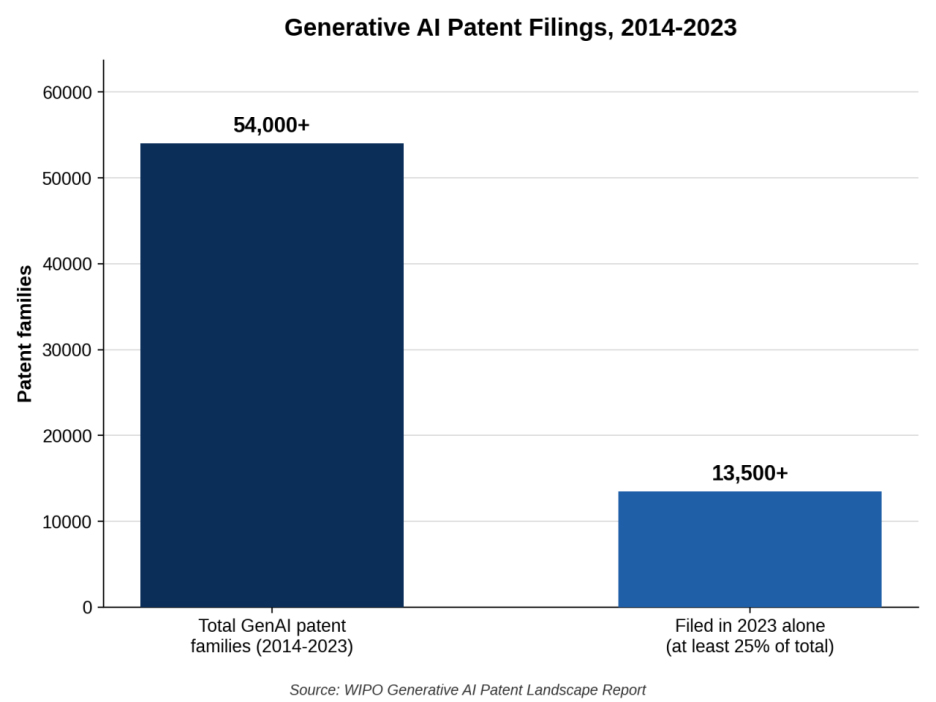
Artificial intelligence is driving one of the biggest patent filing waves in history. According to the World Intellectual Property Organization (WIPO), more than 54,000 patent families related to generative AI were published between 2014 and 2023, with over 25% of those patent families published in 2023 alone. Companies are racing to patent AI-powered assistants, workflow automation platforms, enterprise copilots, healthcare solutions, and customer engagement tools.
But amid this surge lies a legal obstacle that continues to invalidate even granted U.S. patents.
It is called Section 101 of the U.S. Patent Act.
A recent decision involving ClickFunnels and HighLevel serves as a timely reminder that obtaining a patent is only half the battle. Enforcing it is another challenge altogether.
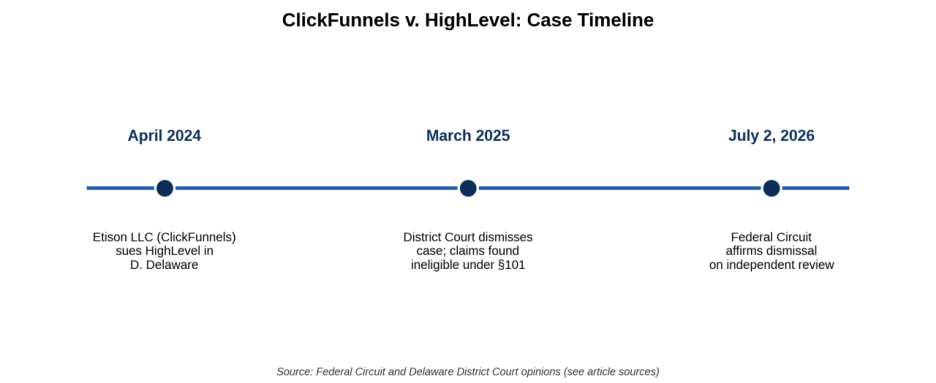
On July 2, 2026, the U.S. Court of Appeals for the Federal Circuit affirmed the dismissal of ClickFunnels’ patent infringement lawsuit against HighLevel, holding that the asserted patent claims were patent ineligible under 35 U.S.C. §101. While the case involved website-building software rather than artificial intelligence, the court’s reasoning carries important lessons for virtually every company developing AI-powered software.
What Was the Dispute About?
In April 2024, Etison LLC, doing business as ClickFunnels, sued HighLevel in the U.S. District Court for the District of Delaware, alleging infringement of two patents:
- U.S. Patent No. 10,846,357
- U.S. Patent No. 11,361,047
The patents described systems for building websites using a sequence of interconnected webpages, allowing users to generate marketing funnels through computer software.
ClickFunnels argued that HighLevel’s funnel-building platform practiced the patented methods.
HighLevel responded with a motion to dismiss, arguing that both patents merely computerized an abstract business concept and therefore failed the requirements of 35 U.S.C. §101, which defines what types of inventions are eligible for patent protection.
The Court’s Decision
The District Court dismissed the case in March 2025, concluding that the claims were directed to the abstract idea of filtering information based on user preferences to arrive at a final result.
ClickFunnels appealed.
The Federal Circuit agreed that the District Court had technically erred by treating one claim as representative of all asserted claims. The Federal Circuit nevertheless held the error harmless because the relevant additional claim limitations had effectively been analyzed and did not supply an inventive concept.
Why Section 101 Keeps Invalidating Software Patents
Section 101 appears deceptively simple. It states that patents may be granted for any new and useful process, machine, manufacture, or composition of matter.
In practice, decades of Supreme Court decisions have created important exceptions.
Courts consistently reject patents directed to:
- abstract ideas,
- laws of nature, and
- natural phenomena.
The turning point came in Alice Corp. v. CLS Bank International (2014).
The Supreme Court established a two-step framework that asks:
First, is the patent directed to an abstract idea?
Second, if so, does it contain an inventive concept that transforms the abstract idea into patent-eligible subject matter?
Simply implementing an existing business practice on conventional computer hardware is generally not enough.
That principle ultimately defeated ClickFunnels’ patents.
Why This Decision Matters for AI Patents
Although ClickFunnels did not involve artificial intelligence, its reasoning maps directly onto today’s AI patent landscape.
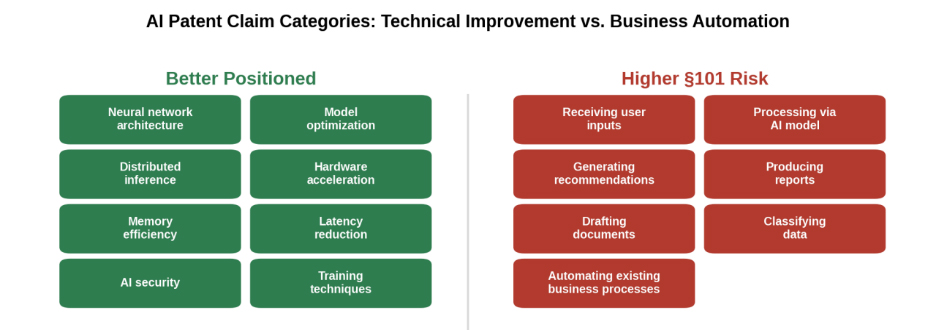
Thousands of recently filed AI patent applications describe workflows such as:
- receiving user inputs,
- processing information using an AI model,
- generating recommendations,
- producing reports,
- drafting documents,
- classifying data, or
- automating existing business processes.
Many of these inventions risk being viewed as automation of human activities rather than technological improvements.
Replacing “website builder” with “large language model” does not automatically create patent eligibility.
Courts increasingly ask a tougher question:
What technical problem has actually been solved?
If the claimed invention merely uses AI to perform an existing business task faster, it may face the same Section 101 challenge encountered by ClickFunnels.
The Real Trap for AI Companies
Many AI startups assume that incorporating machine learning or generative AI into software is enough to satisfy patent requirements.
The courts have repeatedly shown otherwise.
Patent examiners and judges increasingly distinguish between:
AI as a technological improvement versus AI as a tool that automates an existing business workflow.
For example, patents directed to improvements in:
- neural network architecture,
- model optimization,
- distributed inference,
- hardware acceleration,
- memory efficiency,
- latency reduction,
- AI security, or
- training techniques
are generally better positioned than claims focused solely on business automation.
The ClickFunnels decision reinforces this distinction.
Business Impact
The implications extend well beyond this litigation.
According to WIPO, China, the United States, South Korea, Japan and India are among the fastest-growing jurisdictions for generative AI patent filings. Global investment in AI continues to reach record levels, with companies investing billions of dollars annually in proprietary models, enterprise software and automation platforms.
If courts continue applying Section 101 rigorously, many companies may discover that granted patents are difficult to enforce, particularly when the claims emphasize business workflows over technical innovation.
That has significant commercial consequences.
Weak patents can reduce licensing leverage.
They may discourage investors seeking defensible intellectual property.
Competitors may also feel more confident challenging patents early through dismissal motions rather than lengthy infringement trials.
For startups, this can dramatically alter litigation costs and portfolio value.
What Innovators Should Learn
The ClickFunnels decision highlights a critical shift in AI patent strategy.
Simply describing an AI-powered workflow is becoming increasingly insufficient.
Patent applications should instead emphasize technical architecture, measurable engineering improvements, system performance, computational efficiencies, model implementation, and specific technical solutions rather than broad descriptions of automated business functions.
As AI becomes embedded across every industry, the strongest patents will likely protect technological breakthroughs, not merely digital versions of existing business processes.
For innovators, investors and patent owners alike, ClickFunnels v. HighLevel is less about marketing software and more about the future standards that AI patents will need to satisfy to survive in court.
Sources
- https://law.justia.com/cases/federal/appellate-courts/cafc/25-1711/25-1711-2026-07-02.html
- https://law.justia.com/cases/federal/district-courts/delaware/dedce/1%3A2024cv00502/85585/37/
- https://ptacts.uspto.gov/ptacts/public-informations/petitions/1557007/download-documents
- https://ptacts.uspto.gov/ptacts/public-informations/petitions/1557008/download-documents
- https://www.wipo.int/web-publications/generative-artificial-intelligence-patent-landscape-report/en/
- https://www.supremecourt.gov/opinions/13pdf/13-298_7lh8.pdf