

For decades, India’s agricultural growth has been driven by better seeds, mechanization, and irrigation. Today, another technology is quietly transforming farms across the country, not from the ground, but from the sky.
Agricultural drones are emerging as one of the most impactful innovations in precision farming, helping farmers monitor crops, optimize pesticide use, conserve water, and improve productivity through real-time data. Their rise comes at a crucial time for Indian agriculture, which faces mounting pressure from climate change, rising cultivation costs, labor shortages, and shrinking landholdings.
India cultivates nearly 159 million hectares of arable land, making it one of the world’s largest agricultural economies. The sector supports around 45% of the country’s workforce and contributes 18–20% of India’s Gross Domestic Product (GDP). Yet, despite its importance, productivity remains constrained by fragmented land ownership. According to the Agricultural Census, over 86% of Indian farmers are small and marginal landholders, with the average operational holding measuring only 1.08 hectares. Such fragmented farms make it difficult for farmers to invest in expensive machinery while maintaining profitability.
At the same time, climate variability is making farming increasingly unpredictable. Irregular monsoons, prolonged droughts, pest outbreaks, and declining groundwater reserves are forcing farmers to produce more with fewer resources. This growing need for efficiency has accelerated interest in technologies that improve decision-making rather than simply increasing mechanization.
Agricultural drones are becoming central to this transformation. Equipped with high-resolution cameras, multispectral sensors, GPS navigation, and artificial intelligence (AI), these systems allow farmers to monitor fields with unprecedented precision. Instead of relying solely on manual inspections or blanket spraying of pesticides, farmers can identify problems early and apply resources exactly where they are needed. The result is lower production costs, reduced environmental impact, and better crop management.
Why Precision Agriculture Has Become Essential
Traditional farming methods have served Indian agriculture for generations, but they are increasingly challenged by today’s realities.
Conventional crop monitoring often involves physically walking through fields, visually inspecting plants, and making decisions based on experience. While this approach has proven effective over decades, it becomes less practical as labor shortages increase and climate conditions become more unpredictable. Problems such as nutrient deficiencies, fungal infections, or pest infestations frequently remain unnoticed until visible symptoms appear, by which time crop losses may already be significant.
Input management presents another challenge. Fertilizers and pesticides are often applied uniformly across entire fields, even though only certain areas may require treatment. This not only increases production costs but also contributes to excessive chemical runoff, soil degradation, and groundwater contamination.
Water management is equally critical. Agriculture accounts for nearly 80% of India’s freshwater withdrawals, making efficient irrigation one of the country’s most pressing sustainability priorities. With groundwater levels declining across several agricultural states, improving water-use efficiency has become essential for long-term food security.
Precision agriculture addresses these challenges by replacing generalized farming practices with site-specific management. Rather than treating an entire field the same way, farmers can make decisions based on detailed information collected from individual sections of their land. Agricultural drones have become one of the most accessible technologies enabling this shift because they combine aerial surveillance, remote sensing, AI-powered analytics, and automated spraying into a single platform.
More Than Flying Machines
Modern agricultural drones function as intelligent data collection systems rather than simple flying cameras.
During a single flight, drones equipped with multispectral and thermal imaging sensors capture thousands of high-resolution images that are processed into detailed field maps. These images reveal subtle variations in crop health that are invisible to the naked eye.
Using vegetation indices such as the Normalized Difference Vegetation Index (NDVI), drones can identify water stress, nutrient deficiencies, disease outbreaks, and pest infestations days before symptoms become visible in the field. This early warning allows farmers to intervene quickly, preventing localized issues from spreading across entire farms.
The applications extend well beyond crop monitoring. Drones are increasingly being used for precision spraying of pesticides and fertilizers, soil health assessment, irrigation planning, crop acreage estimation, yield forecasting, disaster assessment following floods or droughts, and crop insurance verification.
Artificial intelligence further enhances these capabilities by analyzing collected imagery and generating recommendations for targeted interventions. Instead of relying solely on experience, farmers can make decisions supported by objective field-level data.
Measuring the Impact: Time, Water, and Cost Savings
The strongest case for agricultural drones lies in measurable improvements rather than technological novelty.
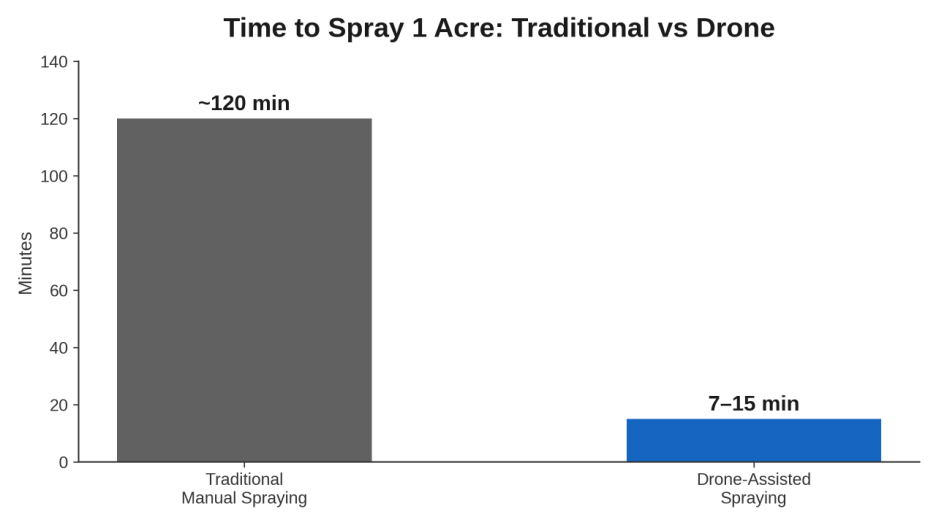
Field demonstrations conducted by the Indian Council of Agricultural Research (ICAR) have shown that drones can spray one acre of farmland in just 7 to 15 minutes, whereas conventional manual spraying typically requires close to two hours. During critical pest outbreaks, this dramatic reduction in spraying time allows farmers to protect crops much more rapidly, particularly when managing larger farms or multiple fields.
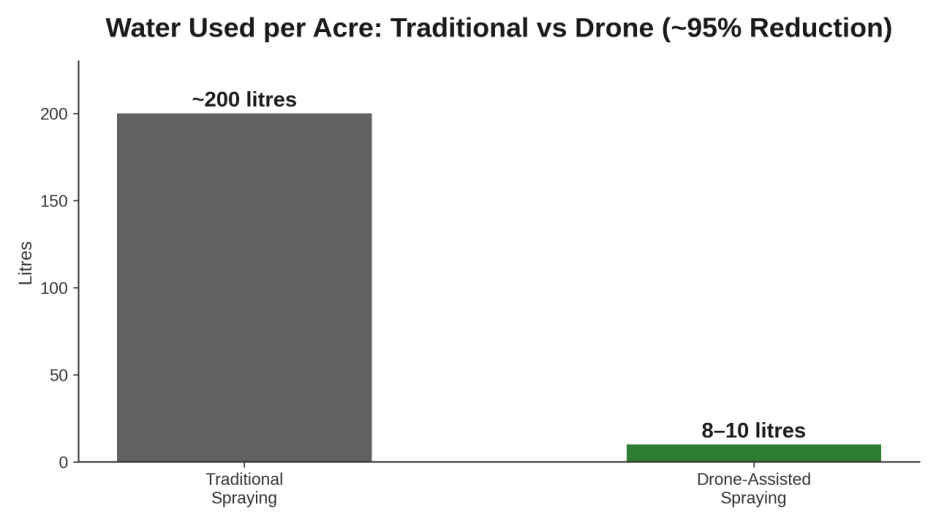
Water conservation is even more striking. Traditional pesticide spraying generally requires around 200 litres of water per acre, while drone-assisted spraying uses only 8 to 10 litres, reducing water consumption by approximately 95%. Considering that agriculture remains India’s largest consumer of freshwater, this efficiency represents a significant step toward more sustainable farming practices.
Economic benefits are equally compelling. ICAR demonstrations have reported reductions in pesticide application costs from approximately ₹437 per acre to nearly ₹300 per acre through drone-assisted spraying. Precision application also reduces chemical wastage while limiting workers’ direct exposure to hazardous pesticides, improving both economic and occupational outcomes.
Perhaps most importantly, these efficiencies enable farmers to respond more quickly to changing field conditions. Faster interventions often translate into healthier crops, reduced input costs, and improved productivity.
Traditional Farming vs Drone-Assisted Farming
| Parameter | Traditional Method | Drone-Assisted Farming |
| Time to spray 1 acre | ~120 minutes | 7–15 minutes |
| Water required | ~200 litres | 8–10 litres |
| Spraying accuracy | Uniform application | Precision targeting |
| Labour requirement | High | Significantly lower |
| Worker exposure to pesticides | Direct | Minimal |
| Crop monitoring | Manual inspection | AI-enabled aerial imaging |
These comparisons highlight why drones are increasingly viewed not simply as mechanized equipment, but as decision-support systems that improve the efficiency of nearly every farming operation.
Policy Support Is Accelerating Adoption
Technology alone cannot transform agriculture without an enabling policy environment, and India has moved quickly to create one.
A major milestone came with the introduction of the Drone Rules, 2021, which replaced a more restrictive regulatory framework with simplified procedures for drone registration, certification, and operations. By reducing administrative barriers, the new rules opened the door for wider commercial deployment of drones across sectors, particularly agriculture.
The policy momentum continued in 2022 when the Ministry of Agriculture and Farmers Welfare launched the Agriculture Drone initiative under the Sub-Mission on Agricultural Mechanization (SMAM). Recognizing that the high upfront cost of drones could discourage adoption, the government introduced financial assistance for Farmer Producer Organizations (FPOs), Custom Hiring Centres, Krishi Vigyan Kendras (KVKs), agricultural universities, and rural entrepreneurs.
Eligible institutions can receive financial assistance of up to ₹10 lakh per agricultural drone to support demonstrations and farmer outreach programs. Rather than encouraging every farmer to purchase a drone, the initiative promotes shared access through Drone-as-a-Service (DaaS) models, enabling small and marginal farmers to hire certified operators whenever needed.
This approach is particularly significant in India, where the average farm size remains just over one hectare. Service-based access allows advanced technologies to reach farmers who would otherwise be unable to justify the investment in purchasing a drone outright.
Government support has also extended beyond subsidies. Training programs are being expanded across the country to develop certified drone pilots, creating new employment opportunities while building the technical workforce needed to support India’s rapidly growing agricultural drone ecosystem.
From Research Trials to Real-World Impact
One of the strongest indicators of agricultural drones’ growing acceptance in India is the scale at which they are being demonstrated and deployed. What began as pilot projects led by research institutions has rapidly evolved into large-scale field demonstrations involving thousands of farmers across the country.
According to the Indian Council of Agricultural Research (ICAR) Annual Report 2023–24, more than 15,000 agricultural drone demonstrations were conducted across over 16,000 hectares, directly benefiting more than 90,000 farmers. These demonstrations covered a wide range of crops, including rice, wheat, cotton, soybean, sugarcane, pulses, and horticultural crops, helping researchers evaluate drone performance under different climatic and farming conditions.
The pace accelerated further in 2024. The Ministry of Agriculture and Farmers Welfare reported that over 27,000 demonstrations had been organized across India, covering more than 30,000 hectares and reaching over 350,000 farmers. Rather than simply showcasing the technology, these demonstrations have helped build confidence among farming communities by allowing growers to witness measurable improvements in spraying efficiency, resource utilization, and crop management.
The expansion of demonstrations also reflects the government’s broader objective of making precision agriculture accessible beyond large commercial farms. Through Farmer Producer Organizations (FPOs), Custom Hiring Centres, and Krishi Vigyan Kendras (KVKs), thousands of smallholder farmers are experiencing drone technology without the financial burden of owning one.
Case Study: IFFCO’s Nano Urea Initiative
One of the most significant commercial applications of agricultural drones in India has come through the Indian Farmers Fertilizer Cooperative Limited (IFFCO).
Following the launch of Nano Urea Liquid, IFFCO announced plans to procure 2,500 agricultural drones to support precision spraying across rural India. Unlike conventional granular fertilizers, Nano Urea is designed to be applied as a foliar spray, making drones an ideal delivery mechanism. The company also partnered with drone manufacturers and rural entrepreneurs to build a nationwide ecosystem for drone-assisted fertilizer applications.
This initiative demonstrates how drone technology can complement agricultural innovations rather than operate independently. By combining precision spraying with next-generation fertilizers, IFFCO aims to improve nutrient-use efficiency, reduce fertilizer wastage, and lower input costs for farmers while creating new employment opportunities for trained drone operators.
Case Study: Garuda Aerospace and India’s Drone Manufacturing Ecosystem
The rapid expansion of agricultural drones has also been driven by India’s growing domestic drone manufacturing industry.
Among the leading companies is Garuda Aerospace, which has deployed drones for pesticide spraying, crop health monitoring, and precision agriculture across multiple Indian states. The company has partnered with government agencies, agricultural institutions, and private enterprises to conduct large-scale field demonstrations while expanding drone pilot training programs.
Garuda Aerospace’s growth illustrates a broader shift in India’s drone ecosystem. Rather than relying heavily on imported platforms, Indian manufacturers are increasingly developing drones specifically designed for local farming conditions, including fragmented landholdings, diverse crop varieties, and tropical weather. This localization is expected to reduce costs, improve after-sales support, and accelerate adoption among small and marginal farmers.
Artificial Intelligence Is Transforming Drones into Decision-Making Tools
While drones are often recognized for their ability to spray crops, their greatest long-term value lies in the intelligence they generate.
Modern agricultural drones capture thousands of high-resolution images during every flight. Artificial intelligence and machine learning algorithms analyze this data to detect crop stress, nutrient deficiencies, disease outbreaks, weed infestations, and irrigation problems, often before these issues become visible to farmers on the ground.
Instead of recommending blanket pesticide applications, AI enables site-specific interventions. Farmers receive digital field maps identifying exactly where treatment is required, reducing unnecessary chemical use while improving productivity.
According to NITI Aayog, AI-enabled precision agriculture has already demonstrated significant benefits in India. Pilot projects have reported 60–80% reductions in pesticide and water use for certain applications, pest-control savings of approximately ₹3,600 per acre, and yield improvements of nearly 40% in mint cultivation, benefiting 30,000–40,000 farmers through precision monitoring and targeted management practices.
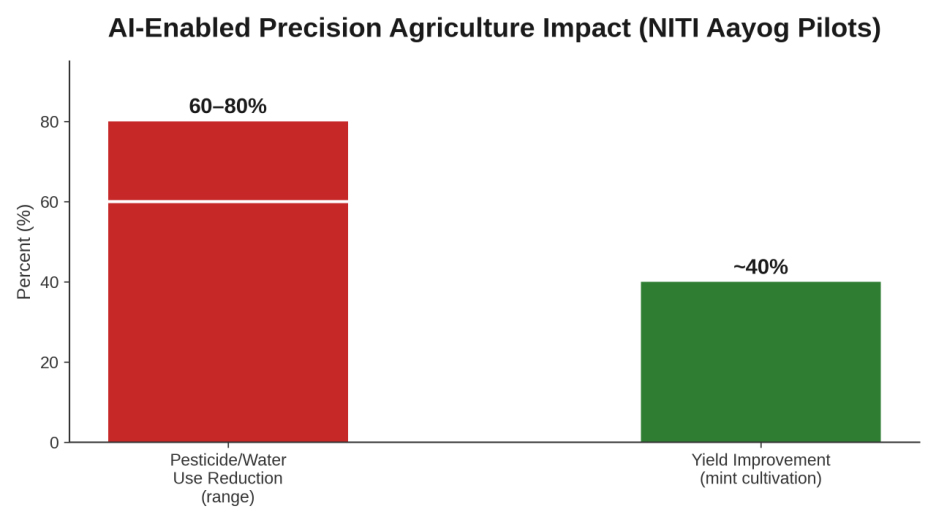
These outcomes highlight the growing convergence of artificial intelligence, remote sensing, and agricultural engineering, transforming drones from flying machines into intelligent farm management platforms.
Building Climate-Resilient Agriculture
Beyond improving productivity, agricultural drones are becoming important tools for sustainable and climate-resilient farming.
Agriculture accounts for nearly 80% of India’s freshwater withdrawals, making efficient resource management increasingly important as groundwater levels continue to decline in many regions. By reducing spray water requirements from approximately 200 litres per acre to just 8–10 litres, drones help conserve one of agriculture’s most critical resources.
Precision spraying also reduces excessive pesticide and fertilizer runoff into nearby water bodies, lowering environmental pollution while preserving soil health. Because drones apply inputs only where needed, they support more responsible for chemical use and reduce unnecessary emissions associated with repeated tractor operations.
Drones are also improving disaster responses. Following floods, cyclones, or droughts, high-resolution aerial imagery enables government agencies and insurance providers to assess crop damage much more rapidly than conventional field surveys. Faster assessments can shorten compensation timelines and support quicker recovery for affected farmers.
As climate change continues to increase production risks, technologies that improve both efficiency and resilience are becoming essential components of modern agriculture.
Challenges That Must Be Addressed
Despite remarkable progress, agricultural drones are not without challenges.
The cost of purchasing a drone remains significant for individual farmers, particularly those cultivating less than two hectares of land. Although Drone-as-a-Service models are reducing this barrier, expanding access will require stronger rural service networks and continued financial support.
Battery endurance also limits operational capacity, especially for larger farms where multiple flights may be required. In addition, the availability of trained drone pilots, maintenance facilities, and technical support remains uneven across different regions.
Digital literacy represents another important challenge. As drones become increasingly integrated with AI platforms, cloud-based analytics, and digital farm management systems, farmers will require training not only in operating the technology but also in interpreting the insights it provides.
Addressing these issues will require continued collaboration between government agencies, research institutions, drone manufacturers, financial institutions, and farmer organizations.
The Future of Indian Agriculture Will Be Data-Driven
India’s agricultural transformation is entering a new phase where productivity will increasingly depend on information rather than intuition alone.
The convergence of drones, artificial intelligence, satellite imagery, Internet of Things (IoT) sensors, and cloud computing is creating highly connected farming systems capable of monitoring crop conditions in real time and recommending interventions throughout the growing season.
As domestic manufacturing expands and Drone-as-a-Service business models mature, advanced farming technologies are expected to become accessible even to the country’s smallest farms. This democratization of precision agriculture has the potential to improve food security while simultaneously reducing water consumption, chemical inputs, production costs, and environmental impact.
Conclusion
India’s agricultural sector faces one of the most complex balancing acts of any major economy: increasing food production for a growing population while conserving diminishing natural resources.
Agricultural drones offer a practical solution to this challenge. They reduce spraying time from nearly two hours to less than 15 minutes per acre, lower water consumption by up to 95%, reduce labor costs, improve worker safety, and enable data-driven decisions through artificial intelligence. More importantly, they shift farming from reactive problem-solving to proactive crop management.
Government initiatives such as the Drone Rules 2021, the Agriculture Drone initiative, and large-scale ICAR demonstrations have laid a strong foundation for adoption. Combined with innovations from organizations like IFFCO and Garuda Aerospace, these efforts are helping transform drones from experimental tools into essential agricultural infrastructure.
For a country where 86% of farmers are small and marginal landholders, the future of farming will not be defined solely by larger machinery or greater chemical use. It will be shaped by intelligent technologies that help farmers produce more while using fewer resources. Agricultural drones represent one of the clearest examples of how digital innovation can support both economic growth and environmental sustainability, making them a cornerstone of India’s next agricultural revolution.
Sources
- https://agricoop.gov.in
- https://agricoop.gov.in/en/divisiontype/mechanization-and-technology
- https://www.dgca.gov.in
- https://digitalsky.dgca.gov.in
- https://www.agriculturejournal.org/volume10number3/the-application-of-drone-technology-for-sustainable-agriculture-in-india/
- https://icar.gov.in/sites/default/files/2025-04/ICAR%20Annual%20Report%202023-24-english.pdf
- https://icar.gov.in/en/agricultural-extension-division/new-initiatives-agricultural-extension-division
- https://epubs.icar.org.in
- https://agcensus.nic.in
- https://www.fao.org/digital-agriculture/en/
- https://www.fao.org/sustainable-agricultural-mechanization
- https://www.worldbank.org/en/topic/agriculture
- https://frontiertech.niti.gov.in/story/part-ii-eyes-in-the-sky-how-drones-and-aerial-intelligence-are-transforming-indian-farming/
- https://www.iffco.in
- https://www.garudaaerospace.com