


More than half of Israel is desert. The country ranks among the world’s most water-stressed nations, with natural freshwater resources so limited that the gap between supply and demand has been a defining national challenge since the state was founded. The Jordan River, once the primary freshwater artery of the region, carries a fraction of its historical flow. The Sea of Galilee, Israel’s largest freshwater reservoir has repeatedly dropped to crisis levels.
And yet Israel exports agricultural technology to over 100 countries. Its farms produce tomatoes, peppers, avocados, and citrus at some of the highest yields per hectare in the world. Its companies lead global markets in irrigation systems, agricultural sensors, and water recycling. Its model is studied by governments from India to Australia to sub-Saharan Africa.
How does a country with so little water become a global model for farming under scarcity?
The answer is not simply drip-irrigation, though that matters. It is something more fundamental: Israel made an early and deliberate decision to treat water as an economic resource, one with a measurable value, a finite supply, and a cost attached to every drop wasted. That decision shaped its technology, its infrastructure, its pricing policy, and its agricultural strategy over several decades.
Water Was Always an Economic Problem First
In most countries, water policy has historically been managed as an environmental or administrative challenge: how much water exists, who has rights to it, how to distribute it equitably. Israel’s approach diverged from this early on.
Israeli policymakers and agricultural economists recognized that in a water-scarce economy, every cubic metre of water allocated to agriculture was a cubic metre unavailable for urban consumption, industrial use, or environmental preservation. The question was never simply how to find more water. It was how to extract more economic value from the water that existed.
This meant designing systems around productivity per drop rather than volume of water extracted. It meant accepting that flood irrigation, however traditional, was economically indefensible in a country where freshwater scarcity was permanent, not cyclical. It meant building water pricing mechanisms that reflected real scarcity rather than subsidizing consumption to keep farmers politically content.
The result was a framework where technology, infrastructure, and economics worked together, rather than technology being deployed in isolation while prices and policy remained distorted.
The First Revolution: Drip Irrigation
The most widely recognized element of Israel’s agricultural transformation is drip irrigation and for good reason. Developed in Israel in the 1960s by engineer Simcha Blass and commercialised through the company Netafim, drip irrigation fundamentally changed the economics of farming in arid regions.
Conventional flood or sprinkler irrigation delivers water broadly across a field. A large proportion of that water evaporates, runs off, or penetrates below the root zone where it cannot be accessed by crops. In a country where freshwater is abundant and cheap, this waste is tolerable. In Israel, it was not.
Drip irrigation delivers water directly to the root zone of each plant through a network of pipes and emitters, in precise quantities, at controlled intervals. The result is a dramatic reduction in water lost to evaporation and runoff, a measurable improvement in crop yields, and the ability to cultivate crops in arid and semi-arid soils that flood irrigation could never support efficiently.
The impact extended beyond water savings. Because nutrients can be dissolved into the irrigation water and delivered directly to roots, a technique known as fertigation, drip systems also improved fertilizer efficiency, reduced input costs, and lowered nutrient runoff into groundwater and surrounding ecosystems. Drip irrigation is now used across more than 15 million hectares worldwide, supporting farming in water-limited regions from India to North Africa to southern Europe.
Drip irrigation made Israeli agriculture more productive with less water. But it was only the first revolution.
The Second Revolution: Turning Wastewater into a Resource
If drip irrigation is the element most people associate with Israeli agriculture, wastewater reuse is the one that most clearly demonstrates the depth of systems thinking behind the country’s water strategy.
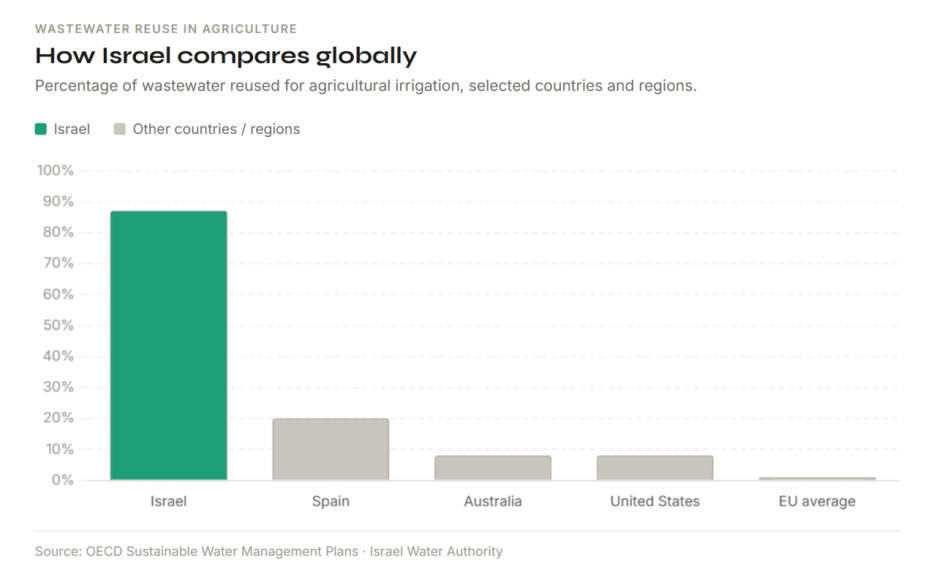
Israel currently reuses more than 87% of its wastewater, the highest rate of any country in the OECD, and one of the highest in the world. The vast majority of this recycled water goes directly into agricultural irrigation. For context, Spain, ranked second globally recycles roughly 20% of its wastewater. The United States recycles less than 10%.
To understand why this matters, consider the alternative. In most countries, urban and industrial wastewater is treated to a basic standard and discharged into rivers, coastal waters, or the ground. It leaves the water cycle as a usable resource. Israel instead built a national infrastructure to capture, treat, and redirect this water back into productive use.
The centerpiece of this system is the Shafdan treatment plant near Tel Aviv, one of the largest wastewater recycling facilities in the world. Treated effluent, known as reclaimed water is transported through a dedicated distribution network to farms in the Negev and other agricultural regions, where it replaces freshwater that would otherwise be drawn from rivers, aquifers, or reservoirs. Today, about 94% of all wastewater in Israel is collected and treated, with 87% reused primarily for agricultural purposes.
This created what economists describe as a circular water economy: urban water consumption does not permanently remove water from the productive system. It generates a lower-quality output that, once treated, can re-enter agriculture and extend the effective water supply without requiring additional extraction.
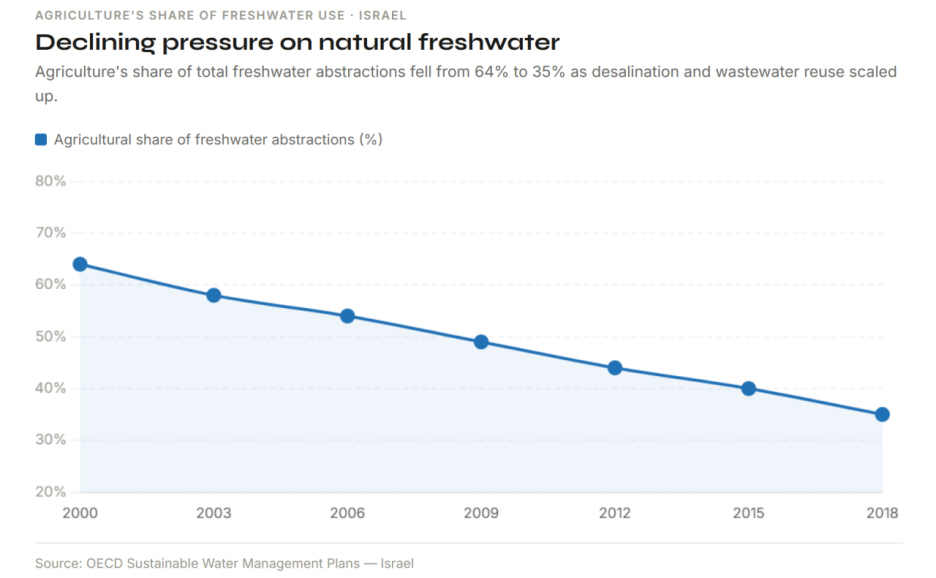
Israel’s wastewater reuse programme did not emerge spontaneously. It required sustained policy commitment, significant capital investment, regulatory frameworks governing water quality standards for agricultural use, and agricultural adaptation to match crop selection with the appropriate water source. But the economic payoff, extending a severely constrained water supply without proportionally increasing extraction, validated the investment. Between 2000 and 2018, agriculture’s share of freshwater abstractions in Israel fell from 64% to 35% of total water withdrawals, a direct consequence of this substitution.
Desalination: Reshaping the System, Not Just Adding Supply
By the early 2000s, Israel faced a freshwater crisis severe enough to threaten both urban supply security and agricultural viability. The government’s response was a major national investment in large-scale seawater desalination along the Mediterranean coast.
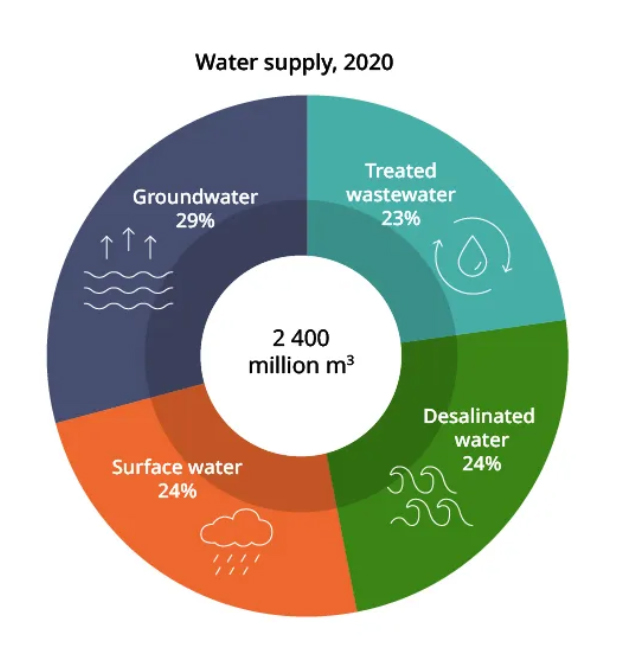
Today, five major desalination plants: Sorek, Hadera, Ashkelon, Palmachim, and Ashdod together supply more than 80% of Israel’s domestic urban water. This is an extraordinary figure by any global standard and represents one of the most complete transitions from natural freshwater to engineered supply anywhere in the world.
The conventional narrative presents desalination as a direct solution to water scarcity:
If you lack freshwater, manufacture it from seawater. But the more important story is how desalination changed the economics of the entire water system.
Desalinated water is expensive to produce. It is energy-intensive, has environmental implications for coastal ecosystems, and remains cost-prohibitive for broad agricultural use at current price levels. Israeli farms do not, in the main, irrigate with desalinated water. So how did desalination help agriculture?
The mechanism is indirect but powerful. Before large-scale desalination, Israeli cities competed directly with agriculture for a fixed and shrinking pool of natural freshwater. Every litre consumed by Tel Aviv or Jerusalem was a litre unavailable for farms. Desalination effectively removed urban demand from that competition. Cities shifted to desalinated supply; natural freshwater and treated wastewater could be redirected toward agriculture without the political and economic conflict over allocation.
Desalination also had a second-order effect on wastewater volumes. As urban consumption of desalinated water increased, the volume of treated wastewater available for agricultural reuse grew in proportion. The system is compounded.
This is why Israel’s water story requires systems thinking rather than a checklist of technologies. Drip irrigation, wastewater reuse, and desalination did not independently solve separate problems. They interacted to restructure the economics of water supply, demand, and allocation across the entire economy.
Farming the Desert
The physical geography of Israel’s agricultural development is, in some ways, the most striking element of the story. The Negev Desert, which covers approximately 60% of the country’s land area, was long regarded as agriculturally marginal or unproductive. It now hosts a substantial portion of Israel’s farming activity.
Desert agriculture in Israel depends on the convergence of several technologies: drip irrigation to deliver water with precision; drought-tolerant and high-value crop varieties developed through decades of agricultural research; controlled-environment facilities: greenhouses, shade nets, and climate-controlled growing structures, that reduce evapotranspiration and allow year-round production regardless of ambient conditions; and increasingly sophisticated sensor networks that monitor soil moisture, temperature, crop stress indicators, and irrigation performance in real time.
The sensor-based, data-driven approach to farming that Israel developed from necessity is now marketed globally under the broader label of precision agriculture. Israeli agri-tech companies export not just hardware but farm management software, remote sensing systems, and crop analytics tools to agricultural operations worldwide including in countries with far greater natural water abundance than Israel itself.
The commercial success of Israeli agricultural technology internationally is, in part, a direct consequence of the domestic constraint that forced its development. Scarcity created an innovation environment that abundance does not replicate.
The Challenges Israel Still Faces
An honest account of Israel’s water and agriculture story requires acknowledging the problems that remain unresolved and the pressures that are intensifying.
Water quality is a persistent concern. Decades of intensive agriculture have contributed to nutrient runoff and groundwater contamination in some regions. The expanded use of reclaimed wastewater, while economically rational, introduces questions about long-term soil health, crop safety, and the accumulation of pharmaceutical compounds that conventional treatment processes do not fully remove. While 99% of population is connected to wastewater treatment plant, the OECD notes that only 63% of Israel’s population currently benefits from tertiary, advanced wastewater treatment, due to delays in upgrading major plants in Jerusalem and Haifa.
Climate change presents a structural challenge that technology and policy have not yet resolved. Under high-emissions projections, mean annual temperatures in Israel could rise by up to 4.4°C by the end of the century, while total annual precipitation could decrease by 25%. Higher temperatures increase crop water demand and evapotranspiration rates, reducing the efficiency gains that drip irrigation and precision farming have delivered. More frequent droughts reduce inflows to the Sea of Galilee and stress aquifer recharge rates.
The cost and sustainability of desalination remains a concern. Desalinated water is produced at significant energy cost, currently largely met by natural gas and at some environmental cost to coastal marine ecosystems. As the proportion of Israel’s water supply derived from desalination grows, exposure to energy price volatility increases. The OECD has explicitly noted that desalination has adverse environmental impacts that must be managed alongside its supply benefits.
Equity and access to questions also arise. The OECD notes that tens of thousands of Bedouins living in unrecognised villages in the Negev have only partial access to water, even as the broader population benefits from near-universal connection to the national water system. Water governance is a political economy question as much as a technical one.
What the Rest of the World Can Learn
Israel’s experience is increasingly relevant for a world in which water stress is expanding rather than contracting. The OECD estimates that water demand globally will outpace sustainable supply in many major agricultural regions by mid-century. India, Australia, parts of sub-Saharan Africa, the Middle East, and Southern Europe all face variants of the challenge Israel has been navigating for decades.
The most important lesson is not drip irrigation. Drip irrigation is a technology; it can be purchased, installed, and operated without any of the broader institutional and policy framework that made Israel’s system work. Countries have done exactly that and achieved far more limited results.
The real lesson is integration.
Israel succeeded because it combined institutional and regulatory reforms with massive infrastructure investment, large-scale wastewater reuse, desalination, and effective regulatory and price signals allowing it to gradually reduce overexploitation of freshwater resources and become more climate resilient. Drip irrigation only generates its full value when water pricing reflects real scarcity and removes the incentive to waste. Wastewater reuse only scales when treatment infrastructure, distribution networks, regulatory standards, and agricultural adaptation proceed in coordination. Desalination only restructures the broader water economy when urban supply security is linked explicitly to agricultural water allocation policy.
The integration of technology, infrastructure, pricing mechanisms, and coordinated policy is what Israel achieved, imperfectly, over time, with significant public investment and political will. That integration is what water-stressed economies elsewhere need to study, not simply the irrigation technology that tends to attract the most attention.
For a country like India which faces severe and worsening water stress across major agricultural states, has a large and politically sensitive farming sector, and is rapidly urbanizing the systems-level lesson is particularly applicable. The question is not whether India can afford to adopt drip irrigation at scale, or invest in wastewater recycling, or expand desalination capacity. It is whether the institutional and policy framework can be built that makes those individual investments work together rather than in isolation.
That is a harder problem than technology. It is also the one that determines whether the investment pays off.
Sources:
- OECD Environmental Performance Reviews: Israel 2023
- OECD: Israel’s Sustainable Water Management Plans
- OECD Environment at a Glance: Israel
- OECD Blog: Israel as a Global Pioneer in Addressing Water Scarcity
- FAO: Solutions to Water Scarcity in Agriculture — The Experience of Israel
- Israel Water Authority: National Water Efficiency Report
- Times of Israel: What Israeli Drips Did for the World