


For the better part of the last decade, artificial intelligence has followed a straightforward trajectory: bigger models, larger datasets, and more computing power. Companies such as OpenAI, Google, Anthropic, and Meta have invested billions into scaling foundation models, with each new generation requiring exponentially greater computational resources to train and deploy.
But what if the next leap in AI performance doesn’t come from building an even larger model?
Tokyo-based Sakana AI believes the future lies elsewhere. Instead of developing another frontier large language model (LLM), the company has introduced Fugu, a multi-agent AI orchestration system that coordinates multiple specialized AI models through a single interface. Rather than asking one model to solve every problem, Fugu intelligently delegates subtasks to different AI agents, combines their outputs, and delivers a unified response.
The idea is simple but significant. Just as complex engineering projects rely on teams of specialists rather than a single expert, Fugu treats AI as a collaborative system instead of a monolithic model. If this architectural shift gains traction, the next competitive advantage in AI may not be the model itself. Instead, it may be the technology that coordinates multiple models efficiently.
Why Bigger Models Are No Longer the Only Answer
Scaling laws have driven much of the recent progress in AI. Larger models generally perform better because they learn from more data and develop stronger reasoning capabilities. However, these gains come at a steep cost.
Training frontier models now requires massive GPU clusters, enormous energy consumption, and infrastructure investments that only a handful of companies can afford. Even after deployment, running these models for millions of users remains computationally expensive.
This has encouraged researchers to explore architectures that improve capability without simply increasing model size.
One promising direction is multi-agent AI, where several specialized models collaborate instead of relying on a single general-purpose model. Different agents can plan, retrieve information, write code, verify results, or critique outputs before producing a final answer. This approach mirrors how human teams solve complex problems by dividing work among specialists.
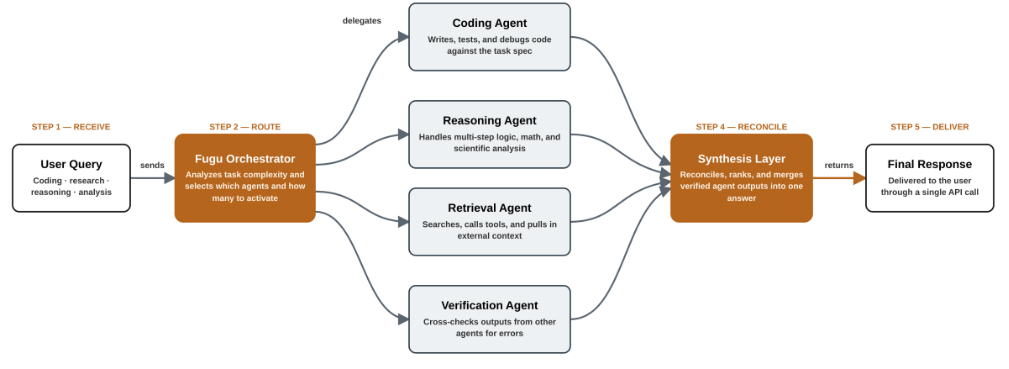
What Makes Fugu Different?
Unlike conventional AI assistants, Fugu is not another standalone language model competing directly with GPT or Claude. Instead, it is itself a language model trained to orchestrate a pool of AI models.
When a user submits a prompt, Fugu first analyzes the task and determines the most effective strategy. Simple requests may be handled by a single model, while more demanding problems are automatically divided into multiple subtasks that are assigned to specialized agents. These agents can work in parallel, verify one another’s outputs, refine intermediate results, and synthesize a final response before returning it to the user.
Importantly, these workflows are not manually programmed. According to Sakana AI, Fugu learns how to coordinate agents dynamically using technologies developed through its TRINITY and Conductor research projects. This means the orchestration strategy adapts to the query instead of following fixed rules.
Sakana AI currently offers two versions of the system:
- Fugu, optimized for low latency and everyday workloads such as coding assistance and productivity tasks.
- Fugu Ultra, designed for complex research, scientific reasoning, cybersecurity analysis, and other multi-step problems where answer quality takes priority over speed.
Collective Intelligence Instead of Individual Intelligence
The philosophy behind Fugu reflects an important shift in AI development.
Instead of attempting to create one model that excels equally at every task, Sakana AI focuses on collective intelligence. The system treats each model as a specialist with unique strengths and allows an orchestration layer to decide which combination of experts should collaborate on a given problem.
In its technical report, Sakana AI describes Fugu as a family of orchestrator models trained using large-scale supervised fine-tuning, reinforcement learning, and evolutionary algorithms. Rather than executing predefined workflows, Fugu dynamically creates what the company calls “agentic scaffolds”, which adapt to each user request.
This means the intelligence of the overall system comes not only from the underlying models, but also from how effectively they are coordinated.
What Do the Benchmarks Show?
Sakana AI evaluated Fugu and Fugu Ultra across several demanding public benchmarks commonly used to assess coding, reasoning, scientific knowledge, and autonomous problem-solving.
According to the company’s technical report, Fugu Ultra achieved competitive performance on benchmarks including SWE-Bench Pro, LiveCodeBench, Terminal Bench, GPQA Diamond, Humanity’s Last Exam, and CharXiv Reasoning. On several of these evaluations, the company reports that Fugu Ultra performs comparably to Anthropic’s Fable 5 and Mythos Preview, despite the fact that neither model was publicly accessible at the time, with Fable 5’s access suspended under U.S. export controls and Mythos Preview never released to the public. This timing was central to Sakana’s pitch: that orchestration could deliver frontier-level performance without depending on models exposed to export-control risk.
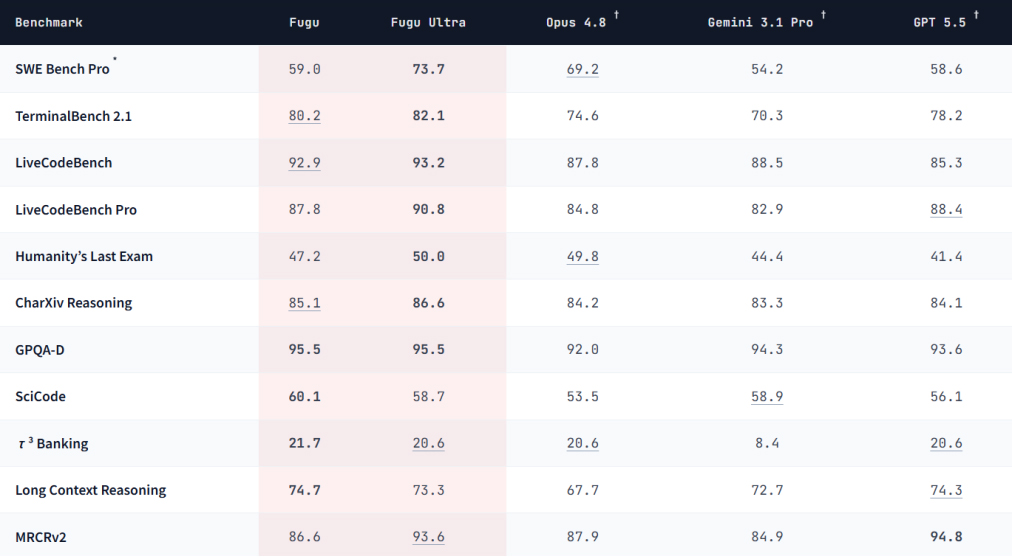
The table above shows the company-reported benchmark performance of Fugu and Fugu Ultra against leading frontier AI models across coding, reasoning, scientific knowledge, and long-context evaluation tasks. Source: Sakana AI Technical Report (2026).
It is important to note that these benchmark results are reported by Sakana AI and have not yet been independently verified. Nevertheless, they demonstrate that intelligent orchestration is emerging as a viable alternative to simply increasing model size.
Perhaps more importantly, they suggest that future AI performance may depend as much on how models collaborate as on the capabilities of any individual model.
Why Enterprises Should Pay Attention
For businesses adopting AI at scale, architecture often matters more than benchmark scores.
Many organizations today rely on multiple AI providers for different workloads. One model may excel at coding, another at reasoning, and another at document analysis. Managing these systems individually increases operational complexity and creates dependence on specific vendors.
Fugu attempts to abstract this complexity behind a single API. By dynamically selecting the most appropriate models for each task, organizations can build AI applications without tightly coupling their products to one provider.
This architecture also offers greater flexibility. As stronger models become available, they can potentially be integrated into the orchestration layer without redesigning the entire application stack. In highly regulated industries, organizations may also choose which models are permitted within their agent pool to satisfy privacy, security, or compliance requirements.
The orchestration layer therefore becomes an independent source of value rather than simply a gateway to existing models.
The Next Patent Race May Focus on Orchestration
For innovators and intellectual property professionals, the significance of Fugu extends well beyond its benchmark performance.
The AI industry has largely concentrated on patenting improvements in model architectures, training techniques, and hardware acceleration. Multi-agent AI introduces an entirely new layer of innovation that may prove equally valuable.
Potential patent opportunities include:
- Adaptive orchestration algorithms that determine how tasks are distributed among multiple AI agents.
- Dynamic model-routing systems that select agents based on expertise, latency, cost, or confidence.
- Verification frameworks that compare, rank, and reconcile outputs generated by different models.
- Test-time compute allocation techniques that intelligently adjust computational resources according to task complexity.
- Enterprise orchestration platforms that integrate proprietary, commercial, and open-source models while maintaining governance, privacy, and regulatory compliance.
As enterprises increasingly deploy AI ecosystems rather than individual models, orchestration itself could become a highly defensible source of intellectual property.
Companies that develop novel coordination mechanisms may be able to secure patent protection not because they built the smartest language model, but because they invented a smarter way for multiple models to work together.
Conclusion
Sakana AI’s Fugu represents more than another AI product launch. It challenges one of the industry’s longest-standing assumptions that better AI requires ever-larger models.
Instead, Fugu argues that intelligence can emerge from collaboration. By treating AI models as specialized experts coordinated through an adaptive orchestration layer, it shifts innovation toward system design rather than model scale.
Whether multi-agent orchestration becomes the dominant AI architecture remains to be seen. However, one trend is already becoming clear. As AI systems become increasingly modular, the technologies that coordinate, optimize, and govern these systems may become just as valuable as the models themselves.
For businesses, researchers, and IP strategists, that could redefine where the next generation of AI patents and competitive advantages will be created.
SOURCES
- https://sakana.ai/fugu-release/
- https://sakana.ai/fugu/
- https://arxiv.org/abs/2606.21228
- https://arxiv.org/abs/2512.04695
- https://arxiv.org/abs/2512.04388
- https://www.datacamp.com/blog/sakana-fugu
- https://www.tomsguide.com/ai/anthropics-fable-five-ban-exposed-ais-next-big-problem-but-sakanas-fugu-may-have-the-answer