


The technology that could eliminate 94% of road accidents has passed its inflection point. What follows is a strategic analysis of the forces capital, IP, regulation, and deployment data now shaping the next era of transportation.
|
$68B AV Market Size, 2024 |
$214B Projected Market by 2030 |
200M+ Fully Autonomous Miles Logged |
10x Patent Filing Growth, 2017–2025 |
Every 26 seconds, a life ends on the world’s roads. Road traffic crashes claim approximately 1.19 million people annually, making them the leading cause of death for those aged 5 to 29. A landmark NHTSA study found human error responsible for 94–96% of all motor vehicle accidents. The autonomous vehicle industry was built, in part, to solve this and the data now suggest it is beginning to.
What began as a research programme has become a commercially operating, heavily capitalised, and intensely contested industry. The decisions being made now in boardrooms, patent offices, and regulatory chambers will determine which companies, technologies, and nations define the next era of mobility. This transition is also reshaping the Autonomous Vehicle Market, where investors, manufacturers, and policymakers are closely tracking technology adoption, regulatory shifts, and long-term commercial viability.
From Concept to Commercial Reality
The clearest evidence of this transition is not found in slide decks. It is found on the streets of San Francisco, Phoenix, Austin, Atlanta, and Los Angeles, where passengers hail fully driverless rides as a matter of daily routine.
Waymo completed over 14 million trips in 2025 alone, more than tripling its ride volume from 2024 and surpassed 20 million lifetime rides. The company has logged nearly 200 million fully autonomous miles and provides approximately 400,000 paid rides each week. Crucially, its real-world safety record is now quantifiable: Waymo vehicles recorded 92% fewer bodily injury claims and 88% fewer property damage claims compared to human drivers across 25 million miles of operation. These are empirical outcomes, not projections.
Global production of autonomous-ready vehicles reached approximately 7.61 million units in 2024, a 39% increase from 5.42 million units in 2023. This is not niche experimentation, it reflects mainstream automotive manufacturing integrating AI processors, sensor fusion systems, and software-defined architectures directly on the factory floor.
A Market on a Steep Ascent
The AV market, valued at approximately $68 billion in 2024, is projected to exceed $214 billion by 2030, a compound annual growth rate that few industries can match. The long-term potential is measured not in billions but in trillions, once the full ecosystem of mobility services, fleet management, data monetisation, and urban infrastructure is factored in. Current autonomous vehicle market prediction models indicate sustained expansion through the end of the decade, supported by AI innovation, fleet deployment, and increasing consumer acceptance across major economies.
AV Market Size Forecast
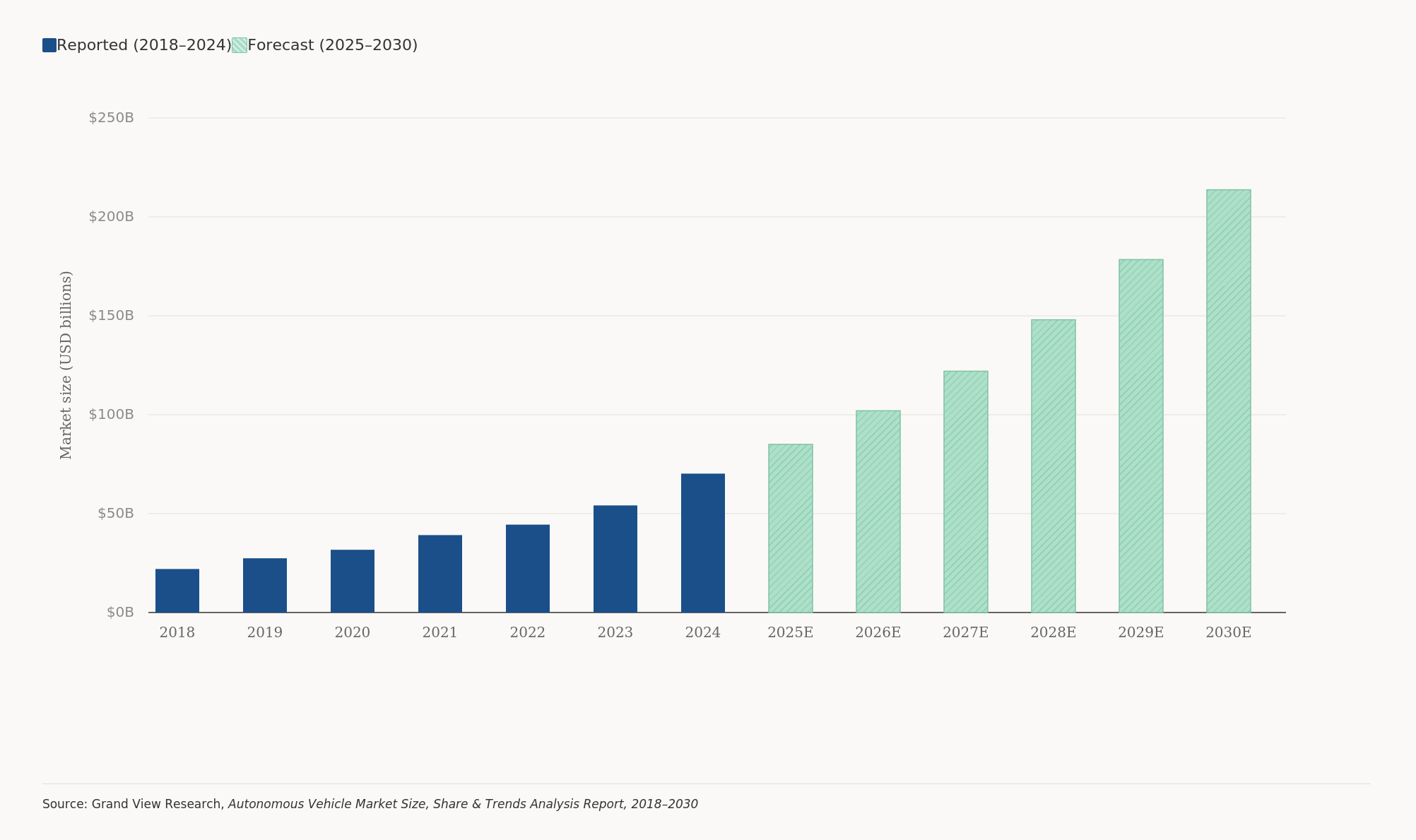
Ongoing market segmentation analyses show that robotaxis, passenger vehicles, commercial fleets, and logistics applications are emerging as distinct high-growth categories within the industry.
The sector’s defining characteristic has shifted from technological feasibility to deployment scale and ecosystem integration. The companies winning today are those that combine data loops, AI model performance, and compute architecture not merely those with the best sensors or the most engineers. As competition intensifies, companies are focusing on expanding their autonomous vehicle market share by integrating proprietary AI, scalable software platforms, and differentiated mobility services.
The Six Technology Pillars Driving the Race
Innovation is converging across six high-intensity domains, each driving both R&D investment and the patent competition that follows:
AI & Machine Learning
The cognitive core. Deep learning powers perception and decision-making, with a shift toward end-to-end driving models that learn directly from data.
Sensor Fusion
Integration of LiDAR, radar, cameras, and ultrasonics for all-condition awareness. The strategic focus is fusing LiDAR precision with radar reliability.
V2X Connectivity
Vehicle-to-everything communication, powered by 5G/6G and edge computing, enabling real-time interaction with infrastructure and cloud systems.
HD Mapping & Localisation
Centimetre-level maps with real-time fleet updates. Critical for high-level autonomy, especially in low-connectivity environments.
Software-Defined Architecture
Vehicles evolving into updatable software platforms. OTA updates and AI-driven fleet optimisation shift value decisively from hardware to software.
Cybersecurity
As connectivity rises, so do risks. Innovation in encryption, authentication, and real-time threat detection is now a strategic necessity, not an afterthought.
The IP Land Grab: Patent Filings Tell the Story
Patent filings are among the most reliable leading indicators of competitive intent in a technology industry. The AV sector’s filing data is unambiguous: this is a high-priority, capital-intensive innovation domain in active build-out, not technological stabilisation.
Annual Patent Filings vs. Grants for AI-Driven Vehicles
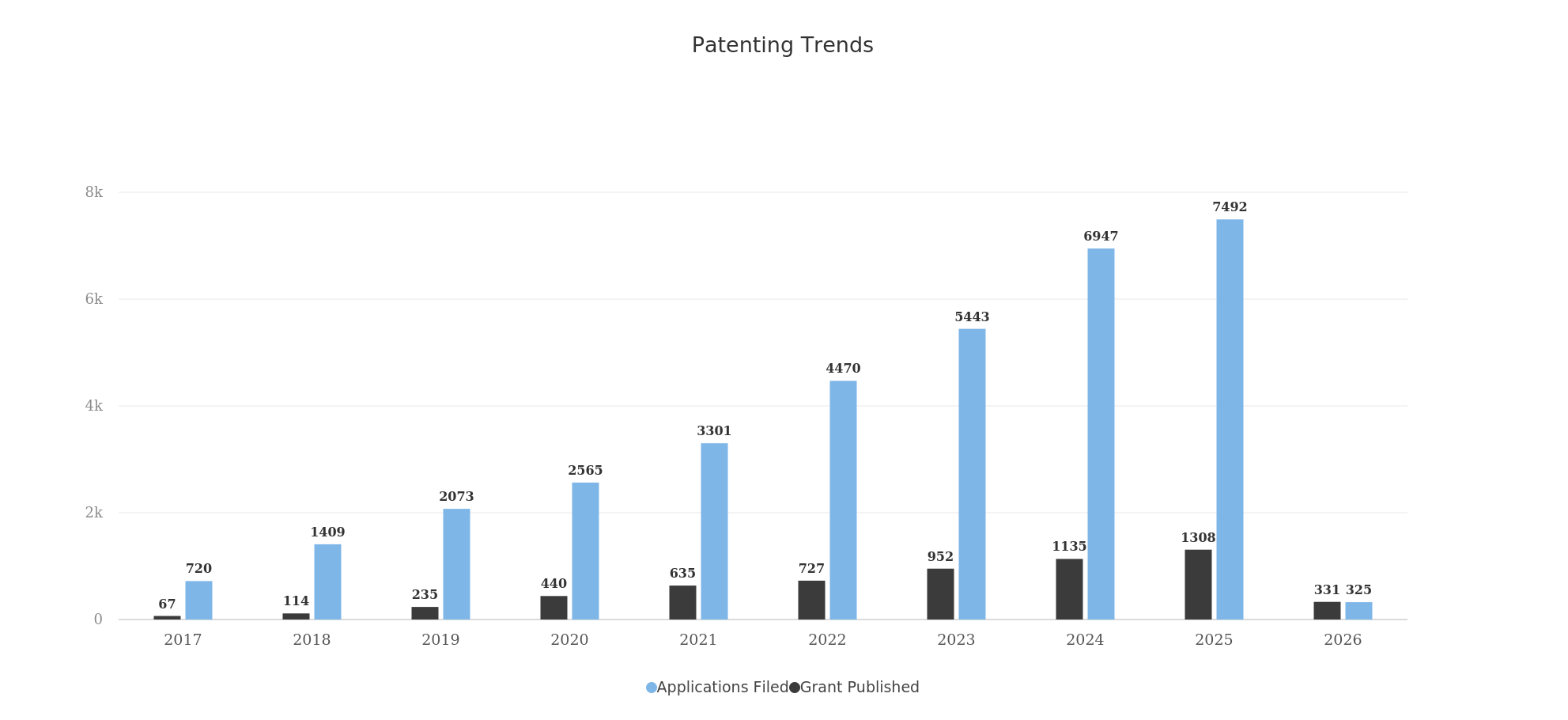
From 720 filings in 2017 to 7,492 in 2025, a ten-fold increase, the trajectory signals something beyond organic innovation. Companies are aggressively securing positions before standards and dominant architectures lock in. The 2025 peak, the highest on record, is consistent with what analysts call an “IP land grab”: an accelerated effort to claim territory while competitive positions remain fluid.
Strategic Implication
The grant-to-application ratio sits at just 15–20%, reflecting standard prosecution timelines of 3–5 years. Today’s filings are tomorrow’s enforceable IP. The industry is pre-enforcement but the conversion wave is coming. Portfolios that are grant-light today could become powerful enforcement instruments by 2027–2029.
Who Holds the Cards: Assignee Power Rankings
The competitive landscape in AV patents is, perhaps surprisingly, still dominated by traditional automakers not by Silicon Valley. Toyota Motor Corporation leads by a clear margin with 1,298 records, followed by Porsche SE (1,027) and Hyundai Motor Group (1,008). Robert Bosch GmbH at 790 records underscores the continuing importance of Tier-1 suppliers, particularly in components, sensors, and control systems.
Top Patent Portfolio Holders AI-for Driven Vehicles
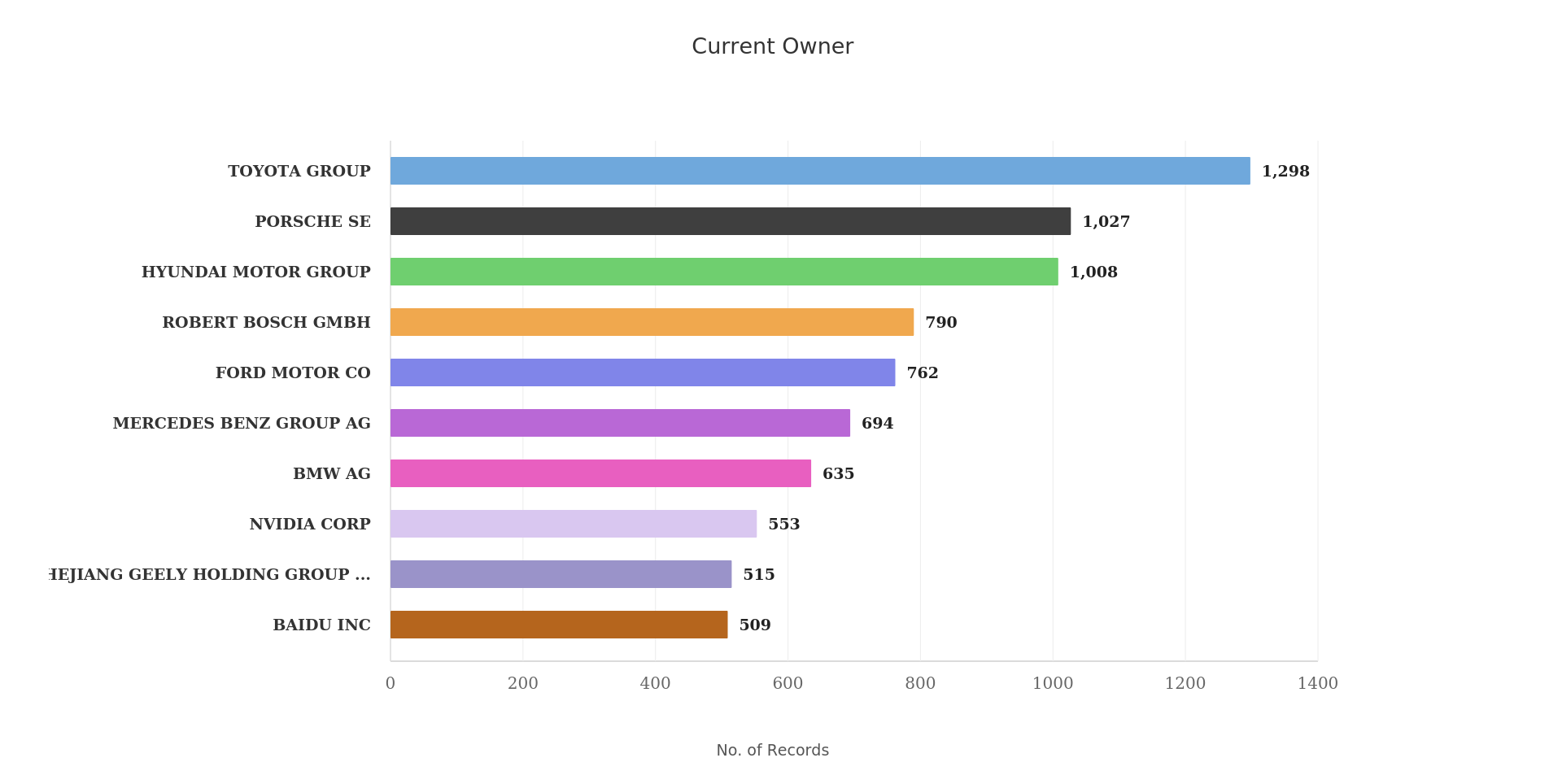
NVIDIA stands out as the only major pure-play technology entrant in the top ten, signalling that compute and AI stack ownership has become a credible strategic entry point. The presence of Baidu and Zhejiang Geely Holding Group reflects China’s state-aligned scaling strategy, particularly in AI-driven autonomy ecosystems.
Yet raw volume does not tell the full story. Ford Motor Company leads in portfolio value index despite holding fewer families than Toyota, indicating high-impact, strategically positioned patents rather than broad-based filing. NVIDIA, similarly, demonstrates strong value density with a comparatively smaller portfolio, its patents are foundational to the AI compute layer that underpins the entire autonomy stack.
The Geography of the Race
The AV patent race is geographically concentrated in ways that mirror geopolitical competition. China’s filing intensity 22,322 records reflects state-backed scaling and aggressive domestic IP strategy. The U.S., with 5,747 records, remains a high-value jurisdiction, oriented toward commercialisation, enforcement, and market access. Europe, anchored by Germany (2,660), represents regulatory-driven innovation and standards leadership.
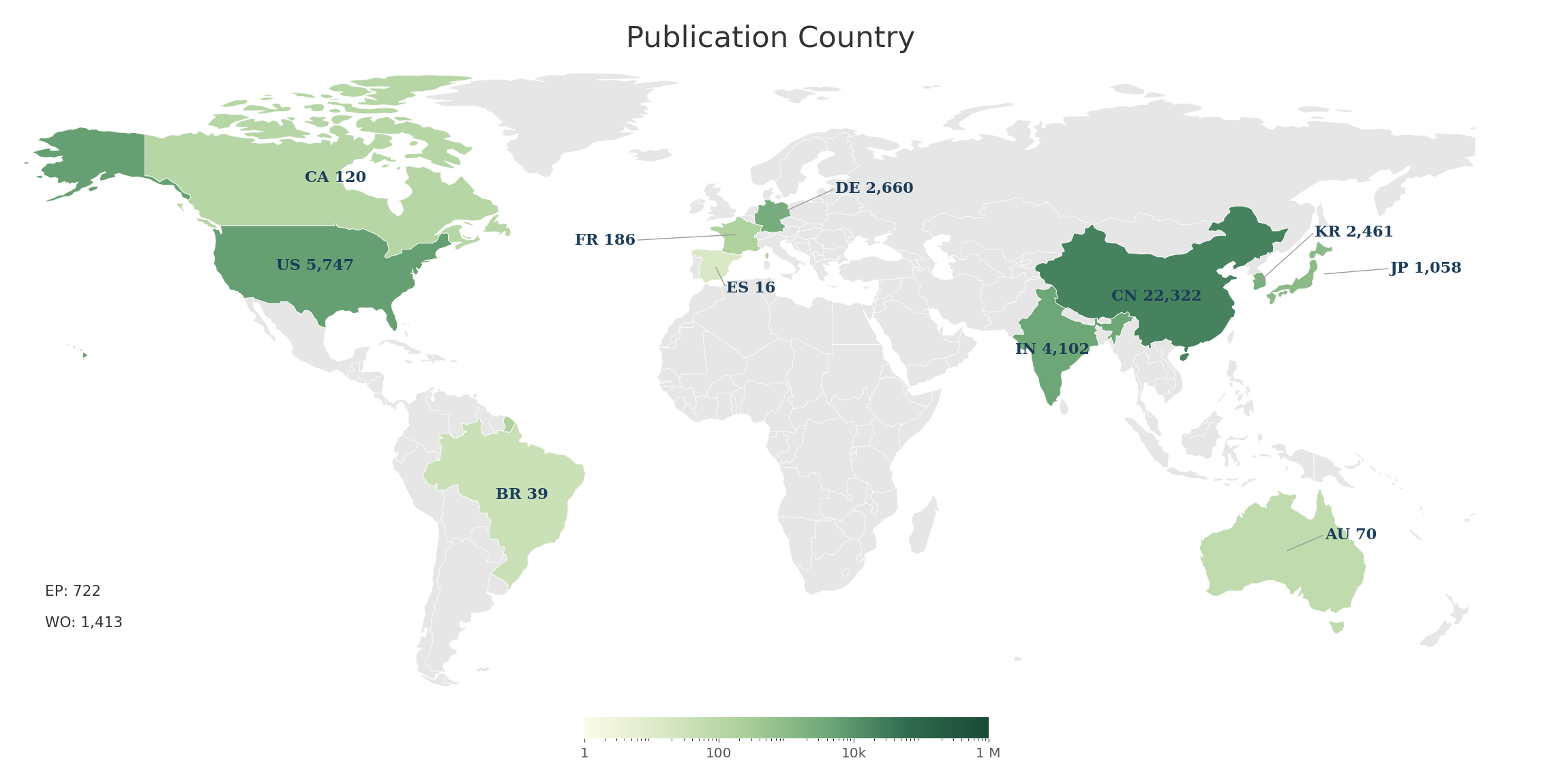
India’s emergence, with 4,102 filings, merits particular attention, it suggests growing participation in software-led autonomy and AI layers, likely connected to the significant engineering talent and R&D investment the country has developed over the past decade. AV policy is no longer merely a safety matter; it has become a geopolitical and economic competition factor. Cross-regional comparisons conducted through autonomous vehicle market allied research frameworks also highlight the growing influence of government policy, intellectual property strategies, and infrastructure readiness on competitive positioning.
The Time-to-Grant Dimension: Speed as Strategy
An often-overlooked strategic variable is how long it takes for a filed application to become an enforceable right. South Korea leads with an average of approximately 20 months, a significant advantage in fast-moving technology cycles. China and the U.S. both average around 31–32 months, providing a strong balance between speed and market relevance. Europe’s 49-month average reflects rigorous examination standards, but often produces stronger, more defensible patents. Brazil, at an average of 112 months, offers limited short-term strategic value despite being a large economy.
The Expiry Cliff and the Window of Opportunity
A near-term IP cliff is approaching. With 722 patents estimated to expire in 2026, a significant portion of the foundational AV IP will enter the public domain creating freedom-to-operate opportunities for challengers and new entrants in core technologies. A second expiry wave, peaking around 2035 with 139 patents, reflects the recent filing surge now locking in long-term protection for AI-driven systems.
The strategic implication is that competitive advantage is time-bound. The current window where positions can still be secured before market consolidation is narrowing. The industry is transitioning from an innovation race to a position-locking phase, and then to enforcement.
Continued autonomous vehicle market growth will depend not only on technological breakthroughs but also on regulatory harmonisation, public trust, and the ability to commercialise autonomous mobility solutions at scale.
Strategic Outlook:
Three Imperatives for Leadership
The analytical evidence converges on three imperatives for organisations seeking durable positions in this landscape.
Control the Autonomy Stack
The greatest competitive moats will be built by those who control the full autonomy stack, AI, compute, and vehicle integration rather than any single layer. The shift from component-level hardware to integrated, full-stack autonomy platforms is accelerating, and value is migrating accordingly from hardware to software and data.
Scale Deployment and Data Acquisition
Real-world data is the sector’s most valuable and least reproducible resource. Waymo’s safety statistics are compelling not just for their content but for their method: they can only be produced by operating at scale. Companies that delay deployment are not merely losing revenue, they are falling further behind in the data feedback loops that improve AI model performance.
Own High-Impact, Defensible IP
The shift is from who owns more patents to who owns the most influential ones. Ford’s portfolio value index surpasses Toyota’s despite a smaller family count. NVIDIA’s AI-stack patents punch well above their volume weight. As the enforcement phase approaches, the quality and strategic positioning of IP citation strength, geographic coverage, legal status will matter more than raw filing velocity.
|
“The current window represents a critical inflection point, where players can still secure durable leadership positions before market consolidation. The race is real, the clock is running, and the data are unambiguous.” |
Looking ahead, the Autonomous Vehicle Market is expected to become one of the defining technology sectors of the next decade, driven by innovation, investment, and increasing real-world deployment across global transportation networks. The autonomous vehicle industry was born from a moral ambition to build a machine that never tires, never drinks, never looks away at the wrong moment. The data now suggest that ambition is within reach. The 92% reduction in bodily injury claims across Waymo’s 25 million miles is among the most consequential statistics in recent transportation history. The strategic and commercial implications of getting this technology right and deployed at scale are enormous. The question is no longer whether it will reshape transportation. It is who will lead when it does.
Interested in the complete picture? Head to our website to explore the full report, featuring an in-depth analysis of autonomous vehicle technologies, patent intelligence, market dynamics, competitive positioning, jurisdictional trends, and the strategic forces shaping the future of mobility.

Download Report
Download Report




Download Report