


|
$2.6B Cost per approved molecule |
90%+ Clinical trial failure rate |
9,500+ AI drug discovery patents analysed |
45+ AI-discovered drugs in clinical trials |
AI based drug discovery is rapidly transforming pharmaceutical research by combining machine learning, predictive analytics, and artificial intelligence to accelerate drug discovery, optimize candidate selection, and reduce development timelines.
Pharmaceutical R&D has for decades been governed by a brutal arithmetic: over a decade of development, nine out of ten candidates fail, and the cost of each approved molecule including the write-offs of those that don’t survive has reached $2.6 billion. Artificial intelligence is systematically attacking every variable in that equation at once.
This shift highlights why AI based drug discovery has become a strategic priority for leading pharmaceutical innovators seeking to improve efficiency across the entire drug discovery pipeline.
The transformation is no longer theoretical. Generative models are designing novel molecules from scratch. AlphaFold has solved structural challenges that stymied structural biology for fifty years. And in September 2024, Insilico Medicine reported positive Phase IIa results for ISM001-055, a first-in-class TNIK inhibitor for idiopathic pulmonary fibrosis discovered and designed entirely by AI demonstrating a dose-dependent improvement in forced vital capacity across 71 patients in a randomised, double-blind, placebo-controlled trial. The molecule went from target identification to preclinical candidate in under 18 months, against a traditional timeline of 2.5 to 4 years.
This is no longer the horizon. It is happening. And the patent and market data now tell a detailed story about who is positioned to lead, where the IP land-grab is concentrated, and what the next phase of competition looks like. Among the most compelling AI in drug discovery examples, Insilico’s achievement demonstrates how AI based drug discovery can compress timelines from target identification to clinical candidates while maintaining scientific rigor.
The rapid commercialization of AI based drug discovery reflects a broader industry transition toward data-driven pharmaceutical innovation powered by artificial intelligence.
The Market: From Signal to Structural Shift
The AI drug discovery market was valued at approximately $1.4 billion in 2022. By 2024, Researchers estimated the figure at $2.35 billion, with a projected CAGR of 24.8% through 2033, reaching $13.77 billion. Arizton places the 2024 market at $1.71 billion with a 30.6% CAGR through 2030.
AI in Drug Discovery: Market Size
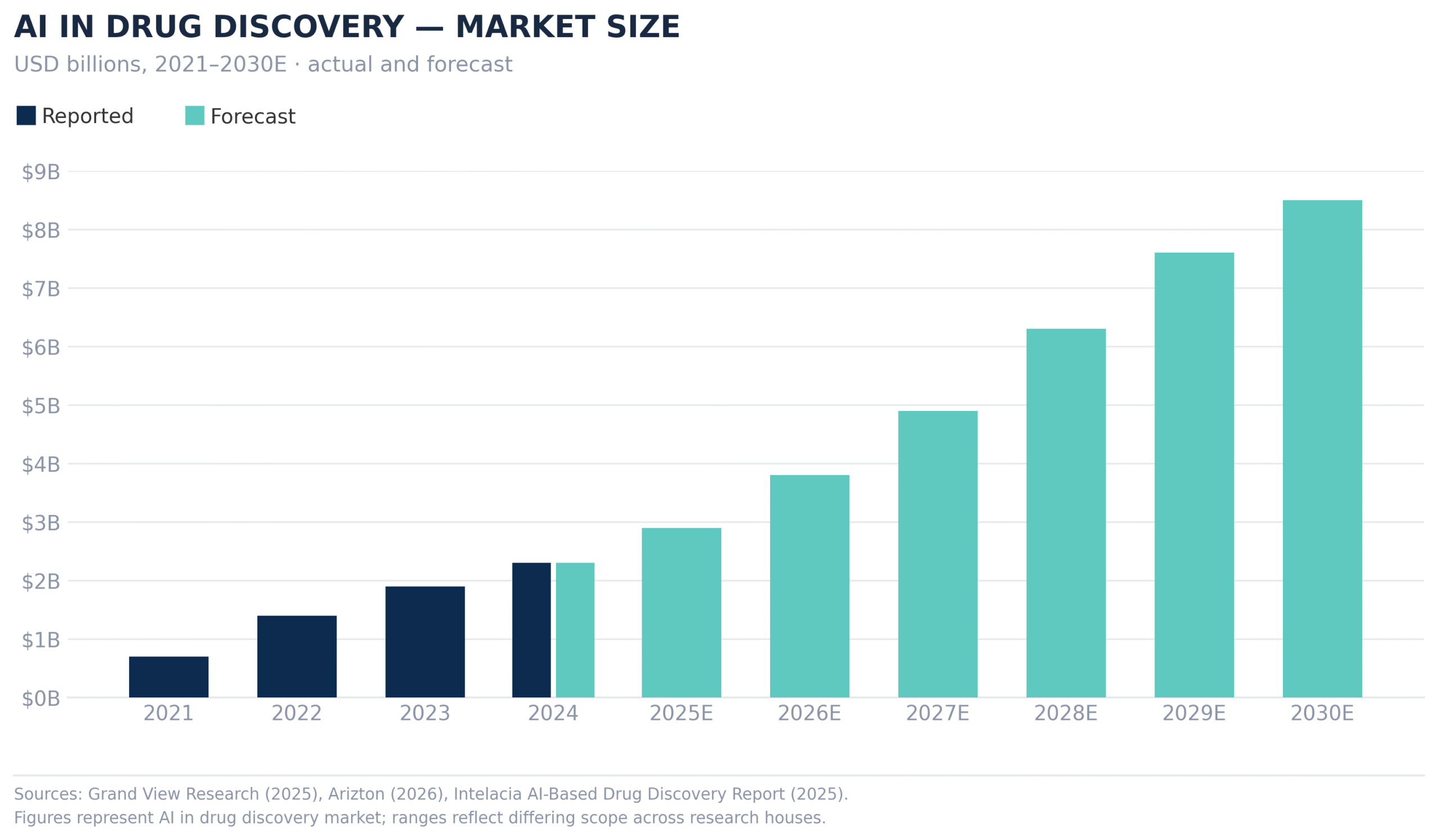
What is most meaningful is not the exact dollar figure which varies across research houses based on scope but the direction and the underlying structural driver: pharmaceutical companies are embedding AI not as a productivity tool but as a core R&D infrastructure layer. Many AI based drug discovery companies are now partnering with pharmaceutical firms to integrate predictive modelling, molecular generation, and automated screening into mainstream drug discovery workflows.
Four Capabilities Converging on the Pipeline
The impact of AI on drug discovery is not monolithic. It operates through four distinct capability layers, each attacking a different stage of the R&D pipeline and each at a different level of maturity.
Generative Molecular Design
Popular AI based drug discovery examples include generative molecular design platforms that create novel compounds with optimized therapeutic properties before laboratory synthesis begins.
Large language models and diffusion models generate novel molecular structures with targeted pharmacological properties, exploring chemical space orders of magnitude larger than high-throughput screening. Key platforms include MolGPT, Reinvent 4.0, and DiffSBDD.
Protein Structure Prediction
AlphaFold and related technologies are widely cited as AI in drug discovery examples because they enable researchers to solve complex structural biology problems at unprecedented speed.
AlphaFold 3 and RoseTTAFold now predict protein-ligand, protein-DNA, and protein-RNA complexes enabling structure-based drug design across nearly the full human proteome at previously impossible scale and cost.
Multi-Omics AI Integration
Graph neural networks and transformer architectures integrate genomics, proteomics, metabolomics, and clinical data to surface disease mechanisms and patient stratification signals invisible to single-modality analysis.
Adaptive Clinical AI
AI-powered patient matching, synthetic control arms, dropout prediction, and real-time dose optimisation are reducing Phase II/III trial durations by an estimated 25–40%, with capital savings of $300M+ per programme.
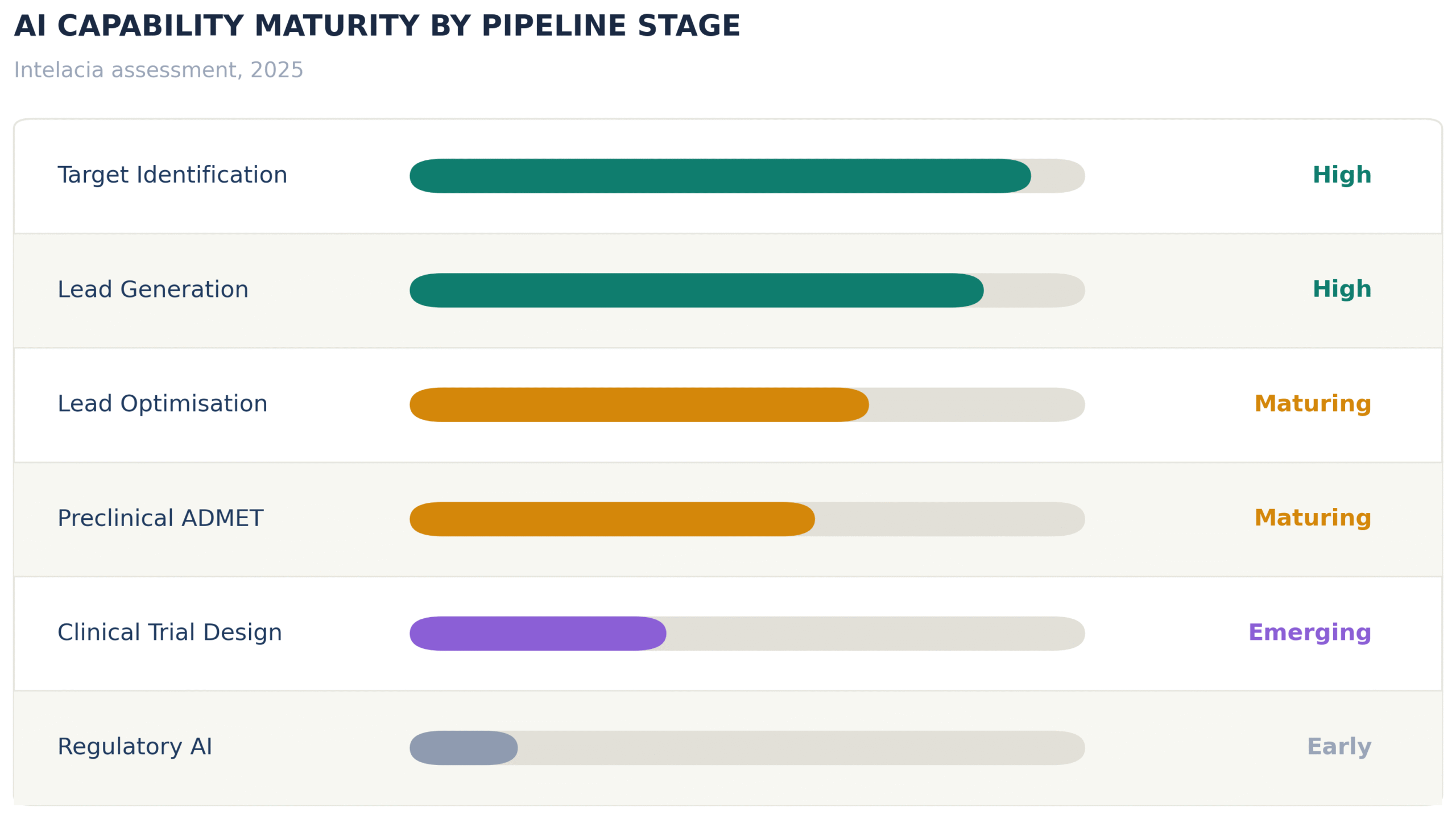
The maturity of each capability varies considerably across the pipeline. Target identification and lead generation are already operating at high maturity. Lead optimisation and preclinical ADMET modelling are maturing rapidly. Clinical trial design AI and regulatory automation are emerging. Regulatory AI is early-stage but advancing quickly as the FDA moves toward finalising guidance on AI-assisted submissions.
AI Capability Maturity by Pipeline Stage
The Patent Landscape: A Land-Grab in Progress
Analysis of 9,500+ AI drug discovery patents reveals a sector in aggressive IP accumulation mode. Annual filings grew from 138 in 2017 to 1,958 in 2025, a fourteen-fold increase in eight years. The 2025 peak, the highest on record, is consistent with what the report describes as a “land-grab phase,” driven by companies staking positions before regulatory standards and dominant architectures consolidate.
The surge in filings illustrates how AI based drug discovery is becoming a major source of competitive intellectual property across global drug discovery ecosystems.
AI Drug Discovery Patent Filing Trend
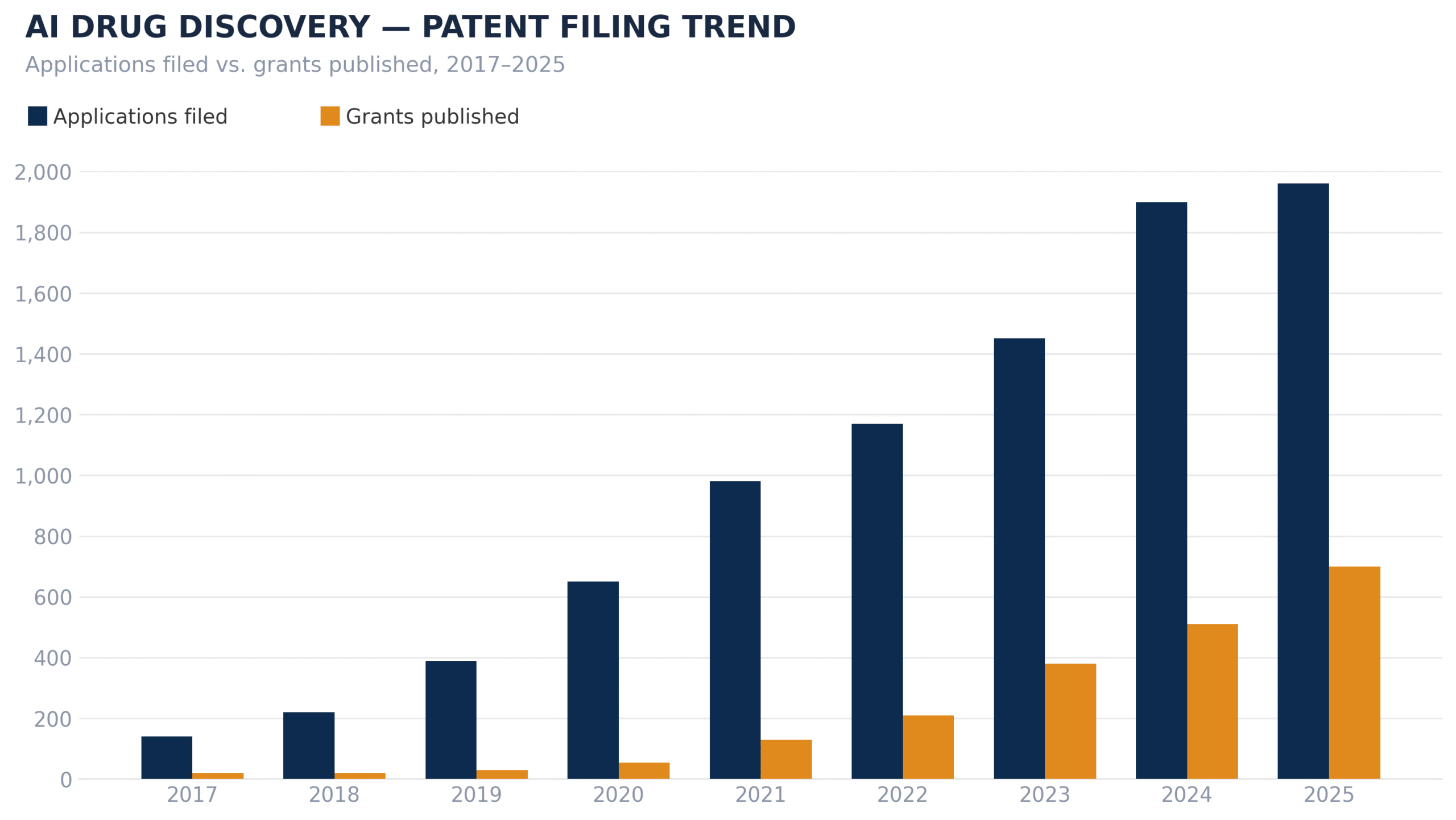
The grant-to-application ratio tells a revealing story. Applications have grown exponentially while grants have scaled linearly reflecting standard 3-to-5-year prosecution timelines and a growing examination backlog. The practical consequence: today’s IP landscape is populated by pending claims that have not yet translated into enforceable rights.
Post-2020 AI shifted from experimental tooling to core R&D infrastructure. Momentum indicates permanent integration into drug discovery, not a crisis-driven spike. Filing focus is moving toward AI-generated molecules and targets, signaling ownership of therapeutic outcomes. AI-native biotechs and tech players are now central patent drivers, not just pharma incumbents. Proprietary datasets + feedback loops are accelerating innovation velocity for early movers.
Strategic Implication
The gap between filing volume and granted portfolio is not a weakness for incumbents, it is a structural moat. Companies with large pending pipelines today can rapidly strengthen their enforcement position within the next 3–4 years, while late entrants face a landscape of freedom-to-operate constraints that were not there in 2020.
Who Holds the IP and Why the Answer Is Surprising
The growing patent activity also reflects increasing investment by AI based drug discovery companies that view proprietary algorithms and biological datasets as long-term competitive assets. The AI drug discovery IP landscape is led not by pharma giants or Silicon Valley firms, but by Chinese universities and state-linked entities. Shanghai University leads with 129 records; Tencent follows with 102; Zhejiang University with 85. Traditional Western pharma largely appears lower down the rankings not because they are absent, but because they are more likely to partner, acquire, or license rather than accumulate early-stage foundational AI filings directly.
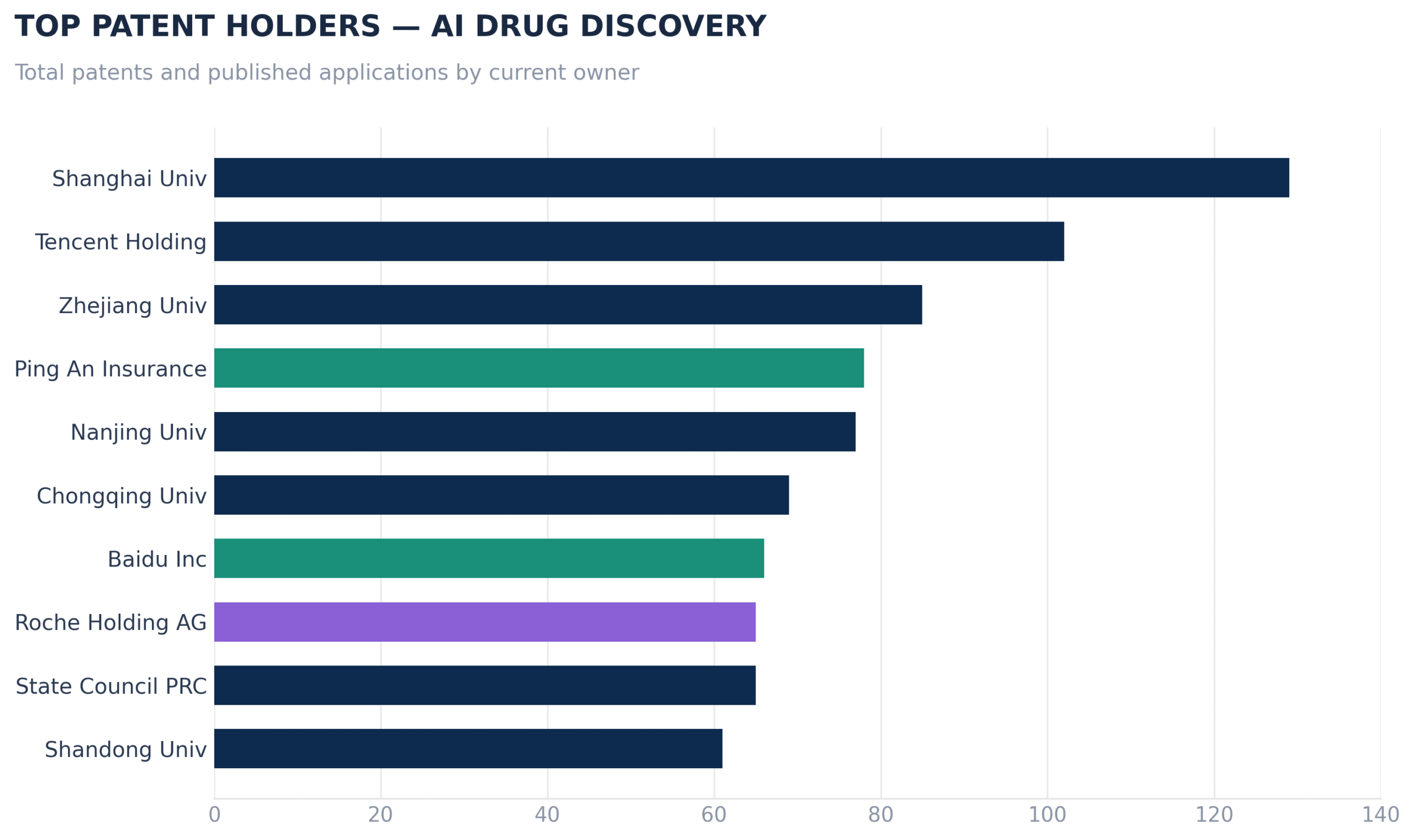
The presence of Tencent and Baidu in the top ten signals something more significant than big-tech diversification. It reflects a deliberate convergence of platform AI capability, trained on enormous general-purpose datasets being redeployed into molecular space. Roche Holding AG is the only Western incumbent in the top ten with consistent multi-region filing depth, indicating a mature IP strategy built around downstream clinical and commercial execution rather than early-stage volume accumulation.
Competitive advantage is shifting from who owns more patents to who owns the most influential ones. The strategic calculus has moved decisively from volume to value density, claim breadth, and downstream clinical applicability.
The Geographic Competition: A New Tri-Polar Order
The jurisdictional data shows a tri-polar innovation structure that is fundamentally different from the conventional US-Europe duopoly that characterised pharmaceutical IP for decades.
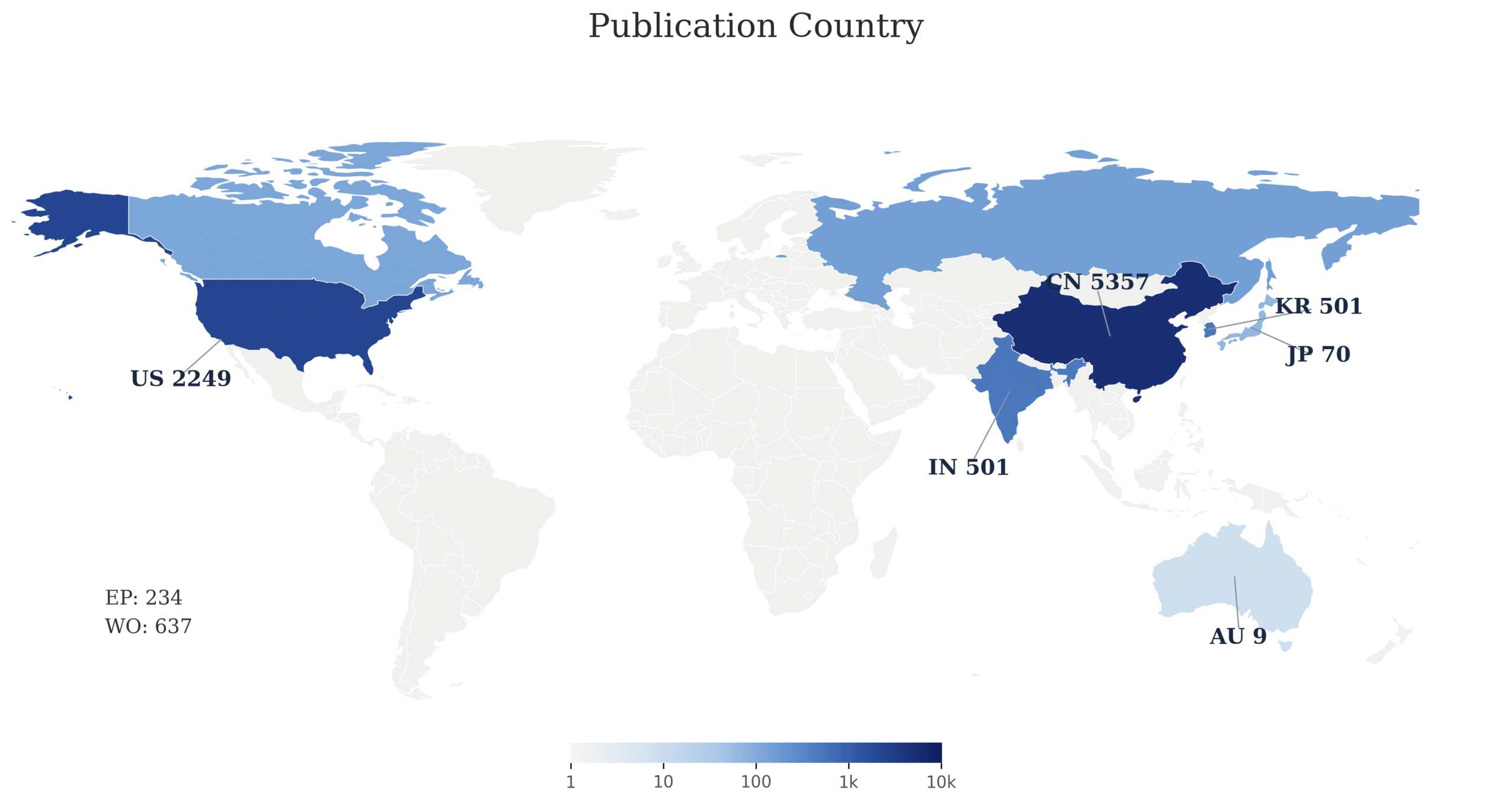
China’s dominance at 5,357 filings compared to the US’s 2,249 is not driven by commercial incumbency but by state-coordinated academic output. In Q1 2025 Chinese companies accounted for 32% of global biotech licensing deal value, up from 21% in 2023 and 2024, reflecting a deliberate transition from generic manufacturing toward cutting-edge drug discovery leadership. India’s emergence at 501 filings, equal to South Korea reflects cost-efficient applied AI rather than foundational platform development, but the trajectory bears watching.
Barriers That Still Constrain the Transformation
The optimistic narrative around AI drug discovery compressing timelines, eliminating attrition, coexists with a set of structural constraints that remain unresolved.
Data scarcity and proprietary siloing remain the most fundamental bottleneck. The quality of AI models is bounded by training data quality, and the most valuable biological datasets, proprietary assay results, clinical observations, patient genomics are fragmented across competing institutions unwilling to share. Federated learning approaches, which allow models to train across distributed data without centralising it, represent one emerging pathway, but adoption remains limited.
Distribution shift: the gap between in silico predictions and in vivo biology is a subtler but equally important problem. A molecule that looks ideal on a generative model’s output may behave very differently in a living system. This limits the degree to which AI can truly compress preclinical timelines without continued wet-lab validation at key inflection points. Even with remarkable progress in artificial intelligence, successful drug discovery still depends on high-quality biological data, experimental validation, and robust regulatory oversight.
A Brief Timeline: From Lab to Clinical Proof
2012
Deep learning applied to QSAR models; Merck Kaggle challenge shows neural networks outperform classical cheminformatics in property prediction.
2017
First wave of AI drug discovery startups, Insilico, Atomwise, Exscientia, Recursion founded within a two-year window. GANs applied to molecular generation.
2020
AlphaFold 2 solves the protein folding problem at scale. DeepMind releases 200M+ structure predictions. Structure-based drug design is democratised.
2023–24
AlphaFold 3 predicts multi-molecular complexes. NVIDIA BioNeMo platform launches. $3B+ in AI-pharma partnership deals signed. Insilico’s ISM001-055 enters Phase IIa.
Sept 2024
Insilico reports positive Phase IIa results for ISM001-055 first AI-designed drug for an AI-discovered target to show clinical efficacy. Dose-dependent FVC improvement of +98.4 mL vs –62.3 mL placebo.
2026+
Convergence era: AI handles target-to-candidate in under 18 months for certain target classes. Regulatory agencies finalise AI-specific guidance. Foundation models covering the full drug-body interaction space emerge as shared infrastructure.
Collectively, these milestones represent some of the strongest AI based drug discovery examples available today and illustrate the accelerating pace of innovation across the pharmaceutical sector.
Strategic Outlook: Three Decisions That Define the Next Phase
The future of pharmaceuticals: artificial intelligence in drug discovery and development is increasingly defined by the convergence of advanced algorithms, proprietary data, and strong intellectual property strategies. The data across market, patent, and clinical signals converges on three strategic decisions that will differentiate leaders from followers as AI drug discovery matures from a capability race into an enforcement and commercialisation phase.
Build Data Moats, Not Just Model Capability
The most durable competitive advantage in AI drug discovery is not the model, it is the proprietary data that trains it. Closed-loop platforms, where wet-lab results continuously feed back into generative model training, are emerging as the architecture of structural advantage. Companies without a strategy to generate and retain proprietary biological datasets will find their AI capabilities commoditising rapidly as open-source models improve.
Convert Filings to Enforceability Before the Wave Arrives
The grant-to-application gap in the patent data represents both a risk and an opportunity. The conversion wave of 2027–2030 will reward companies with the prosecution discipline to have their pending claims granted at the right breadth. Companies that filed aggressively in 2022–2024 for volume need to ensure those applications translate into enforceable IP not just pending claims that invite challenge or narrowing under examination.
Shape the Regulatory Framework, Don’t Just Comply With It
AI-specific regulatory guidance is being written now. The FDA’s emerging framework for AI-assisted IND submissions, the EMA’s evolving stance on AI-originated molecules, and the CJEU’s pending ruling on AI training data will collectively define the terms of competition for the next decade. The companies and institutions participating actively in these processes submitting comments, sharing clinical data, demonstrating transparency will have disproportionate influence on standards that apply to everyone.
The arithmetic of pharmaceutical R&D: $2.6 billion per molecule, 90% attrition, a decade of development is not immutable. The first clinically validated AI-designed drugs have demonstrated that the variables can be compressed. The patent data show a global race to secure the IP that governs how that compression happens. The market projections describe a transformation in its early innings, not its final act. The organisations that will lead the next era of medicine are making their foundational decisions now, about data, IP architecture, and regulatory engagement. Those decisions are harder to reverse than they are to delay.
This article captures the strategic signals. Our full report provides the underlying evidence technology trends, patent intelligence, market forecasts, competitive benchmarking, and jurisdictional analysis to help organizations navigate the evolving AI drug discovery landscape. Head to our website to read the full report.
Download Report
Download Report


Download Report