


A Market at an Inflection Point
India’s crop protection industry is no longer just a supporting pillar of agriculture, it is becoming a strategic lever for food security, export competitiveness, and sustainable farming. As the world’s fourth-largest agrochemical producer and second-largest exporter by volume, India ships pesticides worth over ₹43,224 crore annually to more than 150 countries.
The Scale Paradox: Small, Yet Globally Significant
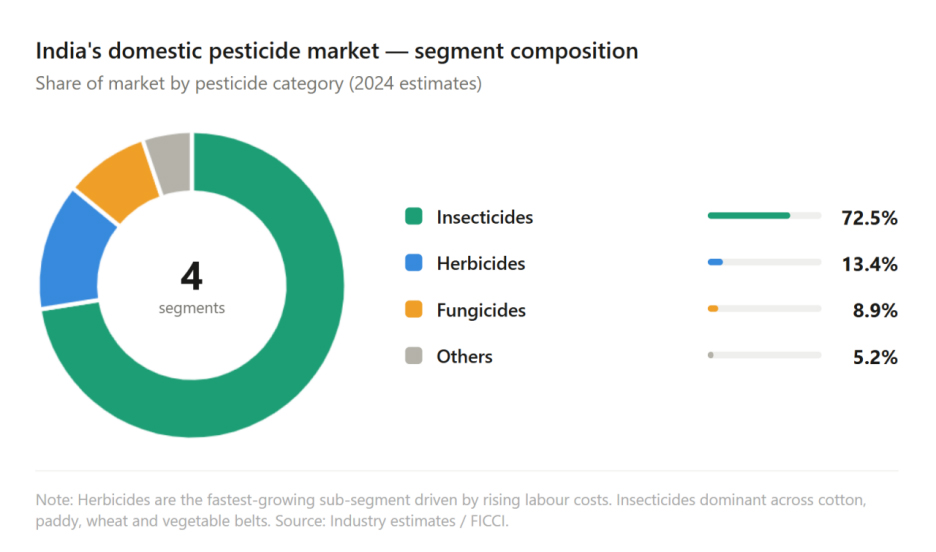
India produces for the world but applies very little at home. Yet India is the world’s second-largest agricultural producer by value, contributing approximately USD 563 billion in farm output annually.
This gap between production scale and application intensity reflects two realities simultaneously: a significant underutilization of crop protection tools, leaving substantial yield potential on the table, and a structural opportunity to move toward sustainable intensification rather than the chemical-heavy pathways that other countries are now trying to walk back from.
Innovation Pipeline: New Molecules and a Record Registration Pace
India’s regulatory environment has meaningfully improved. In the two years leading to 2026, the country registered 36 new pesticide molecules, a record that outpaces comparable registration volumes in Brazil, Malaysia, and Thailand. In a single sitting in July 2025, the Registration Committee approved 27 new crop protection products under Section 9(3) of the Insecticides Act.
On the commercial side, significant product launches reflect sustained R&D engagement with India as a priority market. However, a troubling counter-trend exists: for every 10 patents granted to Western multinational corporations for new pesticide chemistries since 2010, six were not commercially introduced in India, despite being promptly commercialized in other markets. This “park and block” dynamic, reflects an important structural inefficiency: patents are being used not to bring innovation to Indian farmers, but to block domestic generic competition.
The Biopesticide Surge: Sustainability Meets Commercial Logic
The most structurally significant shift in Indian crop protection is the rapid rise of biological alternatives. Several developments are driving this:
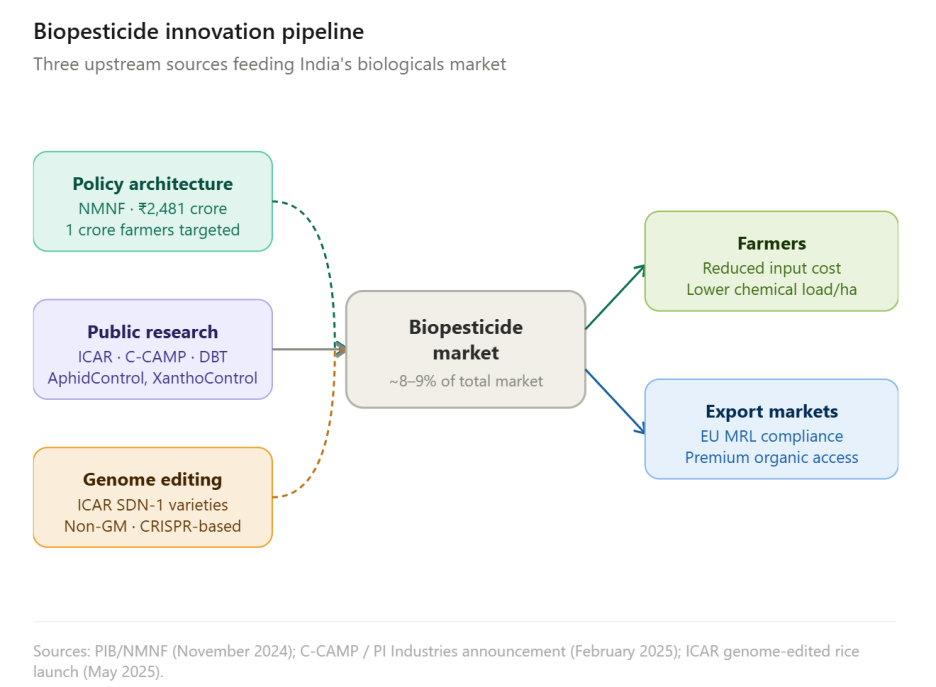
Policy architecture. The National Mission on Natural Farming (NMNF), approved by the Union Cabinet on 25 November 2024, was launched with a total outlay of ₹2,481 crore, targeting 1 crore (10 million) chemical-free farmers and 10,000 Bio-input Resource Centres by the end of the 15th Finance Commission period. This is institutional demand creation at scale.
Public research. The Indian Institute of Spices Research (ICAR-IISR) developed a granular lime-based Trichoderma biopesticide-fertilizer in late 2024. In February 2025, the Centre for Cellular and Molecular Platforms (C-CAMP) transferred two new solutions to PI Industries on an exclusive basis: AphidControl (a botanical pesticide targeting aphids) and XanthoControl (a microbial metabolite targeting Xanthomonas bacteria), both developed under India’s deep science commercialisation initiative by the Department of Biotechnology.
Genome editing. ICAR launched two genome-edited rice varieties on 4 May 2025, DRR Dhan 100 Kamala (19% higher yield, matures 20 days earlier, saving water and reducing methane emissions) and Pusa DST Rice 1 (yields 9.66%–30.4% higher in saline and alkaline soils). These are the world’s first genome-edited rice varieties developed using indigenous CRISPR-based technology, and are classified by the Indian government as non-GM. If these and similar varieties reduce inherent disease susceptibility, they could structurally reduce pesticide demand even as productivity improves.
Digital Agriculture: From Blanket Application to Precision Delivery
Precision agriculture is changing not just what farmers apply, but how. By 2025, over 25 drone models were commercially available to Indian farmers, with government subsidy schemes under SMAM (Sub-Mission on Agricultural Mechanisation) covering 50–75% of acquisition costs for smallholders and up to 100% for Farmer Producer Organisations.
The government’s Soil Health Card Scheme provides farmers with data-driven insights for optimised input management, creating a foundation of agronomic data that precision tools can increasingly leverage.
The IP Debate: Data Exclusivity and the Future of Indian Generics
No policy question is more consequential for India’s agrochemical future than data exclusivity.
At its heart, the debate is this: should India grant multinational corporations a period (typically 3–5 years) during which no other company can use their clinical trial data to register a similar product, even after a patent has expired? Proponents, mostly Western agrochemical MNCs, argue that this incentivizes R&D investment and speeds up the introduction of new molecules. Critics, led by the CCFI and India’s domestic manufacturers, argue it would extend monopoly conditions well beyond the existing 20-year patent term, inflate farmer input costs, and erode India’s dominant position in the global generic agrochemical market.
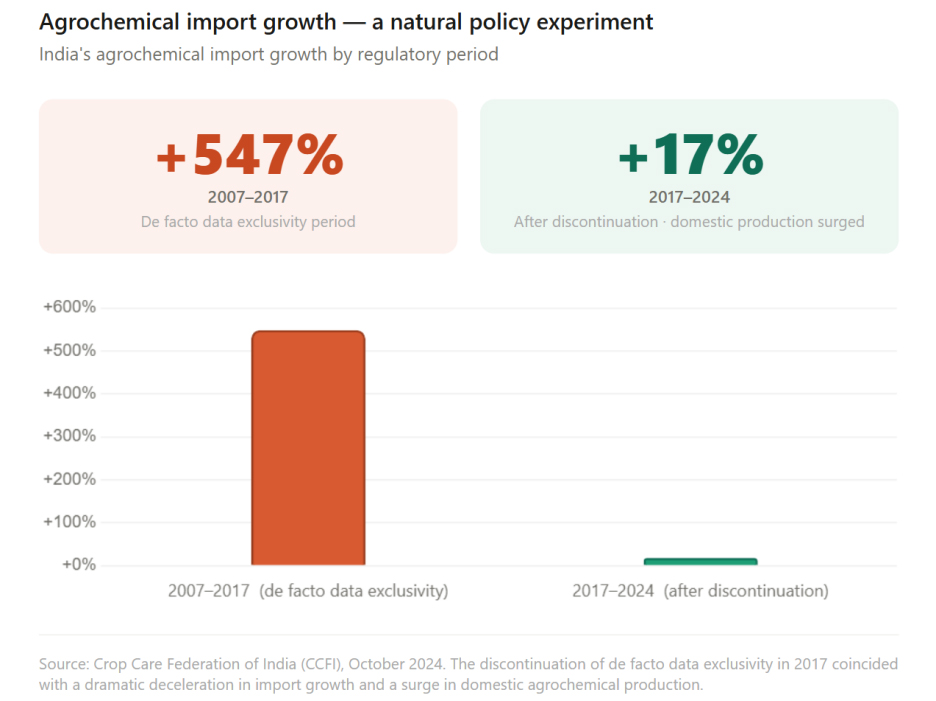
The empirical record is instructive. During 2007–2017, when de facto data exclusivity conditions existed in practice in India, agrochemical imports grew by 547%. Between 2017 and 2024, after those conditions were discontinued, import growth slowed to just 17% while domestic production surged.
Supply Chain, Resistance, and Regulatory Fragmentation: The Risk Horizon
Three structural risks deserve attention.
China dependency. India’s agrochemical industry still depends heavily on Chinese active ingredient imports. Regulatory crackdowns and power shortages in China have repeatedly disrupted supply and driven up costs. While India’s PLI scheme is encouraging local manufacturing, reducing this dependence will take several years.
Regulatory fragmentation. India’s compliance environment remains a patchwork, with individual states empowered to impose restrictions or bans beyond the national framework. The long-pending Pesticides Management Bill, now in its 2025 iteration, is designed to harmonize this landscape but remains un-enacted.
The Road Ahead: Five Trends That Will Define the Decade
- China+1 supply chain realignment. Global buyers seeking to diversify away from single-source supply chains are turning to India. The India–UK Comprehensive Economic and Trade Agreement (CETA), signed on 24 July 2025, eliminates tariffs on approximately 99% of tariff lines including agrochemicals, a tangible boost to export competitiveness.
- The biologicals mainstream. Faster registration pathways (BioRRAP), rising organic acreage, and government-funded bio-input infrastructure under NMNF are collectively moving biopesticides from a sustainability niche to a mainstream commercial category.
- Nano-formulations. Nano-delivery systems, particularly water-dispersible granules and nano-nutrient liquids, are improving efficacy at lower dosage rates, enhancing shelf life, and reducing off-target environmental impact. Paired with drone delivery, they represent the next generation of precision crop protection.
- Genome-edited crop varieties. ICAR’s SDN-1 genome-edited rice varieties, classified by the Indian government as non-GM, reduce inherent susceptibility to disease and climate stress. If the regulatory and consumer acceptance environment remains supportive, genome editing could materially alter the demand curve for pesticides over the next decade.
- AI-driven advisory on scale. As IoT sensor networks, drone imagery, and satellite data converge, AI-powered pest forecasting and targeted intervention recommendations will become standard farm management tools. The farmer who sprays on a calendar schedule is being replaced by the farmer who sprays on a data-confirmed, need-basis for fewer applications, better outcomes.
Conclusion
India’s crop protection industry is navigating a complex but ultimately favorable landscape. The structural tailwinds, global food demand growth, competitive manufacturing costs, supply chain diversification, and the biopesticide and precision agriculture revolution are real and durable.
The choices made in the next few years will determine whether India consolidates its position as a global agricultural input powerhouse or cedes ground through policy missteps. The evidence argues strongly for a path that combines fair IP enforcement, domestic innovation investment, and a decisive pivot toward sustainable, precision-led crop protection. That is the path consistent with India’s farmers, India’s export competitiveness, and India’s long-term agricultural security.
Sources
- National Mission on Natural Farming — Union Cabinet Approval, PIB, 25 November 2024
- ICAR — Genome-Edited Rice Varieties Official Announcement, 4 May 2025
- ICAR-IARI Press Note — Genome-Edited Rice (PDF)
- IISR develops new granular lime-based trichoderma bio-pesticide, fertiliser – The Hindu
- C-CAMP & PI Industries — AphidControl & XanthoControl Transfer, Deccan Herald, February 2025
- India–UK CETA Signing — PIB Official Press Note, 24 July 2025
- IP India — History of Indian Patent System
- PRS Legislative Research — Parliamentary Standing Committee Reports
- SMAM — Sub-Mission on Agricultural Mechanisation, Agrimachinery Portal
- Soil Health Card Scheme — Department of Agriculture & Farmers Welfare
- Crop Care Fed